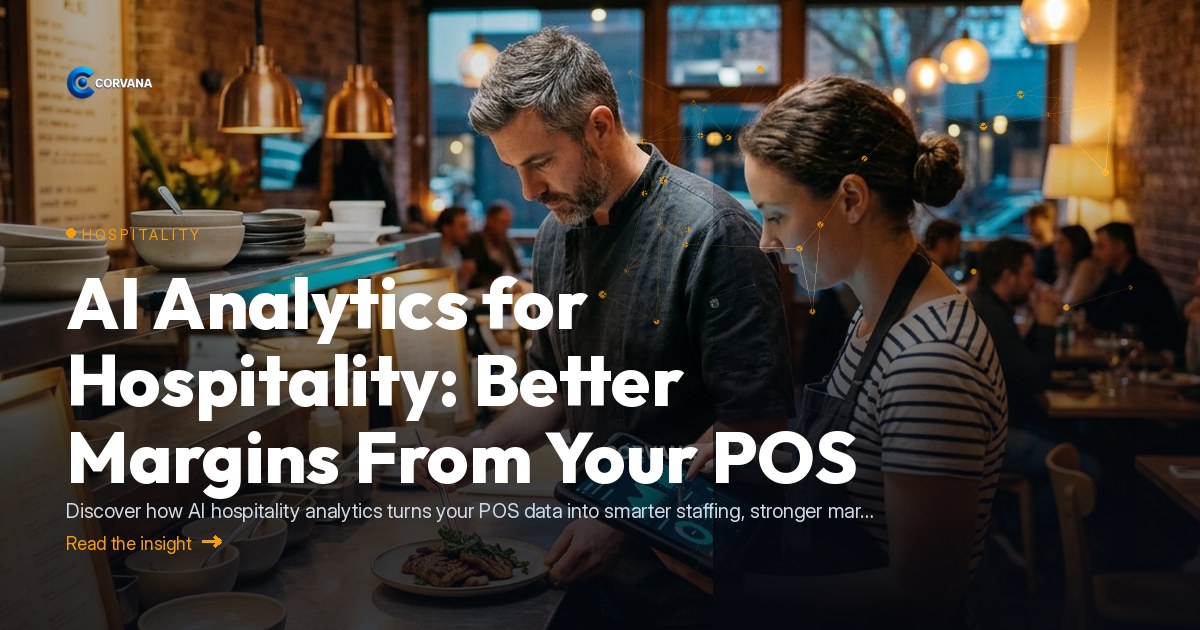
AI Is Changing How Hospitality Operators Run Their Business
AI hospitality tools are no longer a luxury reserved for large hotel chains or fast-food franchises. Across Australia, café owners, restaurateurs, pub groups and catering operators are quietly discovering that the data sitting inside their point-of-sale system — transaction by transaction, shift by shift — can be turned into a genuine competitive edge. The shift is real and it is accelerating: operators who once relied on gut feel and end-of-month reports are now getting live intelligence that tells them what is happening, why it is happening, and what to do about it before the week is out.
This matters because margins in Australian hospitality are famously thin. Ingredient costs, wage obligations under the Hospitality Industry (General) Award, and increasingly unpredictable consumer spending make every percentage point count. The question is no longer whether to use data — your POS is already collecting it — but whether you are actually using it.
The Three Things AI Hospitality Analytics Actually Delivers
1. Freeing Up Staff Time Through Automated Reporting
Most hospitality operators spend hours each week manually pulling sales figures, reconciling them against rosters, and assembling reports that are already a week out of date by the time anyone reads them. That is time that could go into the floor, the kitchen, or developing your team.
AI-driven business intelligence automates that entire layer. Instead of building spreadsheets, your management team receives a structured weekly summary — revenue by category, labour as a percentage of sales, top-selling items, slow movers — without anyone having to compile it. Live dashboards mean the picture is always current, not historical.
When your POS data flows automatically into a unified platform alongside your accounting and rostering data, patterns emerge that no manual process would catch: a Tuesday dinner service that consistently underperforms, a barista shift that is overstaffed relative to cover count, a public holiday that is quietly costing more in penalty rates than it generates in revenue.
2. Reducing Weaknesses by Catching Problems Early
Margin leaks in hospitality rarely arrive as a single dramatic event. They accumulate — a supplier price increase not reflected in menu pricing, a slow creep in labour cost as a proportion of revenue, a loyalty segment quietly churning because nobody noticed the drop-off in visit frequency.
AI analytics changes that by monitoring your data continuously and surfacing anomalies before they become expensive problems. This might look like:
- A cash-flow early warning when forward bookings are tracking below the same period last year
- An alert when your cost-of-goods percentage breaches a threshold you have set
- A flag that a previously loyal customer cohort has not returned in eight weeks
- A compliance prompt when a staff member's rostered hours approach an overtime threshold under the [Fair Work Ombudsman](https://www.fairwork.gov.au) framework
None of this requires a data analyst on staff. The platform does the watching so your team can focus on the work.
3. Capitalising on Your Strengths — Products, People and Segments
Knowing what is working is just as valuable as knowing what is not. AI-driven POS analytics reveals which menu items carry your strongest margins (not just your highest sales volume), which staff members drive the highest average spend per cover, which customer segments return most reliably, and which times of day or week represent your genuine peak opportunity.
Armed with that intelligence, you can make confident decisions: promote the dishes that are already doing the heavy lifting, roster your strongest performers during your highest-value service windows, and direct your marketing spend toward the customer segments with the best lifetime value — rather than casting broadly and hoping.
This kind of insight also feeds into smarter demand forecasting. When AI models draw on historical POS data, seasonal trends, and local event calendars, your ordering and rostering decisions stop being guesswork. The [Reserve Bank of Australia](https://www.rba.gov.au) has noted ongoing variability in household spending patterns, which makes demand forecasting particularly valuable for operators trying to right-size their cost base week to week.
How Corvana Applies AI to Hospitality Operations
Corvana is built specifically for Australian operators, which means the platform is designed around the realities of running a hospitality business here — award rates, GST reporting, EOFY obligations, and the fragmented mix of tools most venues already use.
Corvana connects directly with the POS systems operators actually run, including Square, Lightspeed, Kounta, Mr Yum and Tyro. That POS data is unified in real time with accounting from Xero, MYOB or QuickBooks, rostering and payroll from Deputy, Tanda or Employment Hero, and customer data from platforms like Mailchimp or ActiveCampaign.
The result is a single live picture of the business — not five tabs open across five systems.
Practically, this means:
- Automated weekly reporting delivered to owners and managers without anyone building it
- AI-driven cash flow and demand forecasting so you can plan staffing and purchasing with confidence
- Customer lifetime value tracking and churn early warnings so your best regulars don't quietly disappear
- Benchmarking against ATO and ANZSIC industry data so you know how your margins compare to similar venues
- Role-specific dashboards so a floor manager sees what they need, an owner sees the full picture, and nothing sensitive is exposed unnecessarily
- Compliance monitoring to help you stay across award obligations and flag risks before they escalate
The [Australian Bureau of Statistics](https://www.abs.gov.au) tracks hospitality as one of Australia's more dynamic small business sectors — high turnover of operators, significant employment contribution, and real sensitivity to economic conditions. That context makes the case for better data hygiene not just a productivity argument but a survival one.
---
Frequently Asked Questions
Do I need technical skills to use AI analytics in my hospitality business?
No. Platforms like Corvana are designed for operators, not data scientists. Once your integrations are connected — your POS, accounting software and rostering tool — the platform handles the analysis and delivers plain-language reports and alerts. You do not need to understand how the AI works to benefit from what it tells you.
Will AI analytics work if I only have one venue?
Absolutely. Single-venue operators often benefit most because they are working with fewer resources and cannot afford to have a dedicated finance or analytics function. Automated reporting and early-warning alerts are particularly valuable when the owner is also managing the floor, the roster and the ordering.
How does connecting my POS to an analytics platform actually improve my margins?
Your POS already records every sale, every item, every discount and every void. On its own, that data sits largely unused beyond end-of-day totals. When it is connected to an AI platform alongside your labour costs and supplier invoices, you can see your true margin per dish, your real labour cost per service, and exactly where revenue is leaking — information that makes every pricing and rostering decision sharper.
---
If you'd like to see how Corvana brings all of this together for your venue, we would be glad to show you what it looks like in practice.