AI Automotive Analytics Is Changing How Workshops Run
AI automotive analytics is no longer something reserved for OEM manufacturers or dealer groups with deep pockets. Right now, independent workshops and service centres across Australia are using AI-driven business intelligence to do something they've never been able to do before: see exactly what's happening across bays, parts, staff and customers — in real time, without spending hours in spreadsheets.
What's driving the shift? Pressure from multiple directions at once. Labour costs continue to rise, parts pricing from suppliers fluctuates, customer expectations around wait times are higher than ever, and margins that once felt comfortable are tightening. According to the Reserve Bank of Australia, small business operating costs have remained elevated through recent years, and automotive services are no exception.
The operators who are pulling ahead aren't necessarily the biggest. They're the ones who know their numbers — specifically, which bays are earning, which parts are leaking margin, and which customers are worth fighting to keep.
---
The Real Cost of Not Knowing Your Bay Utilisation
Every unbooked bay is money walking out the door. Every over-scheduled bay is a stressed technician and a customer who waits too long and doesn't come back. Bay utilisation is one of the most powerful levers in a workshop's P&L — and most operators are managing it by gut feel or a whiteboard.
AI changes that. When your booking data, job times, technician rostering and revenue are unified in a single platform, you can see precisely:
- Which bays are consistently under-utilised and on which days
- Which job types take longer than estimated, blowing out throughput
- Whether your current staffing levels match your actual booking demand
- How revenue per bay per day trends over time and by service category
This kind of visibility transforms scheduling from reactive to proactive. You stop filling gaps by chance and start building a booking mix that actually fits your floor capacity.
---
Parts Margin: Where Profit Often Goes Unnoticed
Parts margin is the quiet variable that most workshop owners review quarterly at best — usually when the accountant raises an eyebrow. But parts pricing, supplier discounts and job quoting can shift week to week, and if you're not watching closely, small erosions compound fast.
The problem isn't that operators don't care. It's that the data lives in too many places: the DMS or POS for job cards, the accounting file for supplier invoices, and someone's memory for what the agreed supplier discount was six months ago.
AI-driven analytics connects those data sources and surfaces anomalies automatically. If parts margin on a particular category drops below a threshold, you know about it this week — not at the end-of-quarter review.
---
Three Outcomes That Matter for Workshop Operators
1. Free Up Staff Time by Automating Reporting
Your service advisors and workshop manager shouldn't be reconciling reports every Monday morning. Automated weekly reporting — covering bay utilisation, labour recovery rates, parts margin by category and technician productivity — means leadership walks in with a clear picture already waiting for them. Time saved on admin is time redirected to customers and quality control.
2. Reduce Weaknesses by Catching Problems Early
Early warning is where AI earns its keep. Patterns that would take a human weeks to notice — a dip in return-visit rates from a specific customer segment, a parts supplier whose pricing has quietly crept up, a technician whose job completion times are lengthening — can be flagged automatically. For compliance-conscious operators, monitoring against Fair Work Ombudsman award requirements through integrated payroll and rostering also reduces the risk of underpayment issues before they become penalties.
3. Capitalise on Strengths: Your Best Bays, People and Customers
Not every insight is a warning. AI is equally powerful at showing you what's already working. Which technician has the highest customer return rate? Which service type delivers the strongest margin? Which customer cohort spends the most per visit and refers the most new business? Once you can see your strengths clearly, you can double down on them — roster your best people at your highest-demand times, promote your most profitable services, and build retention campaigns around your most valuable customers.
The [Australian Bureau of Statistics](https://www.abs.gov.au) consistently shows that small businesses with stronger data practices outperform peers on revenue growth. For automotive operators, the pathway to better data has historically required expensive enterprise systems. That gap is closing.
---
How Corvana Applies AI to Automotive Services
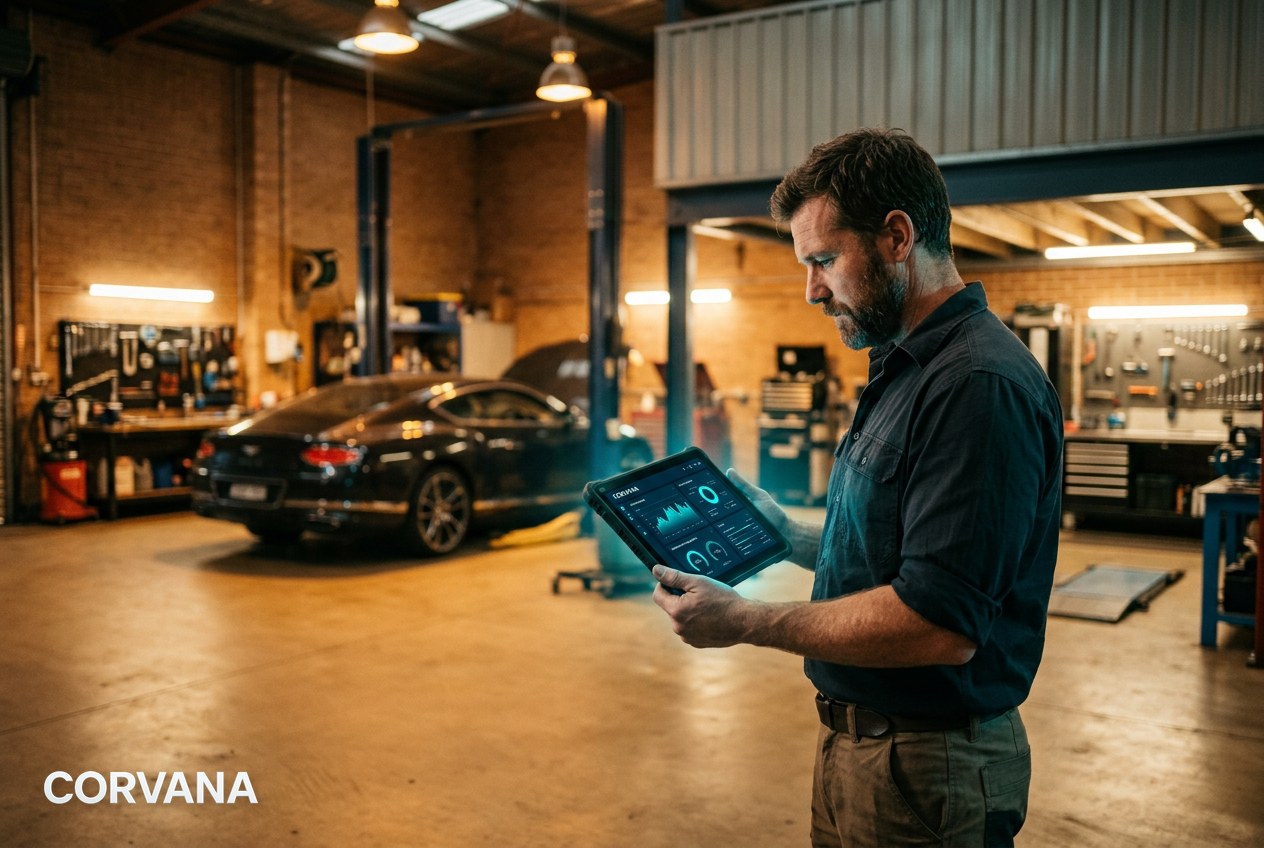
Corvana is built for exactly this kind of operation. It pulls data from across your business — accounting, POS, rostering and CRM — and unifies it into live dashboards designed for automotive workshop operators.
Relevant integrations for workshops include:
- Accounting: Xero, MYOB, QuickBooks — so parts costs, supplier invoices and labour revenue flow into one view
- Rostering & payroll: Deputy, Tanda, Employment Hero — linking technician hours and award rates directly to job revenue for true labour cost visibility
- POS: Square, Lightspeed and others for job card and transaction data
- CRM & marketing: HubSpot, Mailchimp, ActiveCampaign — for customer lifetime value tracking and automated re-engagement campaigns for lapsed customers
Corvana's AI-driven cash flow and demand forecasting helps workshop managers plan staffing and parts ordering ahead of busy periods rather than scrambling to respond. Benchmarking against ATO and ANZSIC industry data lets you see how your margins, recovery rates and overheads compare to similar operations nationally — giving context that raw numbers alone can't provide.
Automated weekly reports mean your front desk, service manager and business owner each see the information relevant to their role, without anyone building a spreadsheet from scratch.
---
Frequently Asked Questions
How does AI help a small workshop with only two or three bays?
AI analytics scales down as well as up. Even with two bays, tracking utilisation by day and time, monitoring parts margin by job type, and receiving automated alerts when customer return rates dip can meaningfully improve profitability. You don't need a large operation to benefit — you need connected data and clear visibility.
Can AI really help with parts margin, or is that just a purchasing problem?
It's both — but AI helps you see which part of the problem is actually hurting you most. Is margin eroding because supplier pricing has shifted, because quotes aren't being updated regularly, or because certain job types are consistently underquoted on parts? Connecting your POS and accounting data through a platform like Corvana lets you pinpoint the source rather than guessing.
How long does it take to get useful insights after setting up a platform like Corvana?
Most workshops begin seeing meaningful dashboard data within the first week of connecting their core integrations. AI forecasting and benchmarking improves as more historical data is incorporated, but early-warning alerts and live utilisation tracking are typically available from day one.
---
If you'd like to see how Corvana brings bay utilisation, parts margin and customer intelligence together in one place for Australian workshop operators, we'd be glad to walk you through it.