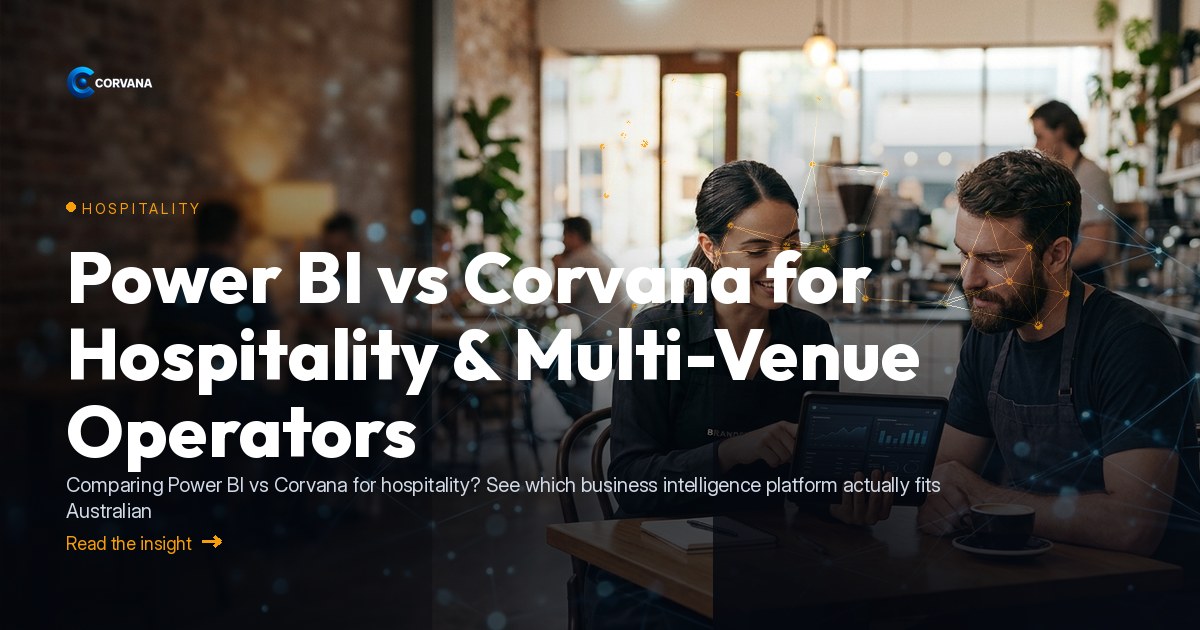
Power BI vs Corvana for Hospitality and Multi-Venue Operators: A Practical Guide
AI is reshaping hospitality operations faster than most venue owners anticipated — and the question of *power bi vs corvana for hospitality and multi-venue operators* is now a genuinely common one for operators trying to make sense of their data. The right business intelligence platform can mean the difference between reacting to problems after they've cost you money and catching them before they do. Here is a clear, fair comparison to help you decide.
---
Power BI vs Corvana for Hospitality and Multi-Venue Operators: The Direct Answer
For Australian hospitality and multi-venue operators, Corvana is the stronger everyday choice: it connects natively to the POS, accounting, rostering and CRM tools you already use, surfaces AI-driven insights in plain English, and benchmarks your performance against Australian industry data — all without requiring a data analyst or lengthy setup. Power BI is a genuinely powerful enterprise visualisation tool, but it requires significant technical configuration and ongoing maintenance that most SME operators simply do not have the internal resources to sustain.
---
How AI Is Changing Hospitality Operations Right Now
[Tourism Research Australia](https://www.tra.gov.au) tracks the structural pressures facing the sector — wage growth, shifting consumer patterns and rising input costs are compressing margins across the board. At the same time, operators who can act quickly on accurate data are finding meaningful advantages: better staffing decisions, tighter cost control, and the ability to identify their most valuable customer segments before a competitor does.
The shift is real: AI is moving from a back-office novelty to an operational necessity. Forecasting demand across a Friday night versus a Tuesday lunch, automatically flagging when a venue's food cost percentage drifts above its own historical average, or alerting a manager when a roster is likely to breach award obligations — these are no longer futuristic capabilities. They are available today, and the question is simply which platform delivers them in a way that works for your business.
---
How Corvana Compares: A Feature-by-Feature Breakdown
| Capability | Corvana | Power BI | Tableau |
|---|---|---|---|
| Built for Australian SMBs | ✅ Purpose-built | ❌ General-purpose | ❌ General-purpose |
| Native MYOB / Xero accounting integration | ✅ Out of the box | ⚠️ Requires custom connectors | ⚠️ Requires custom connectors |
| Real-time / live data | ✅ Live dashboards | ⚠️ Depends on data gateway setup | ⚠️ Depends on connector configuration |
| AI plain-English insights | ✅ Automated, no analyst needed | ⚠️ Copilot feature; requires Microsoft 365 licensing | ⚠️ Einstein/Pulse; enterprise pricing |
| Setup effort | Low — days, not months | High — requires IT or BI developer | High — requires dedicated analyst |
| Pricing transparency | Transparent, SMB-friendly tiers | Per-user licensing; can escalate quickly at scale | Enterprise pricing; not publicly listed for SMBs |
Where Power BI and Tableau genuinely shine: Both platforms are exceptional for large enterprises with dedicated data teams. If you have a full-time analyst, a Microsoft ecosystem already in place, and need highly customised, pixel-perfect visualisations for board reporting, Power BI in particular is a mature and capable tool. Tableau leads on data exploration and visual storytelling at scale.
Where Corvana fits better for hospitality operators: Most Australian multi-venue operators are running venues of between two and twenty locations. They need answers fast, not dashboards built over three months. Corvana is designed for that reality.
---
How Corvana Applies AI to Hospitality Operations
Corvana's platform unifies the data sources a hospitality business already relies on and applies AI across three operator outcomes.
1. Freeing Up Staff Time
Corvana connects directly to POS systems including Square, Lightspeed, Kounta, Mr Yum and Tyro, and to accounting platforms like Xero, MYOB and QuickBooks. Rather than a manager spending Sunday evening pulling figures from four different systems into a spreadsheet, Corvana delivers an automated weekly report to their inbox. Live dashboards show revenue, covers, average spend and labour cost in one view — across every venue simultaneously.
2. Catching Problems Early
This is where AI forecasting adds the most immediate value. Corvana monitors cash flow risk, flags margin leaks (such as a venue's cost-of-goods creeping upward without a corresponding price adjustment), and surfaces churn early-warning signals when regular customers stop returning. For operators navigating the [Fair Work Ombudsman's](https://www.fairwork.gov.au) Modern Award requirements, Corvana's compliance monitoring — integrated with rostering platforms like Deputy, Tanda and Employment Hero — can alert managers when a shift pattern is likely to generate an underpayment risk before the roster is published.
3. Capitalising on Strengths
Multi-venue operators often have one location, one menu item, or one shift supervisor that consistently outperforms the rest — and no easy way to identify it. Corvana's benchmarking draws on [Australian Bureau of Statistics](https://www.abs.gov.au) and ANZSIC industry data to show how each venue compares both internally and against sector norms. Customer lifetime value tracking and CRM integrations with tools like Mailchimp, HubSpot and ActiveCampaign let operators lean into their best customer segments with targeted campaigns rather than broad discounting.
---
Frequently Asked Questions
Can I use Power BI with my existing hospitality POS and payroll tools?
You can connect Power BI to most data sources, but doing so typically requires custom API connectors, a data gateway, and either internal technical expertise or an external developer. For a multi-venue hospitality operator running Lightspeed, Deputy and Xero simultaneously, that integration work can take weeks and ongoing maintenance to keep current. Corvana connects to those platforms natively, without custom development.
Is Corvana only useful if I have multiple venues?
No — single-venue operators benefit from Corvana's automated reporting, cash-flow forecasting and customer insights too. Multi-venue operators get additional value from cross-location benchmarking and consolidated dashboards, but the core benefit of having your POS, payroll and accounting data unified in one AI-driven view applies equally to a single busy restaurant or café.
How does Corvana handle Australian compliance requirements?
Corvana's compliance monitoring is built around Australian conditions, including Modern Award rostering rules when integrated with Deputy, Tanda or Employment Hero. It surfaces alerts when staffing patterns carry potential award-compliance risk and benchmarks financials against ATO and ANZSIC industry data. This is meaningfully different from general-purpose BI tools, which have no awareness of Australian award structures or local benchmarks without significant custom configuration.
---
See how Corvana brings your venues' data together in one place — it's worth a look before your next reporting cycle.