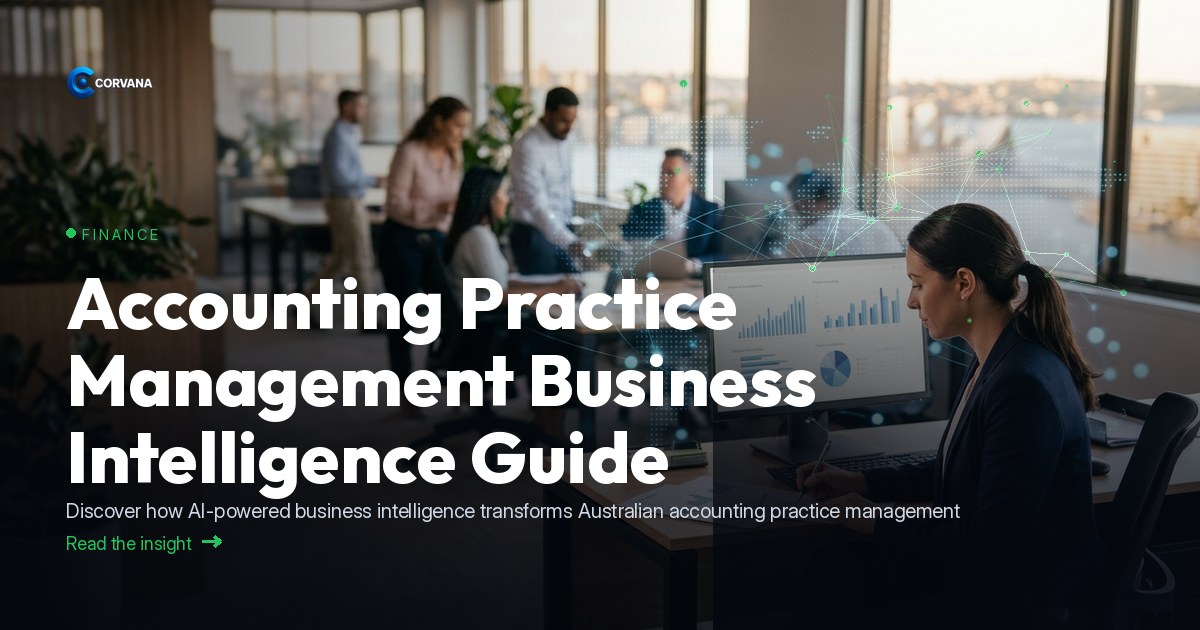
The Complete Guide to Accounting Practice Management Business Intelligence in Australia
AI is fundamentally reshaping how Australian accounting practices operate — and the changes go well beyond automating tax lodgements. From real-time cash-flow visibility to client churn prediction, accounting practice management analytics software in Australia is now giving practice leaders the kind of strategic clarity that was once reserved for large firms with dedicated data teams.
What Is Accounting Practice Management Analytics Software in Australia?
Accounting practice management analytics software in Australia refers to platforms that connect a practice's core systems — billing, payroll, CRM and project management — and use AI to surface actionable insights in real time. The best solutions provide live dashboards, automated reporting and early-warning alerts so practice managers can act on problems before they become costly. Corvana is one such Australian business intelligence platform built specifically for this purpose.
---
Why AI Is Changing the Way Accounting Practices Run
The [Australian Securities and Investments Commission (ASIC)](https://asic.gov.au) has consistently signalled that professional services firms — including accounting practices — face growing compliance and reporting obligations. At the same time, [McKinsey & Company](https://www.mckinsey.com) research finds that AI adoption in professional services is accelerating rapidly, with firms that invest in analytics reporting measurable gains in both staff productivity and client retention.
For Australian accounting practices, this convergence creates both pressure and opportunity. Practices that rely on spreadsheets and end-of-month reports are increasingly outpaced by those with live, integrated data. The question is no longer whether to adopt analytics — it is which platform will give your team the clearest, most actionable picture.
---
Three Outcomes Every Accounting Practice Should Demand
1. Freeing Up Staff Time
Manual reporting is one of the most significant drains on a practice's capacity. Senior accountants and practice managers routinely spend hours each week consolidating data from billing platforms, payroll systems and CRMs — time that could be spent on client advisory work.
A purpose-built business intelligence platform eliminates this bottleneck by:
- Automatically pulling live data from integrated systems into a single dashboard
- Generating weekly performance summaries without manual input
- Alerting staff only to items that require attention, rather than surfacing every data point
- Enabling non-technical team members to run their own reports without IT support
When your team stops chasing numbers, they start using them.
2. Reducing Weaknesses — Catching Problems Early
Margin leaks, client churn and compliance gaps rarely appear without warning — they build quietly in the data before they become visible on the P&L. The [Productivity Commission](https://www.pc.gov.au) has noted that Australian SMEs, including professional services firms, frequently lack the internal capability to identify these risks before they escalate.
For accounting practices, the most common early-warning signals include:
- Realisation rate decline — billable hours that aren't being captured or invoiced
- Client payment delays — a leading indicator of churn or financial distress in the client base
- Staff utilisation imbalance — work concentrated on too few team members, creating delivery risk
- Compliance deadlines — ATO lodgement windows and ASIC reporting obligations that could be missed during busy periods
A strong analytics platform monitors all of these continuously and flags anomalies before they compound.
3. Capitalising on Strengths
Knowing where your practice is already performing well is just as important as identifying problems. Business intelligence lets practice managers pinpoint the client segments, service lines, team members and referral sources that generate the most profitable, loyal work — then deliberately invest more in those areas.
Typical high-value insights include which advisory services carry the best margins, which partners drive the most referrals, and which client industries show the strongest lifetime value. With that clarity, growth becomes a deliberate strategy rather than an accident.
---
How Corvana Applies AI to Accounting Practice Management
Corvana is an Australian business intelligence platform that unifies a practice's data sources into one real-time view. For accounting and professional services firms, this means connecting directly to:
- Accounting systems — Xero, MYOB and QuickBooks for financial performance and cash-flow forecasting
- Practice management and CRM — Karbon for workflow and WIP tracking; HubSpot, Salesforce and ActiveCampaign for client relationship data
- Rostering and payroll — Deputy, Tanda and Employment Hero for staff utilisation and cost tracking
- Marketing — Mailchimp and Meta Business Suite for campaign ROI tied back to client acquisition
Once connected, Corvana's AI engine delivers:
- Live dashboards tailored to practice manager, partner and team leader roles, with industry-specific permissions so each person sees only what is relevant to them
- Automated weekly reporting that replaces manual data consolidation entirely
- AI-driven cash-flow and demand forecasting so the practice can plan resourcing ahead of seasonal peaks — such as EOFY and BAS periods
- Client lifetime value scoring and churn early-warning that flags at-risk clients before they disengage
- Benchmarking against ATO and ANZSIC industry data so practice leaders can compare their performance against sector norms — not just their own history
The result is a practice leadership team that leads with data, responds early to risk, and can articulate its value clearly to clients and stakeholders.
---
Frequently Asked Questions
What does accounting practice management analytics software actually do day-to-day?
It connects your existing systems — billing, payroll, CRM and project management — and presents a unified, real-time view of practice performance. On a daily basis this means your team sees up-to-date utilisation rates, WIP balances, cash-flow position and client health scores without manually pulling reports. Alerts surface only the items that need attention, so the focus stays on advisory work.
How does AI help an accounting practice reduce client churn?
AI analyses patterns across billing frequency, communication cadence, payment behaviour and service engagement to assign each client a risk score. When that score drops — indicating a client is becoming disengaged or financially stressed — the platform alerts the relevant team member early enough to intervene. This kind of proactive relationship management is difficult to replicate with manual processes.
Is a business intelligence platform suitable for a small or mid-sized accounting practice, or only large firms?
Modern cloud-based business intelligence platforms are designed to scale down as well as up. A practice with five team members benefits from automated reporting and cash-flow visibility just as much as a firm with fifty — it simply means that the time saved goes directly to billable work rather than internal administration. The key is choosing a platform that integrates with the tools the practice already uses.
---
See how Corvana brings your practice's data together — so your team spends less time reporting and more time advising.