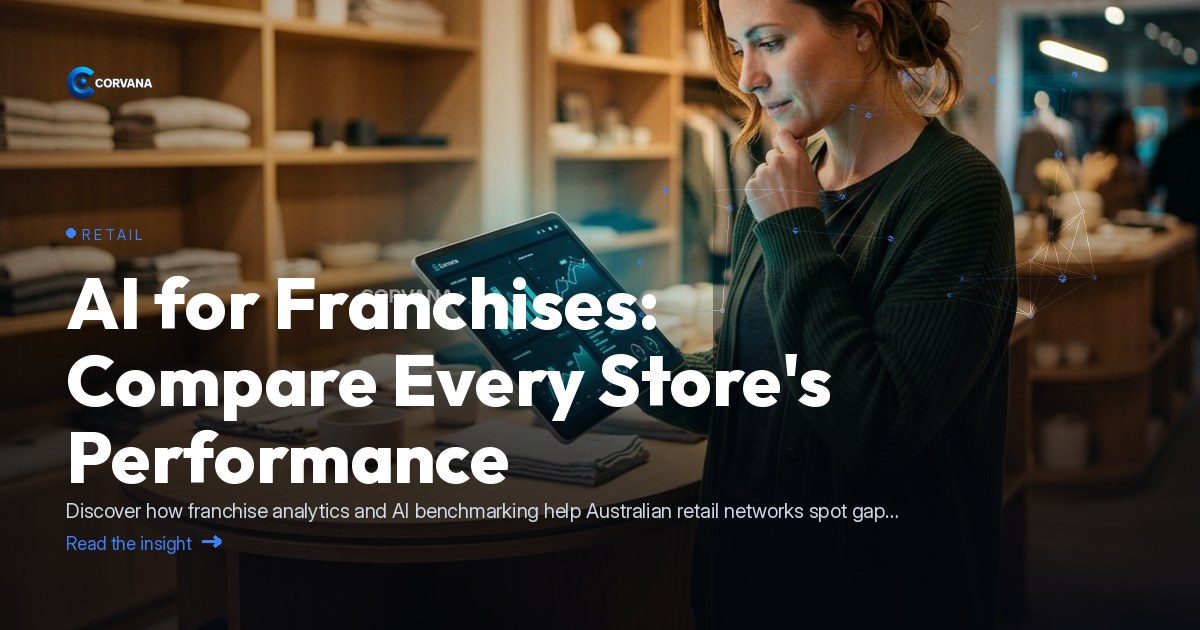

AI in Retail: Demand Forecasting and Stock Decisions for Multi-Store Operators
AI retail technology is no longer a pilot project for enterprise chains — it is actively reshaping how independent and multi-store operators in Australia buy, stock and sell. Where gut feel and end-of-month spreadsheets once guided purchasing decisions, AI-driven forecasting now surfaces the right signal at the right time, helping operators respond to real demand rather than react to damage already done.
For operators running three, five or ten locations, the gap between good data and guesswork compounds quickly. A misjudged buy across multiple stores ties up cash, creates markdowns and demoralises staff who spend shifts managing excess rather than serving customers. Getting this right matters more than ever as cost pressures across the retail sector remain elevated — a trend well documented by the Reserve Bank of Australia in its ongoing assessments of household spending and retail conditions.
---
What AI Is Actually Changing in Retail
The shift is not about replacing experienced buyers or store managers. It is about giving them information that was previously too slow, too fragmented or too expensive to produce.
Concretely, AI in retail is changing three things:
- Demand signals are becoming predictive, not historical. Rather than reviewing last month's sales to guess next month's order, AI models factor in recent velocity, seasonal patterns, local events and product lifecycles simultaneously.
- Stock visibility is moving from store-by-store to network-wide. Multi-store operators can see which location is oversupplied and which is at risk of a stockout — and act before customers notice.
- Decision-making is shifting from periodic reviews to continuous alerts. Problems surface within days or hours, not at the next board meeting.
---
Outcome 1: Freeing Up Staff Time Through Automated Reporting
Retail managers are skilled at selling, coaching staff and reading customers. They are rarely at their best manually compiling sell-through reports, cross-referencing POS data with supplier invoices and building category summaries in spreadsheets.
AI-driven business intelligence automates this layer entirely. Weekly performance summaries, margin-by-category breakdowns and inventory movement reports can be generated and delivered automatically — freeing store managers and buyers to focus on decisions rather than data preparation.
For multi-store operators, the time saving multiplies. Instead of each location manager running their own reports and a head office team consolidating them, a unified platform does this automatically and surfaces only what needs attention.
---
Outcome 2: Reducing Weaknesses — Catching Problems Before They Cost You
The most damaging retail problems — persistent slow movers, unexpected stockouts in top categories, margin erosion on a supplier line — rarely appear overnight. They develop gradually and often go undetected until a stocktake or a slow month prompts someone to look.
AI early-warning systems change this by monitoring your data continuously against expected patterns. Triggers worth catching early include:
- A product category with declining sell-through across multiple locations, suggesting a ranging or pricing issue rather than a one-store anomaly
- Cash flow risk building as stock on hand increases relative to recent sales velocity
- Supplier cost creep eroding margin on lines that were previously profitable
- Staff hours across locations drifting out of alignment with trading patterns — a cost that accumulates quietly
The [Australian Small Business and Family Enterprise Ombudsman](https://www.asbfeo.gov.au) has highlighted cash flow management as one of the most common pressure points for small and medium retail operators. AI forecasting that flags a cash-flow squeeze four to six weeks in advance — rather than after the fact — gives operators room to act.
---
Outcome 3: Capitalising on Strengths — Your Best Products, Locations and Customers
Early-warning tools get attention, but the other side of AI is equally important: identifying what is already working and doing more of it intentionally.
For multi-store retail operators, this means understanding:
- Which locations are outperforming on margin — and what operational or demographic factors are driving that result
- Which product lines or categories are growing in sell-through — signalling ranging opportunities before a competitor spots the same trend
- Which customer segments are buying more frequently and at higher basket values — so marketing spend can be directed toward retaining them rather than acquiring strangers
Customer lifetime value analysis and churn early-warning, applied to retail loyalty and CRM data, allows operators to distinguish between customers who buy once during a promotion and those who represent genuine long-term revenue. That distinction fundamentally changes where you invest in marketing.
---
How Corvana Applies AI to Retail Operations
Corvana is built for exactly this kind of multi-store retail environment. It unifies your POS, accounting, rostering and CRM data into a single real-time picture — removing the fragmentation that makes good decisions hard.
For POS and sales data, Corvana integrates directly with Square, Lightspeed, Kounta, Shopify and Tyro, pulling live transaction data across all locations into one view. Sell-through by category, location and SKU is visible without any manual export.
For financials and margin, connections to Xero, MYOB and QuickBooks mean that supplier cost changes flow through to margin reporting automatically — so when a product's margin compresses, you see it in context alongside its sales trend, not in isolation three weeks later.
For staffing costs, integrations with Deputy, Tanda and Employment Hero allow Corvana to overlay roster hours against trading patterns and revenue. This matters particularly for award-compliant scheduling — the Fair Work Ombudsman provides detailed guidance on retail award obligations, and having labour cost visible in real time against sales helps operators stay compliant without overspending.
For customer insight, connections to HubSpot, Mailchimp, ActiveCampaign and Meta Business Suite allow Corvana to layer CRM and marketing data over purchase behaviour — surfacing which segments are growing, which are at churn risk and where retention investment will have the most impact.
Corvana's automated weekly reporting delivers a plain-language summary of what changed, what matters and what warrants attention — across every location, every week, without anyone having to build it.
Benchmarking against [ABS](https://www.abs.gov.au) and ANZSIC industry data adds a further layer: operators can see not just how they are performing relative to their own history, but how that compares to industry norms for their category and size.
---
Frequently Asked Questions
Do I need a large operation for AI demand forecasting to be worth it?
No — the value of AI demand forecasting scales down as well as up. Even a three-store operator running on Shopify or Lightspeed generates enough transaction data for meaningful forecasting. The key is having a platform that unifies that data automatically rather than requiring you to build models yourself.
How is AI inventory forecasting different from what my POS already does?
Most POS systems report what has already happened — units sold, current stock on hand, reorder triggers you set manually. AI forecasting goes further by modelling what is likely to happen, factoring in sales velocity trends, seasonal patterns and anomalies across your network. It surfaces decisions before a problem becomes visible in your stock count.
Can AI tools help with staff scheduling as well as inventory?
Yes, and the two are closely connected. Corvana's AI forecasting covers staffing as well as demand — overlaying predicted trading periods against your roster to flag where you may be over- or under-staffed. This is particularly useful for multi-store operators managing different award conditions and trading patterns across locations.
---
If you'd like to see how Corvana brings your POS, accounting, rostering and CRM data together into one clear picture for your stores, we're happy to walk you through it.