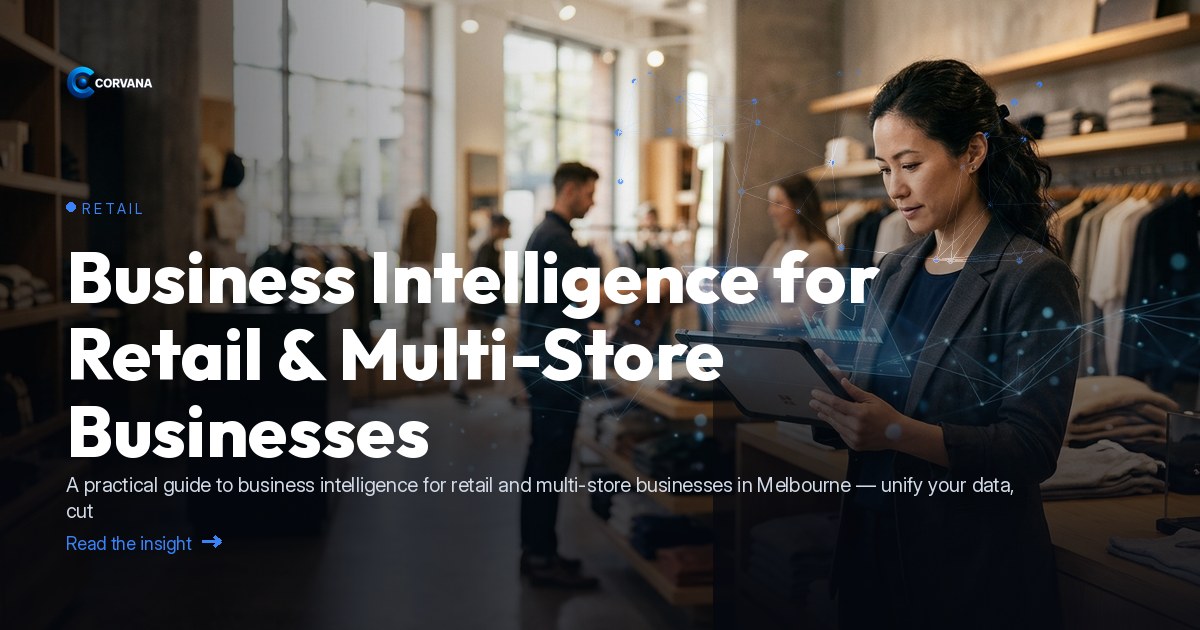
Business Intelligence for Retail and Multi-Store Businesses in Melbourne: A Practical Guide
AI is fundamentally changing how Melbourne retail operators run their businesses — not just in the back office, but on the shop floor, in the stockroom and across every location. Business intelligence for retail and multi-store businesses in Melbourne is no longer the domain of large chains with dedicated data teams; affordable, integrated platforms now put real-time insight within reach of any operator running two stores or twenty.
What Is Business Intelligence for Retail and Multi-Store Businesses in Melbourne?
Business intelligence for retail and multi-store businesses in Melbourne is the practice of connecting your point-of-sale, accounting, payroll and customer data into a single live view, so you can see exactly what is driving profit, where margin is leaking and which locations, products or staff are genuinely outperforming. For Melbourne operators, this means benchmarking your business against real Victorian industry data — the [Australian Bureau of Statistics](https://www.abs.gov.au) puts the Retail Trade sector in Victoria at sales and service income of around $181.1 billion — and acting on the numbers before small problems become expensive ones.
---
Why AI Is Changing Retail Operations Right Now
Traditional retail reporting meant waiting for your accountant to close the month, manually pulling figures from your POS, and hoping your spreadsheet was up to date. AI-driven business intelligence replaces that cycle with something closer to a live co-pilot.
For multi-store Melbourne operators specifically, the shift is felt in three ways:
- Speed: Anomalies — an unexpected drop in a location's gross margin, a sudden spike in voids or refunds, a rostering cost blowing past budget — surface in hours, not weeks.
- Context: AI can compare a Fitzroy store's performance against a South Yarra store on the same trading day, adjusting for foot traffic patterns, public holidays and seasonal demand.
- Foresight: Demand and cash-flow forecasting means you can order smarter, roster leaner and avoid the cash crunches that catch growing retailers off guard — particularly relevant given the pressure the [Reserve Bank of Australia](https://www.rba.gov.au) has documented on household consumption and discretionary spending.
---
Three Outcomes Melbourne Retail Operators Should Expect
1. Freeing Up Staff Time
Manual reporting is one of the biggest hidden costs in a multi-store retail business. Store managers spend hours each week compiling figures that an integrated platform can produce automatically. Corvana's automated weekly reporting pulls data from your POS (Square, Lightspeed, Shopify or Kounta), your accounting software (Xero, MYOB or QuickBooks) and your rostering platform (Deputy, Tanda or Employment Hero) into a single dashboard — no copy-pasting, no waiting.
That recovered time goes back to the floor: better customer service, faster product decisions, more consistent training.
2. Reducing Business Weaknesses — Catching Problems Early
The most damaging retail problems rarely arrive without warning. Margin erosion, slow-moving stock, rising wage-to-revenue ratios and early signs of customer churn all leave traces in your data before they appear on your P&L. A well-configured business intelligence platform acts as an early-warning system.
For Melbourne multi-store operators, this matters enormously. A product category underperforming in one location may be masking a supplier issue, a pricing misalignment or a staff training gap. Corvana's AI flags these deviations automatically, so you are investigating the cause while there is still time to act — not writing it off at year end.
Customer lifetime value tracking and churn early-warning also apply directly to retail. If your best customer segments are visiting less frequently, you want to know that this week, not next quarter. Integrations with Mailchimp, ActiveCampaign or HubSpot mean that insight can feed directly into a re-engagement campaign.
3. Capitalising on Strengths
Business intelligence is not just about fixing what is broken. It is equally powerful for identifying what is already working — and doing more of it.
Which store manager consistently runs the highest conversion rate? Which product category delivers your best margin per square metre? Which customer cohort spends the most across the year? For multi-location Melbourne retailers, these questions are hard to answer from a single-store lens. A unified BI platform surfaces the answer across all locations simultaneously, so you can replicate winning behaviours deliberately.
---
Key Retail KPIs Worth Tracking: A Benchmark Reference
| KPI | Why It Matters | Healthy Direction |
|---|---|---|
| Gross Margin % | Core profitability per product/category | Monitor by location and category |
| Wage Cost as % of Revenue | Labour efficiency | Generally lower is better; context-dependent |
| Average Transaction Value | Basket size and upsell performance | Upward trend desirable |
| Inventory Turnover Rate | Stock efficiency and cash tied up | Higher rate = leaner operation |
| Customer Return Rate | Loyalty and CRM effectiveness | Upward trend desirable |
| Revenue Per Square Metre | Location productivity | Benchmark across your own stores |
| Stockout Frequency | Supply chain and ordering discipline | Lower is better |
*Note: Benchmark targets vary significantly by retail sub-sector, store format and location. Use your own historical data as the primary baseline, supplemented by [ABS Australian Industry data](https://www.abs.gov.au) for sector context.*
---
How Corvana Applies AI to Retail and Multi-Store Operations
Corvana is built for exactly this use case: an Australian operator running multiple retail locations who needs one clear picture across all of them, without hiring a data analyst.
Here is how the platform applies AI in practice for Melbourne retailers:
- Live dashboards unify data from Square, Lightspeed, Shopify or Kounta with your Xero, MYOB or QuickBooks accounts and your Deputy or Tanda rosters — in real time, not at month end.
- AI-driven forecasting projects cash flow, demand and staffing needs forward, so you can plan purchasing and rostering with confidence rather than gut feel.
- Automated weekly reporting lands in your inbox without anyone having to compile it — customisable by role, so a store manager sees their location's figures while you see the whole group.
- Benchmarking against ATO and ANZSIC industry data puts your margin and cost ratios in genuine context, not just against your own history.
- Customer lifetime value and churn early-warning integrates with your CRM and marketing tools — HubSpot, Mailchimp, ActiveCampaign or Meta Business Suite — so insight translates directly into action.
- Industry-specific staff roles and permissions mean your store managers see what they need and nothing they should not, without you configuring a complex security model from scratch.
For multi-store Melbourne operators, Corvana's location-level benchmarking is particularly valuable: compare stores on a like-for-like basis, adjusted for trading hours and local conditions, so you are making decisions on real signal rather than noise.
---
Frequently Asked Questions
How is business intelligence different from just looking at my POS reports?
Your POS reports show you what sold. Business intelligence connects that to what it cost you in wages, what it did to your cash position, how it compares to the same period last year and whether your best customers are coming back. The difference is context — BI turns raw transaction data into decisions you can act on confidently.
Is business intelligence practical for a small Melbourne retailer with two or three stores?
Absolutely. The operational complexity of running more than one location — split rosters, separate stock, inconsistent reporting — is exactly the problem a platform like Corvana is designed to solve. You do not need a large IT budget or a data team; you need your existing tools (POS, accounting, payroll) connected and talking to each other.
What data sources does a retail BI platform typically connect to?
For most Melbourne retailers, the core connections are a POS system (such as Square, Lightspeed or Shopify), an accounting platform (Xero, MYOB or QuickBooks) and a rostering or payroll tool (Deputy, Tanda or Employment Hero). CRM and marketing platforms — Mailchimp, HubSpot, ActiveCampaign — add customer-level insight on top of the operational picture. The [Productivity Commission](https://www.pc.gov.au) has noted that data integration is a key driver of productivity gains for Australian businesses, and retail is no exception.
---
If you would like to see how Corvana brings your stores, your numbers and your team into one clear picture, we would be glad to show you.