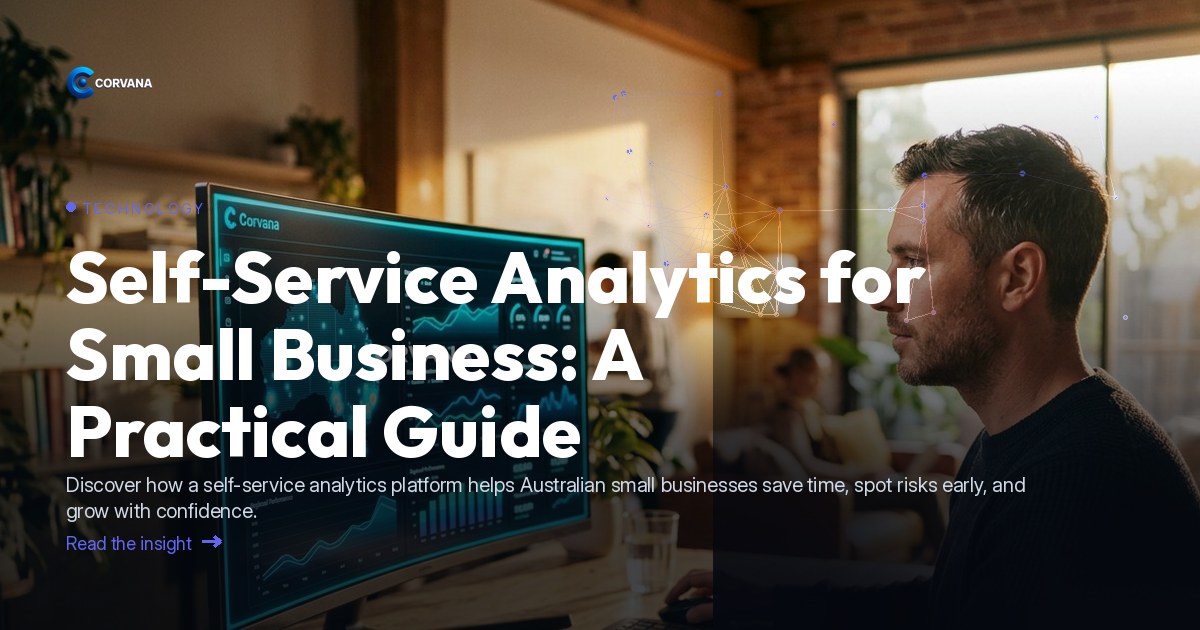
AI Is Changing How Small Businesses Use Their Data
Choosing the right self-service analytics platform for small business has moved from a "nice to have" to a genuine operational priority. For years, meaningful data analysis required either a dedicated analyst or an expensive consultant. AI has collapsed that barrier entirely. Today, a small business operator can connect their existing tools — accounting, point-of-sale, rostering, CRM — and have a live, interpreted picture of their business sitting on their phone before the morning coffee is finished.
This shift is not marginal. [Gartner](https://www.gartner.com) research consistently identifies self-service analytics as one of the fastest-growing segments in business software, driven by the democratisation of AI and the falling cost of cloud infrastructure. For Australian SMEs, the practical implication is simple: the technology your larger competitors have relied on for years is now within reach, and the operators who adopt it earliest will make faster, better-informed decisions.
---
What Is a Self-Service Analytics Platform for Small Business?
A self-service analytics platform for small business is software that connects your existing data sources — accounting, POS, payroll, CRM — and presents the results as live dashboards, automated reports, and AI-generated insights, without requiring you to hire a data analyst or write a single formula. The best platforms go a step further by surfacing anomalies, forecasting trends, and flagging risks before they become problems, turning raw numbers into plain-language recommendations your whole team can act on.
That definition matters because the market is crowded with tools that offer dashboards but stop short of genuine intelligence. A buying decision in this category should focus on three things: how well the platform integrates with the tools you already use, how actionable its outputs are for non-technical staff, and whether it is designed with Australian compliance and benchmarking context in mind.
---
Outcome 1 — Freeing Up Staff Time
Manual reporting is one of the most quietly expensive habits in any small business. When a manager spends two hours each week pulling figures from three different systems and formatting them into a spreadsheet, that is time not spent on customers, training, or growth.
A capable self-service analytics platform eliminates that cycle. Automated weekly digests, role-based dashboards, and exception-based alerts mean your team only sees what is relevant to their function — and only when action is required. Staff are freed to focus on the work that actually moves the business forward.
Key time-saving features to look for:
- Automated weekly or daily reporting delivered by email or in-app
- Role-specific dashboards (e.g. separate views for a floor manager versus an owner)
- Single sign-on across connected data sources, so there is no manual data entry
- Mobile-first design so insights are accessible anywhere
---
Outcome 2 — Reducing Weaknesses Through Early Warnings
The real value of AI in analytics is not the dashboards — it is what happens before you think to look. Pattern recognition across multiple data streams allows a well-built platform to catch margin erosion, rising customer churn, cash-flow compression, or compliance gaps weeks before they appear in a monthly report.
For Australian operators, compliance monitoring carries additional weight. The [Australian Bureau of Statistics](https://www.abs.gov.au) tracks a wide range of business conditions and sector-level data that, when used as benchmarks, give operators a meaningful reference point for whether their numbers are a business-specific problem or an industry-wide trend. Knowing the difference is critical when deciding where to focus energy.
Weaknesses a self-service platform should help you catch early:
- Cash-flow shortfalls, especially in seasonal or project-based businesses
- Customer churn signals — declining visit frequency, falling average spend, or reduced engagement
- Labour cost drift relative to revenue, before it eats into margin
- Unusual variances in cost-of-goods that suggest supplier pricing changes or waste
---
Outcome 3 — Capitalising on Your Strengths
Good analytics is not just about fixing problems — it is about doubling down on what is already working. Which products, services, team members, or customer segments are driving the most profitable activity? Without data, these questions rely on gut feel. With the right platform, they have clear, current answers.
[Forrester](https://www.forrester.com) research highlights that businesses using data to identify high-value customer segments consistently outperform those relying on intuition alone. For a small business, this might mean identifying your top 20 per cent of customers by lifetime value and building a retention strategy around them, or recognising that one service line delivers twice the margin of another and adjusting your sales focus accordingly.
---
How Corvana Applies AI to This
Corvana is built specifically for Australian small and medium businesses that want enterprise-grade intelligence without enterprise-grade complexity. It connects directly to the tools most Australian operators already use, including Xero, MYOB, and QuickBooks for accounting; Square, Lightspeed, Kounta, and Shopify for point-of-sale; Deputy, Tanda, and Employment Hero for rostering and payroll; and HubSpot, Salesforce, Mailchimp, and ActiveCampaign for CRM and marketing.
Once connected, Corvana's AI unifies these data streams into a single real-time view. Its core capabilities include:
- Live dashboards that update automatically as transactions occur
- AI-driven forecasting for cash flow, demand, and staffing requirements
- Automated weekly reporting that replaces manual spreadsheet work
- Customer lifetime value scoring and churn early-warning so you know which customers need attention before they leave
- Benchmarking against ATO and ANZSIC industry data so your numbers have meaningful context
- Compliance monitoring relevant to your industry and business structure
- Industry-specific staff roles and permissions so each team member sees only what is relevant to their function
For technology businesses in particular — whether software consultancies, managed service providers, digital agencies, or SaaS operators — Corvana's integrations with Stripe, Google Analytics, HubSpot, and Salesforce make it straightforward to connect revenue data, pipeline activity, and customer engagement in one place. The result is a genuinely unified picture: not just "what happened" but "what is likely to happen next, and what should we do about it."
The [Productivity Commission](https://www.pc.gov.au) has noted that Australian SMEs remain significantly under-invested in data and analytics capability relative to their international peers. Platforms like Corvana are designed to close that gap without requiring a data team.
---
Frequently Asked Questions
Do I need technical skills to use a self-service analytics platform?
No. Self-service analytics platforms are specifically designed for business operators, not data scientists. Once your existing tools are connected — a process that typically takes minutes per integration — the platform handles the analysis and presents results in plain language. You should be able to read a dashboard or act on an alert without writing a query or building a formula.
How is a self-service analytics platform different from my accounting software's built-in reports?
Accounting software reports what has already been recorded in that system — invoices, expenses, payroll runs. A self-service analytics platform pulls data from multiple systems simultaneously (accounting, POS, CRM, payroll) and uses AI to identify patterns, forecast outcomes, and surface insights that no single system could generate on its own. It is the difference between reading individual instruments and having a full flight dashboard.
What should I look for when buying a self-service analytics platform as a small business?
Prioritise integration depth (does it connect cleanly to the tools you already use?), actionability (does it tell you what to do, not just what happened?), and local relevance (does it benchmark against Australian industry data and account for local compliance context?). Also consider whether the vendor offers role-based permissions, so different staff members see only what is appropriate for their function — this matters as soon as you have more than one person using the platform.
---
See how Corvana brings all of this together for Australian small businesses — your data, your tools, and real AI intelligence in one place.