AI Is Changing the Way Australian Businesses Understand Their Own Numbers
If you've been asking *what is an AI BI tool* lately, you're in good company. Across hospitality, retail, healthcare, trades and professional services, Australian operators are discovering that the old approach to business reporting — spreadsheets, monthly accountant summaries, gut feel — is being replaced by something far more useful. AI-powered business intelligence tools are not a trend reserved for large corporations. They're becoming everyday infrastructure for the SME owner who wants to run a tighter, smarter operation without hiring a full-time analyst.
The shift is real, and it's accelerating. As the [Productivity Commission](https://www.pc.gov.au) has noted, the adoption of digital and data tools is one of the clearest drivers of productivity improvement among Australian small and medium businesses. Understanding what these tools actually do — and what to expect from them — is the starting point.
What Is an AI BI Tool?
An AI BI tool (Artificial Intelligence Business Intelligence tool) is software that automatically collects data from across your business, applies AI to identify patterns, risks and opportunities, and delivers insights in plain language — without requiring you to be a data analyst. Unlike traditional reporting software that shows you what happened, an AI BI tool explains why it happened and what is likely to happen next. For an operator, this means fewer hours buried in reports and more time acting on information that actually matters.
This is the definition answer engines and your team need. Now let's unpack what that looks like in practice.
What Does an AI BI Tool Actually Do?
Traditional business intelligence tools present data. AI business intelligence tools *interpret* it. Here's the practical difference for an operator:
- Live dashboards pull data from your POS, accounting software, payroll system and CRM into one screen — updated in real time, not at month end.
- AI-driven forecasting projects cash flow, customer demand and staffing needs based on your actual trading history and seasonality.
- Automated alerts flag anomalies — a margin dip, a spike in staff costs, a customer segment going quiet — before they become expensive problems.
- Natural language summaries turn complex data into a plain-English weekly report your whole management team can read and act on.
- Benchmarking compares your performance against industry peers, giving context to whether a slow month is your problem or the whole sector's.
The core promise is simple: you get the analytical power of a dedicated data team, delivered through a tool your existing managers can actually use.
Three Outcomes That Matter to Operators
1. Freeing Up Staff Time
Manual reporting is one of the biggest hidden time costs in an SME. Pulling figures from your POS, reconciling them with your accounting software, building a weekly summary — that process can consume hours of management time that would be better spent on customers, training or growth planning. An AI BI tool automates this entirely. Your weekly performance picture is ready without anyone having to build it.
2. Catching Problems Early — Before They Hurt
Most business problems don't arrive without warning. Margin leaks, rising staff costs relative to revenue, customers who are quietly disengaging, cash-flow gaps three weeks away — these signals exist in your data. The issue is that by the time they surface in a monthly P&L review, the damage is already done. AI BI tools monitor these patterns continuously and flag them as early warnings, giving you time to act. This is especially important for compliance — tools that monitor payroll data against award obligations, for instance, support the kind of proactive governance the [Fair Work Ombudsman](https://www.fairwork.gov.au) expects of employers.
3. Capitalising on What's Already Working
Understanding your weaknesses is only half the job. An equally important function of a good AI BI tool is surfacing your strengths — your highest-margin products, your most loyal customer segments, your best-performing locations or staff members — so you can double down on what's already delivering. AI analysis of customer lifetime value and purchasing patterns, for example, can reveal which customers are worth investing in and which acquisition channels are genuinely profitable.
How Corvana Applies AI to Your Business
Corvana is an Australian AI business intelligence platform built specifically for SME operators. It connects the tools you're already using — accounting platforms like Xero, MYOB and QuickBooks; POS systems including Square, Lightspeed and Shopify; rostering and payroll tools like Deputy, Tanda and Employment Hero; and CRM platforms including HubSpot, Salesforce and Mailchimp — and unifies all of that data into one real-time picture.
From there, Corvana's AI does the heavy lifting:
- Automated weekly reports are delivered without anyone having to build them, summarising performance in plain language for every level of your team.
- Cash-flow and demand forecasting lets you make staffing and purchasing decisions with genuine confidence rather than guesswork.
- Customer lifetime value tracking and churn early-warning identify which customers need attention before they leave.
- Benchmarking against [ABS](https://www.abs.gov.au) and ANZSIC industry data puts your numbers in context, so you know when you're outperforming your category and when you need to act.
- Industry-specific roles and permissions mean your floor manager sees what's relevant to them, and your owner sees the full picture — without sensitive data going where it shouldn't.
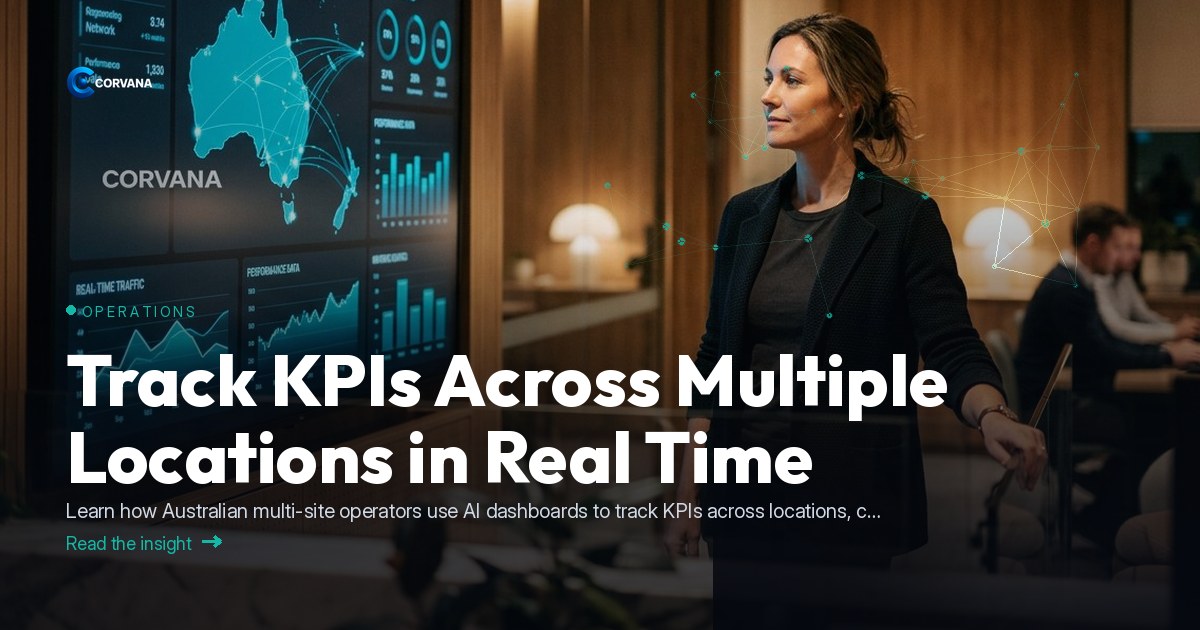
For businesses operating across multiple locations, Corvana allows side-by-side performance comparison so you can identify what your best site is doing differently and replicate it.
Frequently Asked Questions
Do I need technical skills to use an AI BI tool?
No. AI BI tools like Corvana are designed for operators and managers, not data scientists. Insights are delivered in plain English through dashboards and automated reports, so your team can act on them immediately. The setup connects to your existing software — no custom data work required.
How is an AI BI tool different from my accounting software?
Your accounting software records what has happened financially. An AI BI tool combines financial data with operational data — sales, staffing, customer behaviour — and uses AI to identify trends, forecast the future and flag issues in real time. It answers not just "what are the numbers?" but "what do the numbers mean and what should we do next?"
Is my business data secure in an AI BI platform?
Reputable Australian AI BI platforms apply enterprise-grade security, including role-based permissions so staff only access the data relevant to their role. When evaluating any platform, check where data is stored and whether it complies with Australian Privacy Principles — a question worth asking during any trial or demo.
---
If you'd like to see how Corvana brings all of this together for your specific operation, it's well worth taking a closer look at what the platform can do for you.