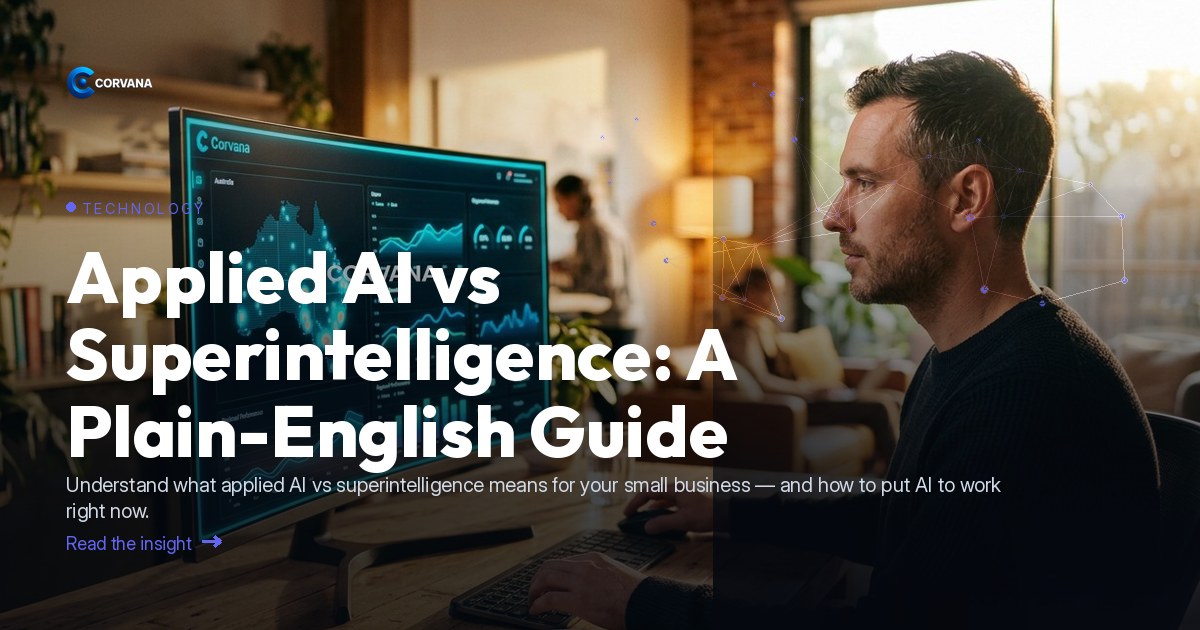
Applied AI vs Superintelligence: A Plain-English Guide for Small Business Operators
The conversation around applied AI vs superintelligence for small business has never been louder — or more confusing. For most Australian operators, the noise around futuristic AI obscures a far more immediate question: which AI is actually useful to me *today*, and how do I start using it without needing a data science team?
This guide cuts through the hype and gives you a grounded, practical picture of where AI genuinely sits right now, and what it can do for your business this week.
---
Applied AI vs Superintelligence for Small Business: What's the Real Difference?
Applied AI is software that uses machine learning and data analysis to do specific, useful jobs — forecasting your cash flow, flagging a margin leak, or predicting which customers are about to churn. Superintelligence refers to a hypothetical future system that surpasses all human cognitive ability across every domain; it does not exist today and remains firmly in the realm of research and speculation. For small business operators in 2026, applied AI is the only kind that matters — because it is already working inside the tools you use every day.
Superintelligence captures headlines because it raises genuinely big philosophical and societal questions. But as [Gartner](https://www.gartner.com) consistently notes, enterprise AI adoption is driven by narrow, task-specific models that deliver measurable returns — not by general-purpose systems that can do everything. The practical gap between the two is enormous, and small businesses should orient their decisions entirely around the applied category.
---
What Applied AI Is Actually Doing in Technology Businesses Right Now
Technology businesses — from SaaS operators and IT service providers to digital agencies and software resellers — are already seeing applied AI reshape daily operations in concrete ways:
- Automated reporting that previously took a half-day to compile now runs in seconds, pulling live data from accounting, CRM and project management systems into a single dashboard.
- Demand and revenue forecasting that surfaces seasonal patterns, renewal risk and pipeline gaps weeks before they become problems.
- Customer churn prediction that identifies which accounts are going quiet, so account managers can intervene before a renewal conversation becomes a cancellation.
- Compliance monitoring that watches for anomalies in billing, leave accruals or data handling obligations — particularly relevant given guidance from the [Office of the Australian Information Commissioner (OAIC)](https://www.oaic.gov.au) around responsible data use and privacy obligations.
- Benchmarking against industry peers using publicly available datasets, helping operators understand whether their margins, headcount ratios and growth rates are tracking well relative to comparable businesses.
The [CSIRO](https://www.csiro.au) has identified applied AI as one of the most significant drivers of productivity improvement available to Australian businesses — not in the abstract, but through concrete automation of knowledge work. Technology businesses, which are often data-rich but time-poor, are particularly well-placed to benefit.
---
Three Outcomes That Should Drive Your AI Strategy
1. Free Up Staff Time by Automating Manual Reporting
In a technology business, skilled staff are expensive and their time is finite. Every hour a project manager, account executive or operations lead spends compiling reports manually is an hour not spent on clients, strategy or growth. Applied AI automates the collection, synthesis and presentation of operational data — so your team gets a clear weekly picture without lifting a finger to build it.
2. Reduce Weaknesses by Catching Problems Early
The most valuable thing applied AI does for technology operators is act as an early-warning system. Margin compression on a service line, a client account going cold, a payroll anomaly, a cash-flow dip three weeks out — these are all detectable patterns in your existing data. Applied AI surfaces them before they become crises, giving you time to act rather than react.
3. Capitalise on Your Strengths
Not every service line, team member or client segment performs equally. Applied AI helps you identify which ones are genuinely driving value — which clients have the highest lifetime value, which services carry the healthiest margins, which team configurations produce the best delivery outcomes — so you can deliberately do more of what's working.
---
How Corvana Applies AI to Technology Businesses
Corvana is an Australian AI business-intelligence platform built specifically for SME operators. For technology businesses, it connects your existing tools — accounting platforms like Xero, MYOB or QuickBooks; CRM and marketing systems like HubSpot, Salesforce, ActiveCampaign or Mailchimp; and analytics tools like Google Analytics — into a single real-time intelligence layer.
From that unified data picture, Corvana delivers:
- Live dashboards showing revenue, margin, cash position and client activity in one view — no manual consolidation required.
- AI-driven cash-flow and demand forecasting so you can see pressure points before they arrive.
- Customer lifetime value scoring and churn early-warning — critical for subscription and retainer-based technology businesses where retention drives everything.
- Automated weekly reporting that lands in your inbox without anyone having to build it.
- Benchmarking against ATO/ANZSIC industry data so you know how your margins and growth stack up against comparable technology businesses.
- Industry-specific staff roles and permissions, so the right people see the right data without exposing sensitive financials to the whole team.
For technology businesses using Stripe for billing, Notion or Airtable for operations, or Google Sheets for ad-hoc analysis, Corvana brings all of that into one coherent view — replacing the fragmented dashboard problem that most growing tech teams know well.
---
Frequently Asked Questions
Is my small business too small to benefit from applied AI?
Most Australian SMEs are already generating enough operational data to benefit from applied AI — they simply lack the tools to make sense of it quickly. If your business uses accounting software, a CRM or any digital payment system, applied AI can synthesise that data into actionable intelligence. You do not need a data team or a large budget; you need the right platform connecting your existing tools.
Should I be worried that superintelligence will disrupt my business?
Superintelligence is not a near-term business planning concern. What *is* worth planning for is the continued rapid advancement of applied AI — tools that automate specific tasks, improve forecasting accuracy and surface insights faster than any manual process. The businesses that will feel disruption are those that ignore applied AI entirely, not those that embrace it thoughtfully and incrementally.
How is applied AI different from the automation I already use?
Traditional automation follows fixed rules — if X happens, do Y. Applied AI learns from patterns in your data and improves over time, making predictions and surfacing anomalies that rule-based systems would miss entirely. The difference in practice is that applied AI can tell you *why* your revenue dipped last month, *which* clients are most likely to churn next quarter, and *what* your cash position will look like in six weeks — none of which a simple automation workflow can do.
---
See how Corvana brings applied AI together in one practical platform built for Australian technology businesses.