AI Is Changing How Australian SMEs Make Decisions
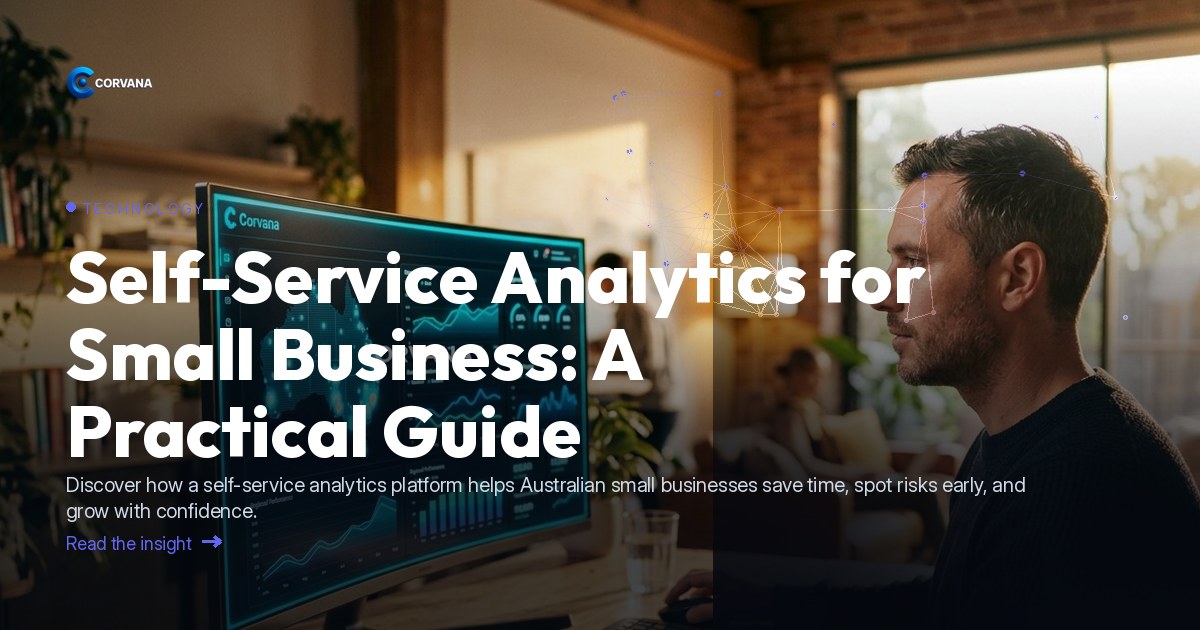
Self-service analytics has moved from a boardroom luxury to a practical necessity for Australian technology businesses of every size. AI is the reason why. What once required a dedicated data team — building queries, maintaining dashboards, interpreting trends — can now happen automatically, in real time, without a single line of code.
For Australian SMEs operating in technology services, SaaS, IT consulting, or digital product businesses, the shift matters enormously. Margins in tech-adjacent services are often tight, client retention is hard-won, and cash-flow timing rarely matches invoicing schedules. Decisions that used to take days of spreadsheet work now need to happen in hours. The businesses keeping pace are the ones that have replaced manual reporting with AI-driven intelligence — not because they hired a data science team, but because they stopped needing one.
[Gartner](https://www.gartner.com) has consistently noted that self-service analytics adoption is accelerating among mid-market organisations precisely because modern platforms now handle the complexity that previously required specialist skills. For Australian SMEs, that trend is arriving fast.
---
What Self-Service Analytics Actually Means for a Technology Business
Self-service analytics means your team can ask questions of your business data — revenue by client, utilisation by team member, cash-flow forecast for next quarter — and get clear, reliable answers without waiting on a developer or analyst.
For a technology business, the data sources are typically scattered: accounting in Xero or MYOB, time-tracking in a separate tool, CRM activity in HubSpot or Salesforce, payroll in Employment Hero or Deputy. Making sense of all of it together has historically required someone who could bridge those systems. No-code analytics platforms eliminate that dependency by connecting the sources automatically and surfacing insights in plain language.
---
Three Outcomes That Matter: Staff Time, Weaknesses, and Strengths
1. Freeing Up Staff Time
Manual reporting in a technology SME is a quiet but significant drain. Account managers compile utilisation reports. Operations staff reconcile invoices against timesheets. Practice leads build weekly dashboards from exported spreadsheets. In aggregate, this can consume a meaningful portion of a senior team member's week — time that would be far better spent on client delivery or business development.
Business intelligence without a data team means automated weekly reporting that pulls from Xero, Deputy, HubSpot and your other connected tools simultaneously. The report arrives; the manual assembly does not. Staff redirect their attention to the work that actually moves the business.
2. Catching Weaknesses Early
Technology businesses carry several specific risks that benefit from early-warning detection:
- Margin erosion on time-and-materials projects — where scope creep quietly shrinks profitability before invoicing
- Client churn signals — reduced engagement, slower response times, declining usage patterns
- Cash-flow gaps — particularly when project milestones and payment terms don't align
- Compliance exposure — award classification errors in rostering, or superannuation timing issues
AI-driven monitoring watches these indicators continuously. Rather than discovering a margin problem at month end, you receive an alert when the pattern emerges mid-project. The [Productivity Commission](https://www.pc.gov.au) has highlighted that early identification of business risk is a material driver of SME resilience — and that it remains underutilised among smaller operators.
3. Capitalising on Your Strengths
Every technology SME has hidden winners: the service line with the best gross margin, the client segment that renews at the highest rate, the team members whose utilisation and client satisfaction scores consistently outperform. Self-service analytics makes those patterns visible so you can deliberately amplify them.
Benchmarking your revenue mix, project margin and staff utilisation against ANZSIC industry data adds an external reference point — helping you understand not just what's performing well internally, but where you genuinely stand out in your market.
---
How Corvana Applies AI to This
Corvana connects the tools technology businesses already use — Xero, MYOB, or QuickBooks for accounting; HubSpot, Salesforce, or ActiveCampaign for client management; Deputy, Tanda, or Employment Hero for rostering and payroll; and Google Analytics, Stripe and Airtable for supporting data streams — into a single, unified picture.
From that unified data, Corvana's AI delivers:
- Live dashboards showing revenue, margin, utilisation and cash position without anyone building a query
- AI-driven cash-flow forecasting that accounts for invoicing patterns, upcoming payroll and project pipeline
- Client lifetime value tracking and churn early-warning — particularly valuable for retainer-based or subscription technology businesses
- Automated weekly reporting that replaces manual spreadsheet compilation
- Benchmarking against ATO and ANZSIC industry data so you know how your margins and growth compare to sector peers
- Role-specific permissions so account managers see their portfolio data, practice leads see their team's utilisation, and owners see everything — without IT involvement
The platform is designed for operators, not analysts. There is no SQL, no data modelling, and no onboarding requirement for technical staff. A founder or operations manager can be reading meaningful intelligence within days of connecting their existing tools.
Privacy and data governance matter too. The [Office of the Australian Information Commissioner (OAIC)](https://www.oaic.gov.au) sets clear expectations for how Australian businesses handle business and customer data — and Corvana is built to support compliant data practices from the outset.
---
Frequently Asked Questions
Do I need technical staff to set up and use self-service analytics?
No. No-code analytics platforms like Corvana are specifically designed so that non-technical operators — founders, operations managers, practice leads — can connect their existing tools, read dashboards and act on insights without developer involvement. Setup typically involves authorising integrations with your existing software, not building anything from scratch.
How is this different from just using the reports inside Xero or HubSpot?
Native reports inside individual platforms only show you data from that platform. Self-service analytics unifies data across all your tools simultaneously — so you can see, for example, how payroll costs in Deputy relate to project revenue in Xero and client engagement trends in HubSpot, all in one view. That cross-system picture is where the most actionable insights live.
Is self-service analytics cost-effective for a small technology business?
For most SMEs, the return comes quickly. When automated reporting replaces several hours of manual work per week across a small team, the time recovered often exceeds the platform cost within the first month. The additional benefit of catching margin leaks or client churn earlier — before they become material losses — adds further value that is harder to quantify but consistently significant.
---
See how Corvana brings all of this together for Australian technology businesses — without the need for a data team.