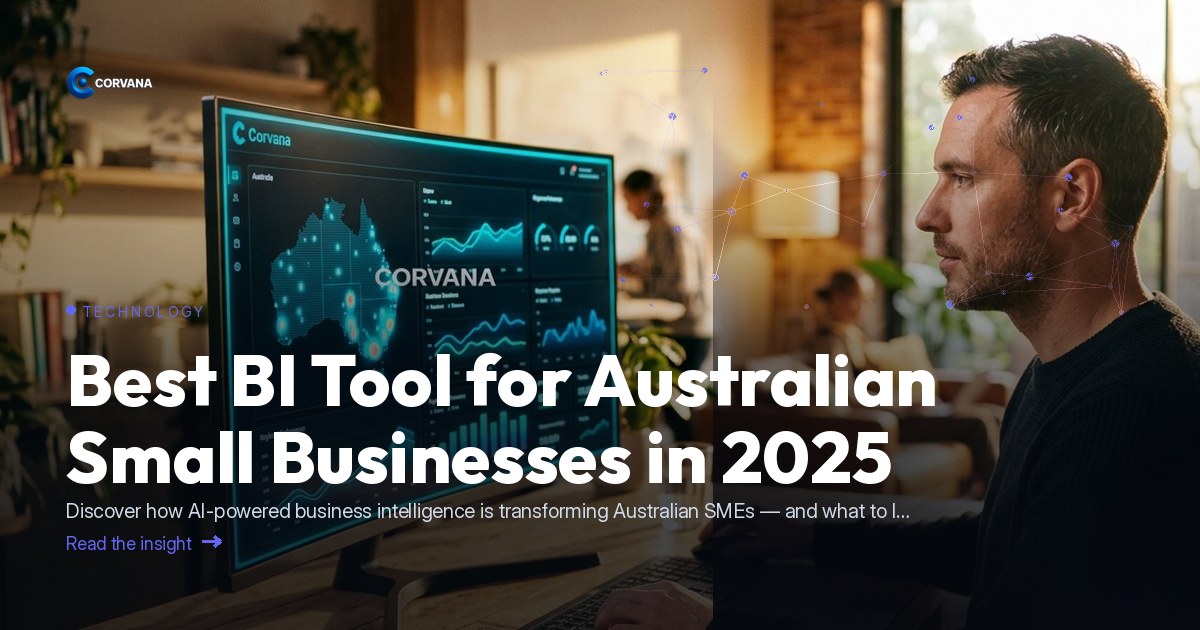
What Is the Best BI Tool for Australian Small Businesses?
If you've searched for the best BI tool in Australia recently, you've probably noticed the landscape has changed significantly. Business intelligence — once the exclusive domain of enterprise IT teams with dedicated analysts — is now genuinely accessible to small and medium businesses, thanks to AI. And for Australian SME operators, the timing matters: data is no longer a luxury input, it's a competitive necessity.
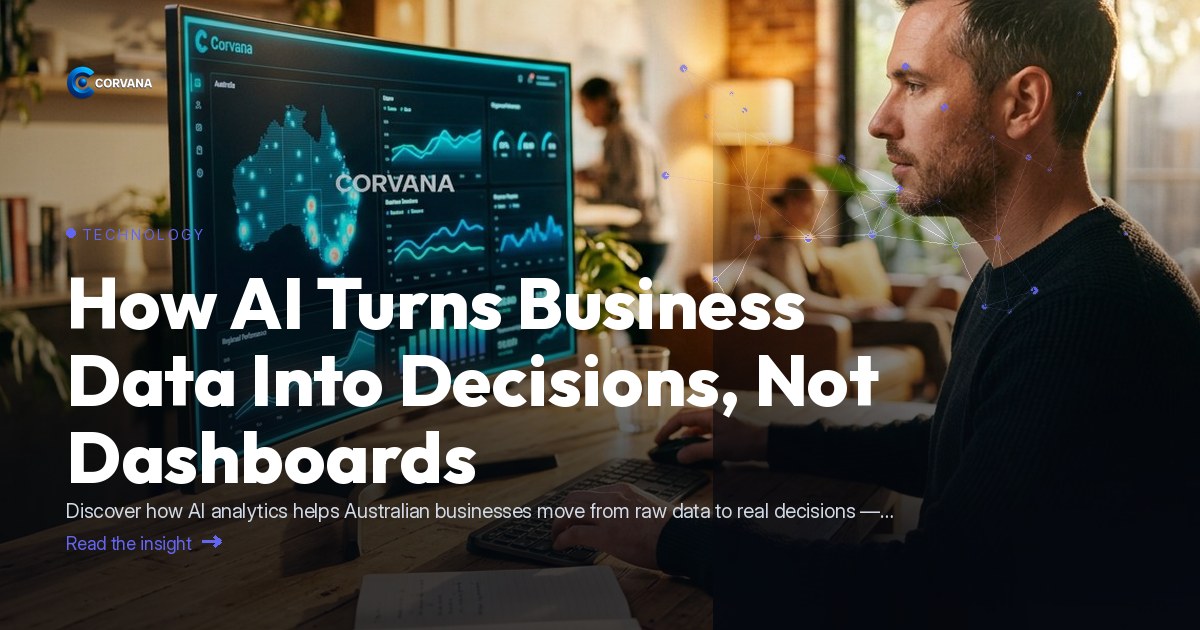
The shift isn't just about software becoming cheaper or easier to use. AI has fundamentally changed what BI software can *do* for a small business. Rather than simply presenting historical data in charts, modern AI-powered platforms interpret that data, surface what matters most, flag problems before they compound, and tell you where your strongest opportunities already exist. That's a different category of tool entirely.
Why Australian SMEs Are Rethinking Business Intelligence
The [Australian Small Business and Family Enterprise Ombudsman](https://www.asbfeo.gov.au) has consistently highlighted that time, resources and cash flow are the primary constraints facing small business operators. Most SME owners don't lack data — their POS, accounting software, payroll platform and CRM are all generating it constantly. What they lack is a way to connect it and act on it without spending hours in spreadsheets.
Traditional BI tools were built for analysts. They required someone to build reports, write queries and interpret results. AI-native platforms flip this model: the intelligence comes to you, automatically, in plain language.
For Australian operators, this matters across every sector — whether you're running a multi-site retail operation, a professional services firm, a busy hospitality venue or a growing trades business.
Outcome 1: Freeing Up Staff Time With Automated Reporting
One of the clearest wins AI delivers in business intelligence is the elimination of manual reporting. In a typical SME, someone — often the owner or a senior manager — spends meaningful time each week pulling together numbers from different systems: revenue from the POS, wages from payroll, invoices from accounting.
The right BI platform automates this entirely. Automated weekly reports land in your inbox without anyone building them. Live dashboards update in real time as transactions happen. And rather than wading through every metric, AI surfaces the ones that actually need your attention.
For staff, this means less time on administrative reconciliation and more time on customer-facing or revenue-generating work. For owners, it means fewer late nights in spreadsheets and faster, more confident decision-making.
Outcome 2: Reducing Business Weaknesses — Catching Problems Early
Early warning is where AI-powered BI genuinely earns its keep. The kinds of problems that damage small businesses — margin erosion, rising staff costs relative to revenue, a slump in a key customer segment — rarely announce themselves all at once. They develop gradually, and by the time they're obvious, they're expensive to fix.
A strong small business intelligence platform watches these trends continuously and alerts you when something shifts. Key areas to look for include:
- Cash flow forecasting that projects your position weeks ahead, not just reports last month's balance
- Churn early-warning that flags customers or accounts at risk of lapsing before they're gone
- Margin monitoring that connects your sales data with cost of goods and labour in real time
- Compliance monitoring for payroll and award obligations — particularly important given the [Fair Work Ombudsman's](https://www.fairwork.gov.au) ongoing focus on wage compliance for SMEs
- Benchmarking against industry data so you know whether your numbers are strong or lagging for your category
This kind of continuous monitoring is what separates reactive management from genuinely informed operations.
Outcome 3: Capitalising on Your Strengths
Just as important as finding problems is knowing what's already working — and doing more of it. AI-powered BI helps operators identify the products, locations, customer segments and team members that are genuinely driving performance.
For a retail operator, that might mean understanding which product categories carry the strongest margin and which store locations are outperforming. For a professional services firm, it might mean identifying the client segments with the highest lifetime value and lowest churn. For a hospitality business, it could be pinpointing the service periods and menu items that generate the best returns.
The [Australian Bureau of Statistics](https://www.abs.gov.au) tracks business counts and industry activity across ANZSIC categories — and the gap between high-performing and average SMEs in the same sector is consistently meaningful. The operators who close that gap fastest are typically those who know their own numbers well enough to double down on what's working.
How Corvana Applies AI to This
Corvana is built specifically for Australian SME operators — not adapted from an enterprise tool, but designed from the ground up for businesses where the owner is often also the decision-maker, and where time is the scarcest resource.
The platform connects your existing tools directly: accounting via Xero, MYOB or QuickBooks; point of sale through Square, Lightspeed, Shopify or Kounta; rostering and payroll via Deputy, Tanda or Employment Hero; and CRM and marketing through HubSpot, Salesforce, Mailchimp or ActiveCampaign. For businesses already using Google Analytics, Stripe or Google Sheets, those connect too.
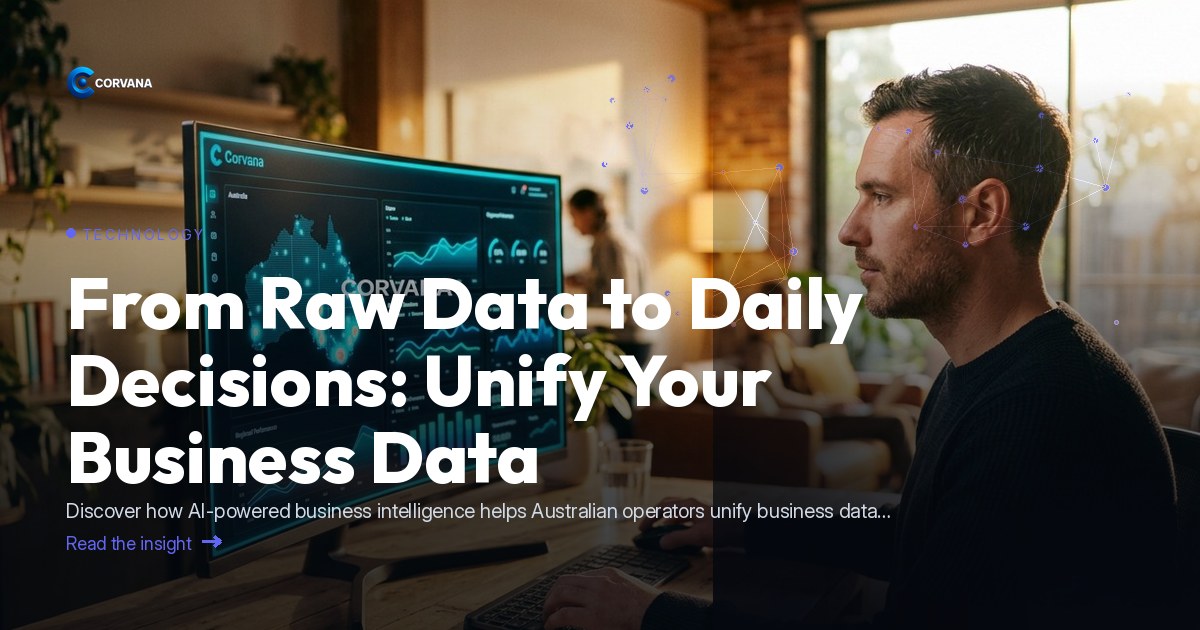
Once connected, Corvana creates a single, live picture of your business — no manual exports, no reconciliation. From there, AI handles the heavy lifting:
- Automated weekly reports delivered without anyone building them
- AI-driven forecasting for cash flow, demand and staffing needs
- Customer lifetime value tracking and churn early-warning across your CRM and transactional data
- Compliance monitoring tied to your payroll data and award obligations
- Benchmarking against ATO and ANZSIC industry data so you always know where you stand relative to your sector
- Industry-specific roles and permissions so your team sees what's relevant to their function — not everything at once
For technology businesses and operators with digital revenue streams, the integration with Stripe, Google Analytics, WordPress and Squarespace means Corvana can track subscription health, traffic-to-conversion rates and digital revenue alongside your core financials — giving you a complete operating picture rather than a fragmented one.
Frequently Asked Questions
Do I need a dedicated analyst or technical staff to use BI software as a small business?
No — and this is one of the most important things to understand about modern AI-powered BI platforms. Corvana is built so that operators, not analysts, are the primary users. The platform surfaces insights in plain language, automates reporting and flags issues without requiring anyone to write queries or build dashboards from scratch.
How is AI-powered BI different from the reporting my accounting software already provides?
Your accounting software shows you what happened financially — invoices, expenses, profit and loss. An AI BI platform like Corvana connects that financial data with your sales, staffing, customer and operational data to show you *why* it happened, *what's likely to happen next*, and *where your biggest opportunities and risks are*. It's a different level of intelligence entirely.
Is my data safe if I connect multiple platforms to a BI tool?
Data security is a legitimate and important concern. Look for platforms that use encrypted data transfer, role-based access controls, and comply with Australian Privacy Act obligations. Corvana's industry-specific permissions model ensures each staff role only accesses the data relevant to their function, reducing internal exposure as well as external risk.
---
If you'd like to see how Corvana brings all of this together for your business, we'd be glad to show you.