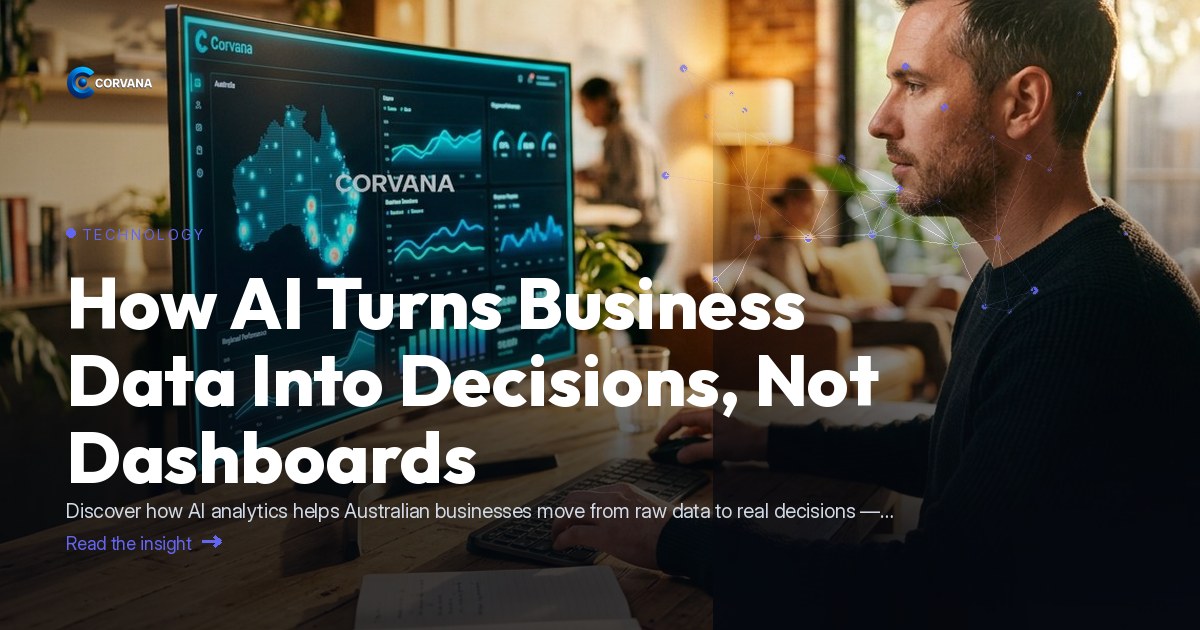
AI Analytics Is Changing How Australian Businesses Actually Use Their Data
For most businesses, data has never been the problem. The problem is what happens after it arrives. Sales figures land in one system, payroll sits in another, and customer records live somewhere else entirely. AI analytics is changing this — not by producing more reports, but by connecting the dots automatically and surfacing what genuinely needs attention.
This shift matters enormously for Australian operators right now. The [Productivity Commission](https://www.pc.gov.au) has consistently highlighted that productivity gains in the services sector depend on businesses being able to make better decisions faster. AI business intelligence is one of the most practical levers available to do exactly that — without hiring a data team.
From Raw Data to Real Decisions
The core promise of AI in business intelligence is straightforward: instead of logging into four different platforms and building a spreadsheet to understand last week's performance, an AI-driven system does that work continuously, flags what matters, and presents it in plain language.
The result is a genuine shift from reactive to proactive management. You stop finding out about a margin problem three weeks after it started. You stop guessing whether you're overstaffed on a Tuesday afternoon. You start making decisions based on what's actually happening — not what you remember or what the most recent gut feeling suggests.
This is not a capability reserved for enterprise businesses with dedicated analysts. It's increasingly accessible to Australian SMEs across every sector.
Outcome 1: Freeing Up Staff Time
Manual reporting is one of the most quietly expensive habits in any business. When an owner or manager spends hours each week pulling together data from accounting software, a POS system, and a payroll platform, that time has a real cost — and a real opportunity cost.
AI analytics automates this entirely. Weekly performance summaries, cash-flow snapshots, and staff productivity overviews can be generated and delivered without anyone lifting a finger. That frees your team to focus on the work that actually requires human judgement: customer relationships, operational decisions, and growth planning.
Automated reporting also reduces the risk of errors that creep in when data is manually compiled and reformatted across multiple sources.
Outcome 2: Catching Problems Before They Become Costly
Early warning is where AI business intelligence earns its keep most clearly. The systems that deliver the most value are those that detect emerging issues — not just describe historical ones.
Some of the most common early warnings that AI analytics can surface for Australian businesses include:
- Cash-flow risk: Forecasting shortfalls days or weeks before they hit, giving you time to act
- Margin compression: Identifying which products, services, or locations are quietly losing ground
- Compliance gaps: Monitoring award rates and rostering patterns against [Fair Work Ombudsman](https://www.fairwork.gov.au) requirements before they become underpayment issues
- Customer churn signals: Detecting when previously active customers or clients begin disengaging, well before they leave
- Staffing misalignment: Flagging when rostered hours consistently don't match actual demand
Each of these is the kind of problem that looks obvious in hindsight but is easy to miss when you're running a business day to day.
Outcome 3: Capitalising on What's Already Working
AI business intelligence isn't only about problems. It's equally valuable for identifying your genuine strengths — the products with the best margins, the customer segments with the highest lifetime value, the team members who drive the most revenue, the locations or days that consistently outperform.
Once you can see these patterns clearly, you can make deliberate decisions to lean into them: allocate marketing spend toward your highest-value segments, schedule your strongest staff during your highest-traffic periods, replicate what's working in one location across others.
This is the part of data-driven decision-making that often gets overlooked when businesses are focused on fixing problems. Knowing what's working is just as strategically important as knowing what isn't.
How Corvana Applies AI to This
Corvana is built specifically to deliver these three outcomes for Australian SMEs. It unifies data from your existing tools — rather than requiring you to replace them — and applies AI to make that combined data genuinely useful.
On the accounting side, Corvana integrates with Xero, MYOB, and QuickBooks to pull live financial data and generate AI-driven cash-flow forecasting. For sales and transaction data, it connects with Square, Lightspeed, Kounta, Shopify, and Tyro. Rostering and payroll data flows in from Deputy, Tanda, and Employment Hero, enabling staffing cost analysis against actual revenue performance. Customer and marketing data from HubSpot, Salesforce, Mailchimp, ActiveCampaign, and Meta Business Suite feeds into customer lifetime value modelling and churn early-warning alerts.
Rather than presenting all of this as a wall of charts, Corvana surfaces automated weekly reports and prioritised alerts — so operators see only what requires attention, not everything that was measured. Benchmarking against [ABS](https://www.abs.gov.au) and ANZSIC industry data gives additional context: you can see not just how your business is performing, but how it compares to similar businesses in your sector.
Industry-specific staff roles and permissions mean the right people see the right information — without exposing sensitive financial data to team members who don't need it.
Frequently Asked Questions
Isn't AI analytics only relevant for large businesses with complex data needs?
Not at all. AI business intelligence is particularly valuable for small and medium businesses precisely because those operators typically don't have a dedicated analyst on staff. Automating the data-gathering and pattern-recognition work means a single owner-operator or small management team can make decisions that would otherwise require significant additional headcount.
How is AI analytics different from the reporting I already get from my accounting software or POS?
Your accounting software and POS each report on their own data in isolation. AI analytics connects multiple data sources — sales, payroll, customer behaviour, cash flow — and identifies patterns and risks that only become visible when those sources are combined. It also applies forecasting and anomaly detection rather than simply describing what has already happened.
How long does it take to get useful insights after connecting my systems?
Most businesses begin seeing meaningful outputs within the first week of connecting their core platforms. The AI improves its forecasting accuracy over time as it builds a longer history of your specific business patterns, but early alerts and reporting begin almost immediately once the integrations are live.
---
If you'd like to see how Corvana brings your business data together into decisions you can actually act on, we'd love to show you around.