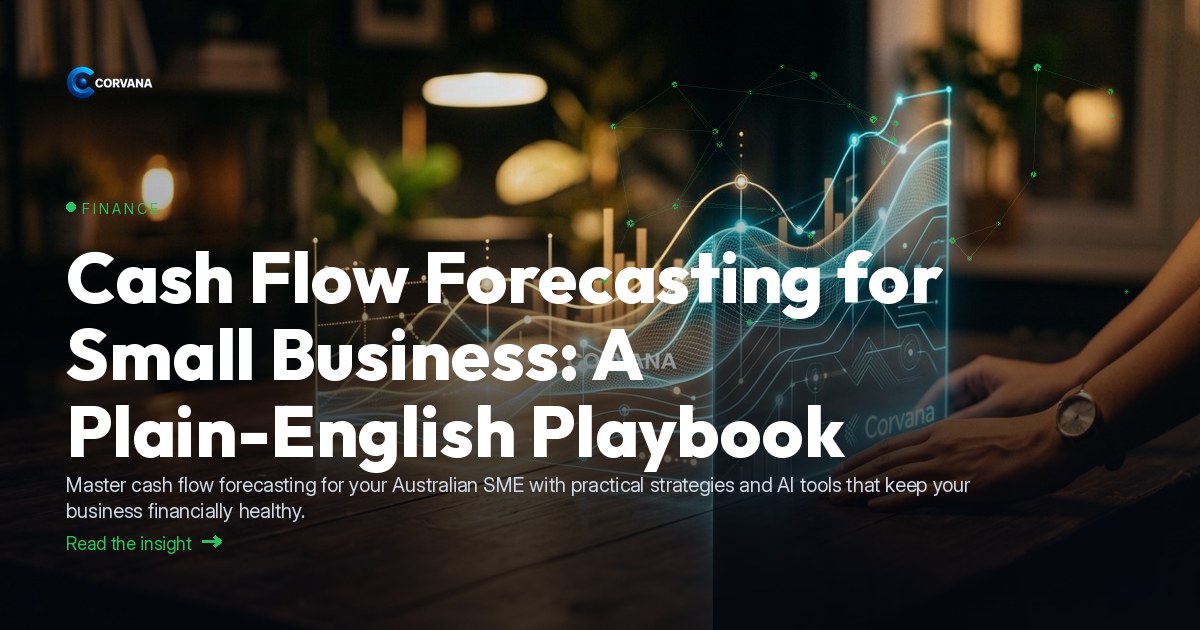
Cash Flow Forecasting for Small Business: A Plain-English Playbook
AI is quietly reshaping the way Australian small businesses manage their money — and cash flow forecasting is where the shift is most visible. Where owners once relied on gut feel, end-of-month spreadsheets or a quarterly conversation with their accountant, AI-powered tools now surface cash position changes in real time, flag risk weeks before it becomes a crisis, and free up hours that used to disappear into manual reconciliation. For SME operators, that is not a marginal improvement — it is a fundamentally different way of running a business.
What Cash Flow Forecasting Actually Means
At its simplest, a cash flow forecast tells you how much money you expect to have in the bank on any given future date, based on what is coming in and what is going out. It is distinct from profit: a business can be profitable on paper and still run out of cash if the timing of inflows and outflows is misaligned. [ASIC](https://asic.gov.au) identifies poor cash flow management as one of the most common contributors to small business insolvency in Australia — which underlines why forecasting matters far more than most operators realise until it is too late.
A useful forecast typically covers:
- Operating cash flows — revenue collected, wages, rent, supplier payments
- Investing cash flows — equipment purchases, fit-out costs, asset disposals
- Financing cash flows — loan drawdowns, repayments, owner drawings
Done well, it answers the questions that keep business owners up at night: Can I make payroll this Friday? Can I afford that new hire next quarter? What happens to my cash if my biggest client pays 30 days late?
Why SME Cash Flow Management Is Genuinely Hard
The [Reserve Bank of Australia](https://www.rba.gov.au) has consistently noted that smaller businesses carry higher financial vulnerability than larger firms — partly because they have thinner cash buffers, and partly because their revenue is often lumpy and seasonal. Add in the reality that many SME owners are juggling operations, sales and finance simultaneously, and it becomes clear why cash planning is so frequently reactive rather than proactive.
Common pain points include:
- Revenue recognised in the accounting system before cash is actually collected
- GST and BAS obligations creating predictable but easy-to-forget cash demands
- Payroll timing that does not align neatly with revenue cycles
- Overtrading — growing quickly but running out of working capital to fund that growth
Manual spreadsheet forecasting addresses some of this, but it is fragile: one formula error, one missed invoice update or one forgotten creditor payment and the whole picture is unreliable.
Three Operator Outcomes That Good Forecasting Delivers
1. Freeing Up Staff Time
Finance administration — chasing invoices, reconciling accounts, building weekly cash reports — consumes disproportionate time in most SME back offices. AI-driven cash flow forecast software automates the data ingestion from your accounting system, POS and payroll platform, and produces a rolling forecast without anyone having to touch a spreadsheet. Your bookkeeper or finance manager shifts from data entry to decision support.
2. Reducing Weaknesses: Early Warnings That Matter
The real power of AI forecasting is not the forecast itself — it is the early warning when the forecast deteriorates. If debtor days are creeping up, if a large creditor payment is about to coincide with a slow trading week, or if a wage bill is running ahead of revenue projections, an intelligent system surfaces that signal now, not at month end. This is where [ASIC MoneySmart](https://moneysmart.gov.au) guidance on maintaining a cash buffer becomes actionable: you can see exactly how many weeks of runway you have at any point in time.
3. Capitalising on Strengths
Cash flow forecasting is not only defensive. When you can see clearly that a particular product line, service or customer segment reliably generates fast-paying, high-margin revenue, you can lean into it — prioritising marketing spend, inventory and staff capacity toward what is already working. Benchmarking your cash conversion cycle against industry peers adds another dimension: if your sector typically collects in 21 days and you are collecting in 35, there is a concrete improvement opportunity sitting right there.
How Corvana Applies AI to This
Corvana connects your accounting data — whether you run Xero, MYOB or QuickBooks — with your POS system (Square, Lightspeed, Shopify, Tyro), rostering and payroll platforms (Deputy, Tanda, Employment Hero) and CRM tools (HubSpot, Salesforce) into a single live data environment. From that unified picture, Corvana's AI engine generates:
- Rolling cash flow forecasts updated continuously as new transactions flow in, with scenario modelling for best, base and stress cases
- Automated weekly reporting delivered to your inbox — no manual builds, no stale numbers
- Early-warning alerts when cash position is projected to fall below a threshold, when debtor ageing is deteriorating, or when labour costs are trending ahead of revenue
- Benchmarking against ATO and ANZSIC industry data so you know whether your margins, payment terms and expense ratios are competitive or need attention
- Customer lifetime value and churn signals from your CRM data — because retaining your best customers is one of the most effective cash flow strategies available
For operators who have historically relied on their accountant to tell them what happened last quarter, Corvana shifts the conversation to what is likely to happen next month — and what to do about it while there is still time to act.
Frequently Asked Questions
What is the difference between a cash flow forecast and a profit and loss statement?
A profit and loss statement shows revenue and expenses over a period, regardless of when cash actually changes hands. A cash flow forecast shows the timing of actual money moving in and out of your bank account. A business can show a healthy profit on its P&L while simultaneously running short of cash — which is why both documents matter and why the forecast is often the more urgent of the two for day-to-day decision-making.
How far ahead should an SME cash flow forecast look?
Most advisors recommend maintaining at least a 13-week (three-month) rolling forecast as a minimum, with a 12-month view for strategic planning purposes. The 13-week window is short enough to be reasonably accurate and long enough to give you time to act on problems — for example, arranging a short-term facility or deferring a discretionary spend before a cash gap opens up.
Does my business need dedicated cash flow forecast software, or can I use a spreadsheet?
Spreadsheets can work for very simple businesses with predictable, low-volume transactions. As soon as your business has multiple revenue streams, staff costs that vary week to week, or more than a handful of creditors, a connected software solution becomes significantly more reliable. The main advantages are automatic data feeds (eliminating manual entry errors), real-time updates, and alert logic that a spreadsheet simply cannot replicate — particularly valuable when you are too busy running the business to check the model daily.
---
If you'd like to see how Corvana brings your accounting, payroll and sales data together into a live cash flow picture, we're happy to walk you through it.