AI Is Changing How Australian Small Businesses Make Decisions
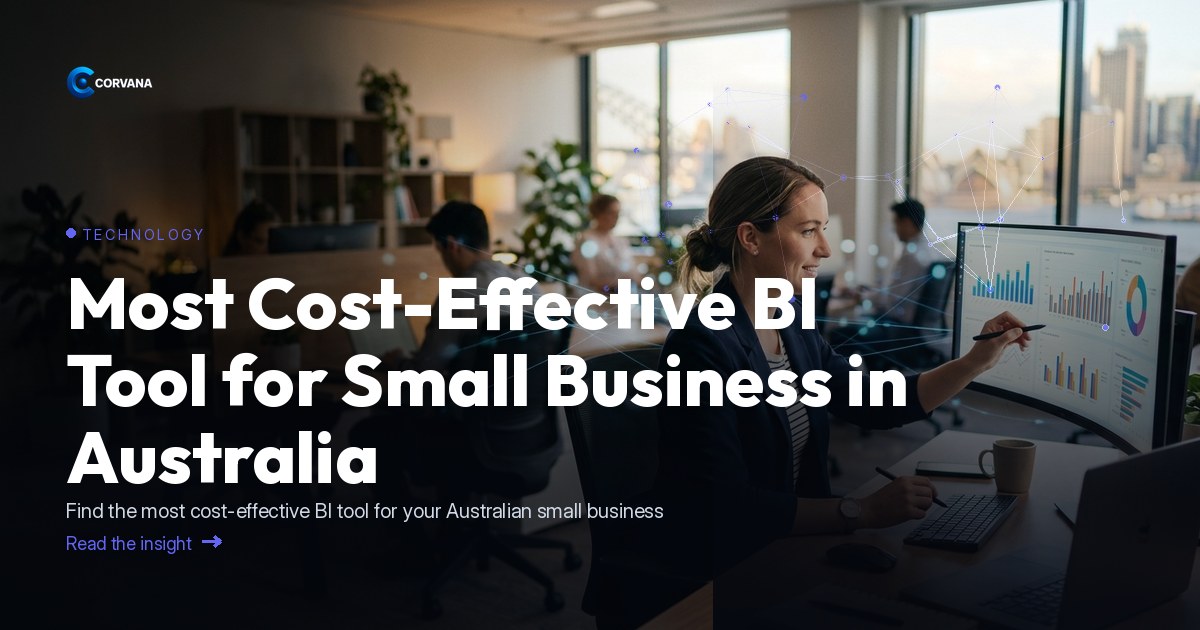
Finding the most cost-effective BI tool for a small business in Australia has never mattered more — because the gap between businesses that use their data and those that don't is widening fast. AI-powered business intelligence is no longer a capability reserved for enterprise companies with dedicated analysts. It's becoming the practical edge that lets a café owner spot a margin leak on a Tuesday morning, or a trades business catch a cash-flow problem before it becomes a crisis.
The shift is real and it's happening now. According to the [Australian Small Business and Family Enterprise Ombudsman](https://www.asbfeo.gov.au), small businesses make up the vast majority of Australian enterprises, yet many still rely on end-of-month spreadsheets or gut instinct to manage performance. AI-driven BI tools change that equation by surfacing the right information at the right time — automatically, without needing a data team behind you.
---
What Is the Most Cost-Effective BI Tool for a Small Business in Australia?
For most Australian small businesses, the most cost-effective BI tool is one that connects your existing software stack — POS, accounting, payroll, CRM — into a single live view, automates the reporting you're already doing manually, and flags problems before they become expensive. Corvana is purpose-built for this: it's an Australian AI business-intelligence platform that unifies your data sources and delivers industry-specific insights, forecasts and early warnings without requiring a dedicated analyst or technical setup.
The key word here is *cost-effective* — not cheapest. A low-cost tool that requires hours of manual configuration, produces generic dashboards, or can't integrate with your existing systems will cost you more in staff time and missed opportunities than a well-designed platform that works from day one.
---
What to Look for in a BI Tool as a Small Business Operator
Before committing to any platform, run it against these criteria:
- Integrations with tools you already use — your accounting package, POS, payroll and CRM should connect without custom development
- Automated reporting — weekly or daily summaries delivered to you, not reports you have to go and pull
- Industry-specific context — benchmarks and KPIs relevant to your sector, not generic metrics designed for enterprise
- AI-driven forecasting — cash flow, demand and staffing predictions that help you plan, not just report on the past
- Early-warning alerts — proactive flags when something is trending the wrong way
- Compliance visibility — award rate monitoring, payroll accuracy, and ATO-relevant summaries
- Appropriate access controls — role-based permissions so staff see what they need, and nothing more
---
Outcome 1: Free Up Staff Time with Automated Reporting
Manual reporting is one of the biggest hidden costs for small businesses. When your bookkeeper, ops manager or you personally are spending hours each week pulling numbers from different systems and assembling them into a spreadsheet, that's time not spent serving customers, training staff or growing revenue.
A genuinely cost-effective BI tool replaces that process. Automated weekly performance summaries, live dashboards that update as transactions occur, and AI-generated commentary mean your team spends time acting on information — not collecting it. The [Productivity Commission](https://www.pc.gov.au) has consistently highlighted the productivity dividend available to Australian businesses through better adoption of digital tools, and BI automation is a direct path to that dividend.
---
Outcome 2: Reduce Business Weaknesses with Early Warnings
The most expensive problems in a small business are the ones you don't see coming. Margin erosion on a product category, a shift in customer retention, payroll errors that create Fair Work exposure, or a cash-flow gap three weeks out — these are all catchable with the right data, and all damaging when missed.
AI-powered BI tools monitor your business continuously and alert you when patterns suggest a problem is developing. That might be a supplier cost increase that's compressing your gross margin, a cohort of customers whose purchase frequency has dropped, or a rostering pattern that's putting you at risk of award non-compliance under the [Fair Work Ombudsman](https://www.fairwork.gov.au) framework. Early-warning systems turn these from crises into manageable adjustments.
---
Outcome 3: Capitalise on What's Already Working
BI isn't only about finding problems. The other half of the value is identifying where your business is already strong — and doing more of it deliberately.
Which product lines carry the healthiest margins? Which customer segments have the highest lifetime value and the lowest churn risk? Which staff members or locations are outperforming, and what can be replicated? AI-driven segmentation and benchmarking surfaces these answers clearly, so you can double down on what's working rather than spreading effort evenly across a business that isn't performing evenly.
---
How Corvana Applies AI to This
Corvana is designed specifically for Australian small and medium businesses. It pulls live data from the tools most Australian operators already run — accounting platforms like Xero, MYOB and QuickBooks; POS systems including Square, Lightspeed, Kounta, Shopify and Tyro; rostering and payroll tools like Deputy, Tanda and Employment Hero; and CRM and marketing platforms including HubSpot, Salesforce, Mailchimp and ActiveCampaign.
Once connected, Corvana builds a unified real-time picture of your business and applies AI to deliver:
- Live dashboards updated as your data changes, with industry-specific KPIs
- AI cash flow, demand and staffing forecasts so you plan with confidence, not guesswork
- Automated weekly reports delivered without you lifting a finger
- Customer lifetime value scoring and churn early-warning so you protect your best customers
- Benchmarking against ATO and ANZSIC industry data so you know how you sit relative to your sector
- Compliance monitoring for payroll, award rates and reporting obligations
- Industry-specific roles and permissions so each team member sees what's relevant to their function
For businesses in healthcare, Corvana also integrates with Cliniko, HotDoc and Best Practice. Fitness and wellness operators connect via Mindbody. Property businesses can link PropertyMe, Property Tree, Domain and REA. Professional services firms integrate with Clio and Karbon. Whatever your industry, the platform is built to speak your language.
The [Australian Bureau of Statistics](https://www.abs.gov.au) tracks the growing role of digital technology adoption across Australian industries — and the businesses moving fastest are those connecting their operational data into a single, intelligent layer rather than managing it system by system.
---
Frequently Asked Questions
Do I need a data analyst or technical team to use a BI tool?
No — and for small businesses, this is one of the most important things to check before choosing a platform. Corvana is built so that business owners and their existing staff can set it up, read the dashboards and act on the insights without any data science background. The platform handles the complexity; you focus on the decisions.
How do I know if a BI tool is genuinely cost-effective, not just cheap?
Calculate the cost against the staff time it saves in manual reporting, the value of problems it catches early, and the revenue upside from acting on customer and product insights. A platform that saves your ops manager five hours a week and catches one margin issue per quarter will deliver multiples of its subscription cost. Price per month is the starting point, not the whole story.
Can a BI tool help with compliance as well as performance?
Yes — and for Australian businesses, this is increasingly important. A good BI platform will monitor your payroll against award rates, flag anomalies in your reporting figures, and give you clean, ATO-aligned financial summaries. Corvana's compliance monitoring is designed with Australian employment and tax obligations in mind, so you're not managing that separately.
---
If you'd like to see how Corvana brings all of this together for your specific business, it's worth taking a closer look at what the platform can do from day one.