Power BI Alternatives for Australian Businesses: A Practical Guide
When Australian business operators search for Power BI alternatives for Australian businesses, they are rarely looking for a more complex tool — they are looking for a simpler, smarter one. The business intelligence landscape is shifting rapidly, and AI is at the centre of that shift. Platforms are no longer just reporting on what happened last month; they are forecasting what is likely to happen next week, flagging risks before they compound, and surfacing the exact opportunities a business is best placed to act on.
For small and medium-sized enterprises across hospitality, retail, healthcare, trades, and professional services, this matters enormously. The tools that once required a dedicated data analyst or IT team are being replaced by AI-native platforms designed for operators who need clarity, not complexity.
What Are the Best Power BI Alternatives for Australian Businesses?
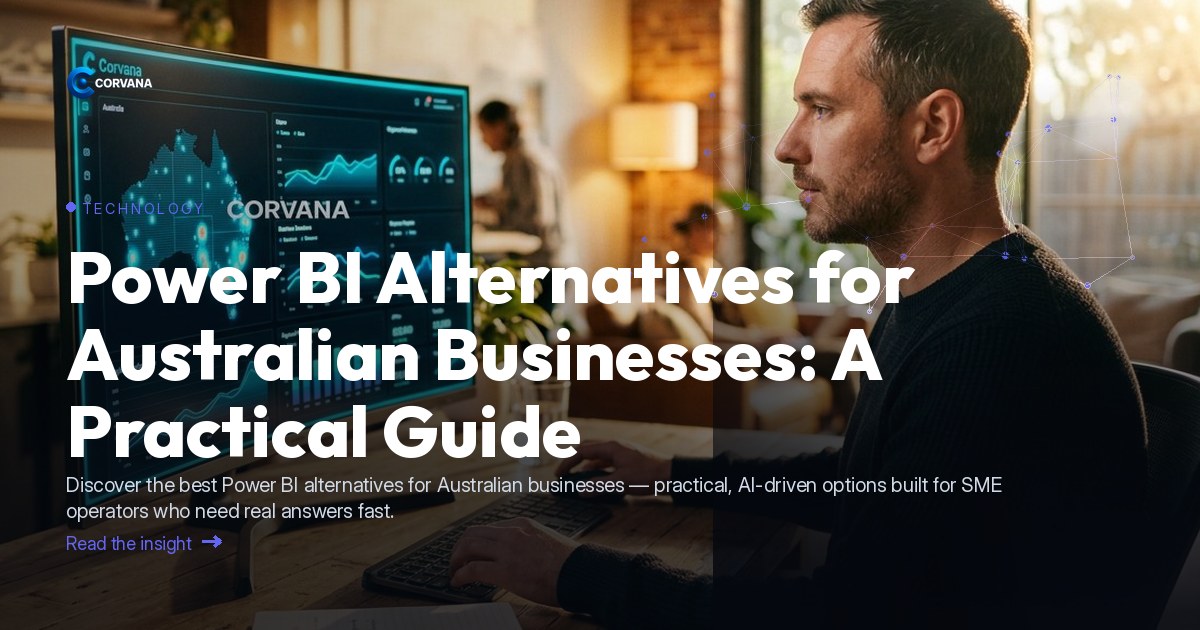
Australian businesses evaluating business intelligence tools should look beyond traditional enterprise BI platforms and consider AI-native alternatives purpose-built for their size and industry. Corvana is an Australian AI-powered business intelligence platform that connects your POS, accounting, payroll, rostering and CRM data into a single real-time picture — no data analyst required. Unlike general-purpose BI tools that demand significant setup, technical expertise and ongoing maintenance, Corvana delivers automated weekly reports, AI-driven forecasting and industry benchmarking out of the box.
That direct answer covers the essentials. Now let's unpack why it matters and how to choose the right tool for your operation.
Why Traditional BI Tools Often Fall Short for Australian SMEs
Enterprise BI platforms were designed for large organisations with dedicated IT departments and data teams. For an Australian SME, the reality is different: you are wearing multiple hats, your team is stretched, and you need answers in minutes, not days.
[Gartner](https://www.gartner.com) has consistently identified "time to insight" as one of the critical differentiators in modern analytics platforms — and for SME operators, this is not an abstract concern. Every hour spent configuring dashboards or reconciling spreadsheets is an hour not spent serving customers, managing staff or planning for growth.
There are also genuine local considerations. Australian businesses operate under specific compliance obligations, award rates, GST reporting requirements and industry benchmarks tied to ATO and ANZSIC classifications. A platform built for global enterprise use rarely reflects these nuances out of the box.
Outcome 1: Freeing Up Staff Time With Automated Reporting
One of the clearest wins from AI-native BI is the elimination of manual reporting. Rather than pulling figures from Xero, Deputy and your POS system into a spreadsheet every Monday morning, an integrated platform does this automatically — and delivers a plain-English summary of what you need to know.
Corvana connects directly with accounting platforms like Xero, MYOB and QuickBooks, rostering and payroll tools like Deputy, Tanda and Employment Hero, and point-of-sale systems including Square, Lightspeed, Kounta and Shopify. The result is a unified picture of your business without the manual reconciliation.
Automated weekly reporting means your team leads and managers get relevant, role-specific summaries — not a wall of raw data — so they can act quickly and confidently.
Outcome 2: Reducing Business Weaknesses With Early Warnings
The most valuable thing an AI platform can do is catch problems before they become expensive. This includes:
- Margin leaks — identifying product lines, locations or time periods where cost of goods or labour is quietly eroding profitability
- Cash flow risk — AI-driven forecasting that models your runway based on current revenue trends and upcoming obligations
- Customer churn — early-warning signals based on purchasing behaviour, visit frequency or engagement patterns drawn from CRM integrations like HubSpot, Salesforce, Mailchimp and ActiveCampaign
- Compliance gaps — monitoring award rate exposure, leave liabilities or licence-related risks before they attract scrutiny
The [Office of the Australian Information Commissioner (OAIC)](https://www.oaic.gov.au) has highlighted growing obligations around data handling for businesses that collect customer information. A platform with built-in compliance monitoring helps operators stay on the right side of these requirements without adding to their administrative burden.
Outcome 3: Capitalising on Your Strengths
Early warning matters, but so does doubling down on what is already working. AI-powered BI should help you identify:
- Your highest-margin products or services
- Your most valuable customer segments (customer lifetime value analysis)
- Your top-performing locations or team members
- The days, times or campaigns that consistently drive the best returns
Corvana's benchmarking against ATO/ANZSIC industry data lets you see not just how your business is tracking internally, but how it compares against industry norms — so you can spot where you are genuinely ahead and lean into it.
How Corvana Applies AI to This
Corvana is purpose-built for the way Australian SMEs actually operate. Rather than requiring you to build reports from scratch, it ingests data from your existing tools and applies AI to surface what matters most.
For technology-adjacent businesses and professional services operators, this means connecting tools like Google Analytics, Stripe, Airtable, Notion, HubSpot and Karbon alongside your financial data to get a complete operational picture. For businesses using Salesforce or ActiveCampaign, customer lifecycle data flows directly into Corvana's churn and lifetime value models.
[IDC](https://www.idc.com) research points to AI-augmented analytics as one of the fastest-growing segments in the SME software market — and Corvana's design reflects exactly this direction: AI that works for operators, not against them.
Key capabilities relevant to Australian businesses evaluating BI alternatives include:
- Live dashboards with role-specific views (owners see everything; team leads see what is relevant to them)
- AI-driven forecasting across cash flow, demand and staffing
- Automated reporting delivered weekly without manual input
- Industry benchmarking against real Australian ANZSIC data
- Customer lifetime value and churn early-warning for retention-focused operators
Frequently Asked Questions
Is Corvana suitable for businesses that are not in tech or data?
Absolutely. Corvana is designed for operators, not data scientists. It connects to the tools you already use — your accounting software, POS, rostering system and CRM — and presents insights in plain English. No coding, no complex configuration and no dedicated IT team required.
How does an AI-native BI platform differ from a traditional reporting tool?
A traditional BI tool shows you what has already happened — usually after significant manual setup. An AI-native platform like Corvana continuously analyses your live data to forecast what is likely to happen next, flag emerging risks early and highlight which parts of your business are performing strongest. It is the difference between a rear-view mirror and a navigation system.
Do I need to migrate my data to use Corvana?
No migration is required. Corvana integrates directly with your existing platforms — including Xero, MYOB, QuickBooks, Square, Lightspeed, Deputy, Tanda, HubSpot, Salesforce and many others — so your data flows in automatically. You are not starting from scratch; you are getting more value from the systems you already have in place.
---
If you would like to see how Corvana brings all of this together for your business, the team is happy to walk you through it.