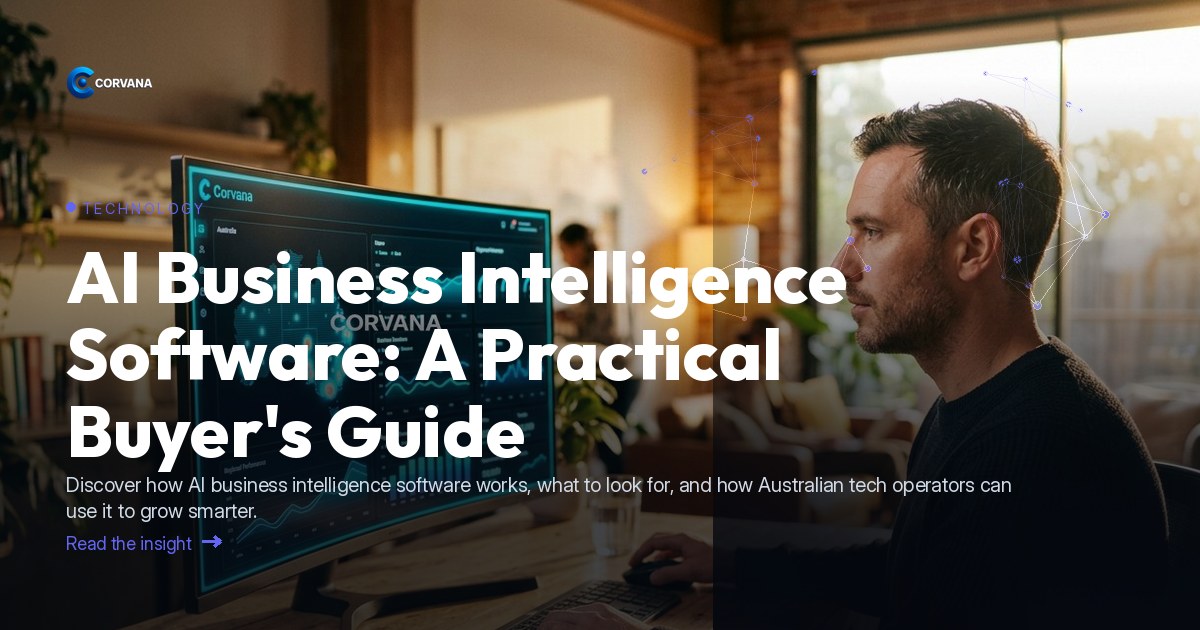
AI Business Intelligence Software: A Practical Buyer's Guide
AI business intelligence software is reshaping how technology businesses operate — not by adding complexity, but by replacing hours of manual reporting with real-time insight that actually drives decisions. For Australian tech operators managing subscriptions, services, projects and fast-moving teams, the gap between those who act on data and those who guess is widening quickly. This guide cuts through the noise so you can choose the right platform with confidence.
---
What Is AI Business Intelligence Software?
AI business intelligence software is a category of platform that connects your core business data sources — accounting, CRM, project management, payroll — and uses artificial intelligence to surface trends, flag risks and recommend actions automatically. Unlike traditional dashboards that simply display what has already happened, modern AI BI tools forecast what is likely to happen next and alert you before problems become costly. For technology businesses specifically, this means visibility across revenue, utilisation, client churn and cash flow in a single, unified view.
---
Why AI Is Changing Business Intelligence for Tech Operators
Technology businesses sit on more data than almost any other sector, yet many operators still rely on spreadsheets, siloed reports and gut feel to make major decisions. That is changing rapidly. [Gartner](https://www.gartner.com) has consistently tracked the acceleration of AI-augmented analytics as a top enterprise priority, and the momentum is flowing down to small and mid-size operators faster than ever.
The drivers are practical:
- Real-time data from cloud-based tools means there is no reason to wait for end-of-month reports.
- AI forecasting can model cash flow, resource demand and client retention with a level of nuance that spreadsheets simply cannot match.
- Automated alerts surface the things that matter — a margin dip on a key account, a support team under-rostered for next week, a client whose engagement has dropped — without requiring someone to go looking.
For tech operators scaling a services or SaaS business, these capabilities are not a luxury. They are increasingly the baseline for running a tight, competitive operation.
---
Three Outcomes That Matter: What to Look for in a Buying Decision
1. Freeing Up Staff Time Through Automated Reporting
Manual reporting is a hidden cost in almost every technology business. When account managers, operations leads or finance staff are assembling weekly numbers from multiple tools, they are not doing the work that actually moves the business forward.
Look for a platform that:
- Generates automated weekly or monthly reports without manual input
- Consolidates data from your accounting, CRM and project tools into one view
- Uses role-based dashboards so each team member sees only what is relevant to their work
The time recovered from automated reporting can be redirected to client delivery, business development or strategic planning — all higher-value activities.
2. Reducing Weaknesses Through Early Warning Intelligence
Technology businesses face a specific set of risks: client churn, project margin erosion, cash flow gaps between invoicing and payment, and compliance obligations around data handling. The [Office of the Australian Information Commissioner (OAIC)](https://www.oaic.gov.au) continues to place growing obligations on businesses that handle personal data, making compliance monitoring a genuine operational concern, not just a legal one.
A strong AI BI platform will proactively flag:
- Clients showing early signs of disengagement or churn
- Projects where actuals are diverging from budgeted margins
- Cash flow shortfalls before they become urgent
- Compliance gaps that need attention
Early warning capability is the difference between managing a problem and being surprised by it.
3. Capitalising on Strengths: Your Best Clients, Services and People
Most technology operators know roughly which clients or services drive the most revenue. Far fewer know which ones drive the most *profitable* revenue, or which team members generate the highest return per hour. AI BI software should make this visible — clearly and quickly.
Seek out platforms that surface:
- Customer lifetime value (CLV) and segmentation by revenue and margin
- Service line performance benchmarked against industry norms
- Team utilisation and output by individual and role
- Geographic or segment trends if you operate across locations or markets
Understanding where your real strengths sit lets you double down on what is working rather than spreading effort evenly across everything.
---
How Corvana Applies AI to Technology Businesses
Corvana is built specifically for Australian operators, and for technology businesses it brings together the tools already in your stack. By connecting accounting platforms like Xero, MYOB or QuickBooks with CRM systems including HubSpot, Salesforce or ActiveCampaign, Corvana creates a single, live picture of business performance — no manual exports required.
On the revenue side, Corvana's AI analyses client engagement data to surface lifetime value scores and churn early-warning signals, giving account teams the lead time to intervene before a client leaves quietly. On the cost side, integration with rostering and payroll tools like Deputy, Tanda or Employment Hero means staffing costs are visible alongside revenue in real time, making utilisation and margin genuinely manageable.
Corvana's benchmarking capability uses [ABS](https://www.abs.gov.au) and ANZSIC industry data to contextualise your numbers — so you can see not just how you are performing, but how you are performing relative to comparable technology businesses across Australia. AI-driven cash flow forecasting, automated weekly reports and industry-specific role permissions round out a platform designed to give technology operators clarity without complexity.
For technology businesses connected to Google Analytics, Stripe, Squarespace or WordPress, Corvana can pull digital performance and payment data into the same view, bridging the gap between marketing activity and financial outcomes.
---
Frequently Asked Questions
What makes AI business intelligence software different from a standard dashboard tool?
Standard dashboard tools display historical data — they show you what happened. AI business intelligence software goes further by identifying patterns, generating forecasts and surfacing anomalies automatically, without you needing to ask. For technology operators, this means problems and opportunities are flagged proactively, not discovered after the fact.
How long does it take to get value from an AI BI platform?
For most small to mid-size technology businesses, a well-integrated AI BI platform begins delivering meaningful insight within the first few weeks, once core data sources are connected. The real compounding value — accurate forecasts, reliable churn signals, margin trend analysis — typically builds over the first two to three months as the AI learns your business patterns.
Is AI business intelligence software suitable for small technology businesses, or just enterprise?
Modern AI BI platforms are increasingly designed for SME operators, not just large enterprises. Cloud-based deployment, subscription pricing and pre-built integrations with tools like Xero, HubSpot and Deputy mean a small technology business can access the same quality of insight that was once reserved for companies with dedicated analytics teams. The key is choosing a platform built for your scale, not one that has been scaled down from an enterprise product.
---
See how Corvana brings all of this together for Australian technology businesses — in one live, connected view that your whole team can actually use.