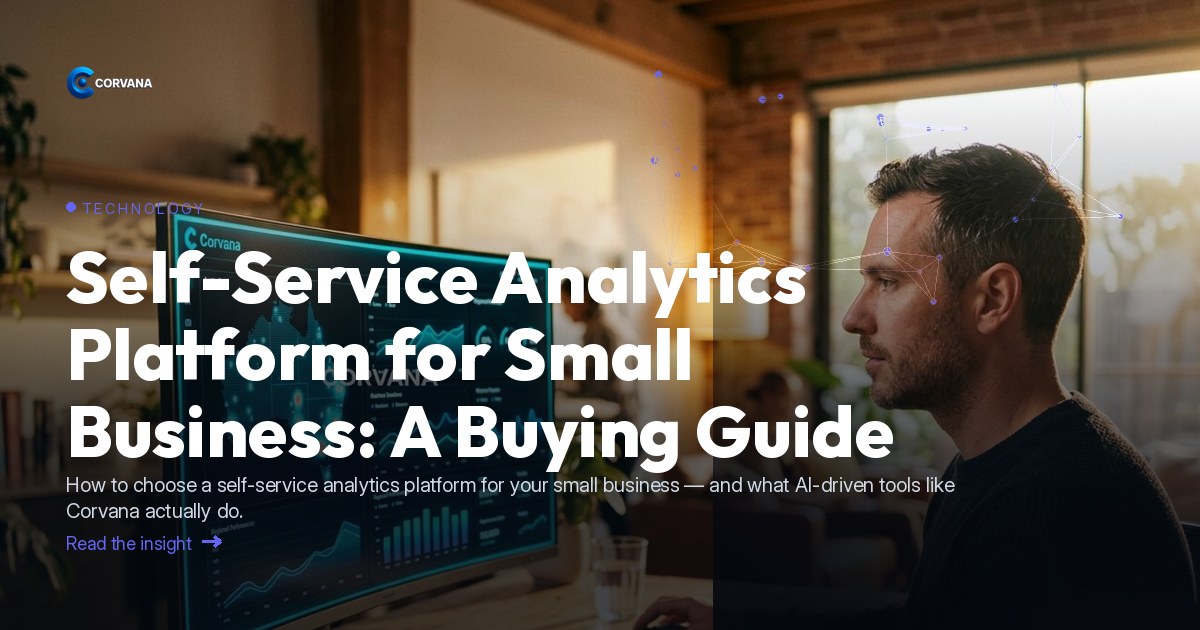
Self-Service Analytics Platform for Small Business: A Practical Buying Guide
AI is quietly rewriting how small businesses make decisions. The self-service analytics platform for small business has shifted from a niche enterprise tool to something any operator with a POS, accounting package and a few staff can realistically use — without needing a data analyst on the payroll. For technology-adjacent businesses in particular, where product cycles move fast and customer expectations are high, the ability to pull live insights from your own data is no longer a nice-to-have.
What Is a Self-Service Analytics Platform for Small Business?
A self-service analytics platform for small business is a software tool that connects your existing data sources — accounting, point of sale, payroll, CRM — and gives non-technical users live dashboards, automated reports and AI-driven alerts without requiring manual spreadsheet work or outside technical help. The best platforms surface only what matters, flag problems before they compound, and highlight where your business is already performing well. For Australian SMEs, the right platform means your team spends less time chasing numbers and more time acting on them.
---
Why AI Has Changed the Game for Small Business Analytics
For years, "business intelligence" meant expensive enterprise software, a dedicated analyst and a lag of days or weeks between data and decisions. [Gartner](https://www.gartner.com) has tracked a clear shift toward augmented analytics — AI and machine learning built directly into the tools ordinary workers use — and that shift has now reached the small business market in a meaningful way.
What this means practically: AI doesn't just report what happened last week. It identifies patterns across your revenue, staffing costs, customer behaviour and cash flow simultaneously, then tells you what to pay attention to. For a small team already stretched across operations, that compression of insight is significant.
The [Productivity Commission](https://www.pc.gov.au) has noted that productivity gains from digital adoption in Australian SMEs remain unevenly distributed — businesses that use data actively tend to pull ahead of those that don't. A well-chosen self-service platform is one of the most accessible entry points to that advantage.
---
The Three Outcomes a Good Platform Should Deliver
1. Free Up Staff Time
Manual reporting — exporting CSVs, building spreadsheets, reconciling numbers across systems — consumes hours that could go toward customers, product or growth. A self-service platform automates the weekly reporting cycle, surfaces anomalies automatically, and delivers a single view across all your connected tools. Staff who previously spent Monday morning on reporting spend it on action instead.
2. Reduce Business Weaknesses Early
The real value of AI in analytics is early warning. Rather than discovering a margin problem at month end, or realising a key customer segment is quietly churning, a platform with AI-driven monitoring catches these signals while you still have time to respond. This applies across:
- Cash flow shortfalls projected weeks ahead
- Unusual drops in revenue from specific products or locations
- Payroll costs creeping above forecast thresholds
- Compliance gaps before they become audit issues
3. Capitalise on Your Strengths
Most businesses underinvest in what's already working. A good platform tells you which products, team members, customer segments or campaigns are outperforming — and gives you the data to double down. If one service tier is delivering outsized margin, or one customer cohort has a consistently high lifetime value, that's where your next investment decision should start.
---
How Corvana Applies AI to This
Corvana is an Australian AI business-intelligence platform built specifically for SMEs. It unifies data from your POS, accounting software, rostering and payroll tools, and CRM into one real-time picture — no manual exports, no stitched-together spreadsheets.
Integration partners relevant to technology and professional services businesses:
- *Accounting:* Xero, MYOB, QuickBooks
- *POS and payments:* Square, Shopify, Stripe, Lightspeed
- *Rostering and payroll:* Deputy, Tanda, Employment Hero
- *CRM and marketing:* HubSpot, Salesforce, Mailchimp, ActiveCampaign, Meta Business Suite
- *Project and workflow:* Google Sheets, Notion, Airtable
- *Web and analytics:* Google Analytics, WordPress, Squarespace
- *Professional services:* Karbon, Clio
Once connected, Corvana's AI engine does several things that a standard dashboard tool does not:
- AI-driven forecasting for cash flow, demand and staffing — so you can plan with confidence rather than hope
- Automated weekly reporting delivered without anyone having to build it
- Customer lifetime value and churn early-warning — flagging accounts or segments showing disengagement signals before revenue actually drops
- Benchmarking against ATO and ANZSIC industry data — so you can see how your margins, costs and growth stack up against comparable businesses
- Industry-specific roles and permissions — so your operations manager, finance lead and leadership team each see exactly what's relevant to their role
For technology businesses managing recurring revenue, project pipelines or subscription cohorts, the combination of CRM integration (via HubSpot or Salesforce), accounting data (Xero or MYOB) and cash flow forecasting gives a genuinely unified picture of where the business is heading — not just where it has been.
[IDC](https://www.idc.com) research consistently points to integration depth as one of the most important differentiators in business intelligence platforms. Corvana's approach of connecting purpose-built Australian tools reflects that directly.
---
Buying Guide: What to Look for in a Self-Service Analytics Platform
When evaluating options, Australian SMEs should ask:
- Does it connect to the tools I already use? Native integrations beat manual imports every time.
- Can non-technical staff use it without training? If it requires a data analyst to maintain, it's not truly self-service.
- Does it surface insights or just display data? Dashboards are useful; AI-driven alerts and forecasts are transformative.
- Is it built for Australian compliance and benchmarking contexts? ATO and ANZSIC benchmarks matter for local operators.
- How does it handle data privacy? The [Office of the Australian Information Commissioner (OAIC)](https://www.oaic.gov.au) sets clear expectations under the Privacy Act — your platform should handle customer and business data accordingly.
- Can it scale across multiple locations or business units? If you grow, your analytics platform should grow with you.
---
Frequently Asked Questions
Do I need technical skills to use a self-service analytics platform?
No. The "self-service" in the name means non-technical users can connect data sources, view dashboards and receive automated reports without writing code or managing databases. The best platforms are designed so that an owner-operator or office manager can navigate them on day one, with role-based permissions ensuring each team member only sees what's relevant to their work.
How is a self-service analytics platform different from a standard reporting tool?
A standard reporting tool shows you what happened. A self-service analytics platform with AI goes further — it identifies patterns, flags anomalies, forecasts what is likely to happen next, and recommends where to focus attention. For small business owners who don't have time to dig through raw data, that difference is substantial.
What data sources should a small business analytics platform connect to?
At a minimum, look for connections to your accounting software (Xero, MYOB or QuickBooks are common in Australia), your POS or payment processor, and your payroll or rostering tool. If you run marketing campaigns, CRM integration adds significant value. The more sources a platform unifies natively, the more complete and reliable the picture it can give you.
---
If you'd like to see how Corvana brings all of this together for your business, it's worth taking a closer look at what the platform can surface from the data you're already collecting.