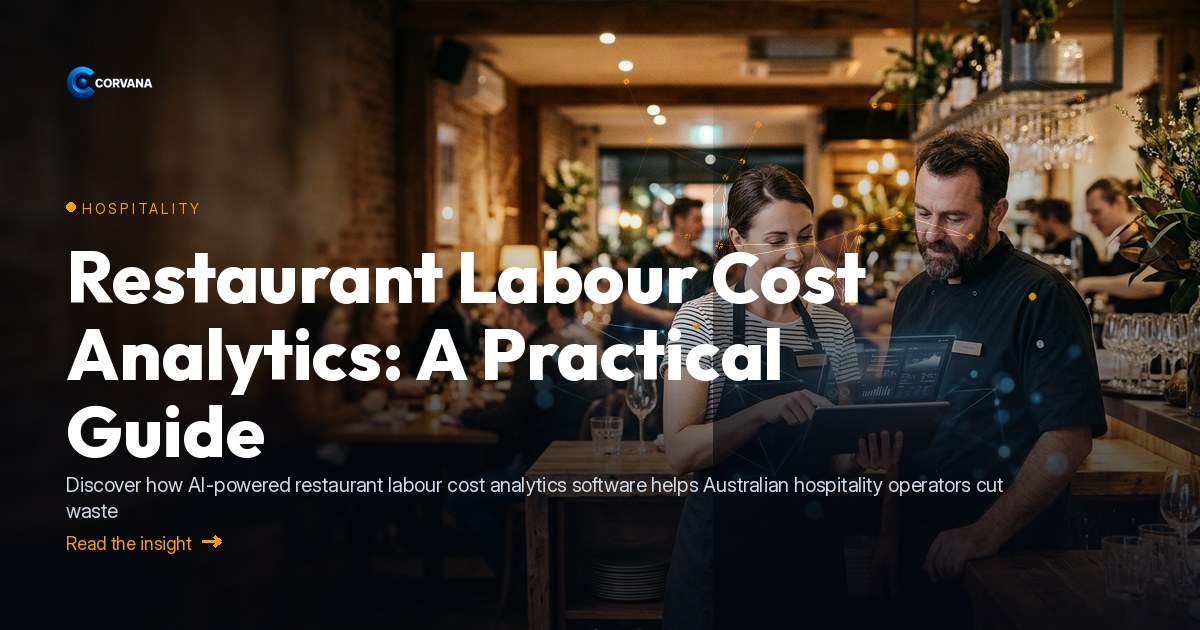
Restaurant Labour Cost Analytics: A Practical Guide for Australian Operators
AI-powered restaurant labour cost analytics software is quietly reshaping the way Australian hospitality businesses are run — not by replacing good operators, but by giving them information they never had fast enough to act on. From café groups managing weekend penalty rates to multi-venue restaurants juggling split shifts, the ability to see labour costs in real time, against actual revenue, is fast becoming a competitive necessity rather than a luxury.
The [Reserve Bank of Australia](https://www.rba.gov.au) has flagged persistent cost pressures across the services sector, and hospitality operators feel this acutely: wages, superannuation, and award complexity combine to make labour one of the largest and least predictable cost lines on any P&L. AI tools that surface these costs clearly — and flag problems before they compound — are changing the conversation from reactive to proactive.
What Is Restaurant Labour Cost Analytics Software?
Restaurant labour cost analytics software connects your rostering, payroll and POS data to give you a live view of what your wage bill is costing you relative to what you are earning, shift by shift. The best platforms go further, using AI to forecast demand, alert you to margin risk, and benchmark your performance against industry norms — so you are not just watching the numbers, you are acting on them before they hurt the business.
Why Labour Costs Are So Hard to Manage in Hospitality
The hospitality industry operates under some of the most complex award conditions in Australia. The Restaurant Industry Award and Hospitality Industry (General) Award include penalty rates, junior loadings, overtime provisions and allowances that change depending on the day, time and role. The [Fair Work Ombudsman](https://www.fairwork.gov.au) regularly reminds operators that underpayment — even unintentional — carries serious consequences.
Layered on top of award complexity is the operational reality: covers fluctuate, no-shows happen, a wet Saturday can gut projected revenue. Without a system connecting your roster to your actual trading data, managers are flying blind — over-staffing on quiet nights, under-staffing on busy ones, and discovering the damage only when the weekly accounts come in.
Three Outcomes That Matter to Restaurant Operators
1. Freeing Up Staff Time
Manual reporting eats hours that your managers should be spending on the floor. When labour data, POS revenue and payroll figures live in separate systems, someone has to reconcile them — usually in a spreadsheet, usually after the fact. AI-driven analytics platforms automate this reconciliation, delivering a weekly summary that tells your managers what actually happened without them having to build it themselves.
Automated dashboards surface your labour-cost percentage, wage-to-revenue ratio by shift, and actual versus rostered hours — all without manual data entry. That is time returned to your team to focus on service, training and the customer experience.
2. Reducing Weaknesses — Catching Problems Early
The most damaging labour cost blowouts in hospitality tend to be invisible until end of month. A kitchen running on casual overtime, a venue where split shifts are costing more than the covers justify, a payroll configuration that has drifted out of award compliance — these are exactly the kinds of issues that AI early-warning systems are built to catch.
Good restaurant labour cost analytics software will alert you when your labour percentage crosses a threshold, when overtime is trending upward mid-week, or when a particular shift pattern is consistently unprofitable. These signals, delivered in real time, let you act before the problem compounds.
[Tourism Research Australia](https://www.tra.gov.au) tracks the ongoing pressure on hospitality operators from both cost and demand-side volatility — a reminder that the margin for error in this industry is thin and shrinking.
3. Capitalising on Strengths
Analytics is not only about plugging leaks. The same data that reveals where you are losing money also shows you where you are winning. Which shifts consistently return strong margins? Which team configurations produce the best covers-per-labour-hour? Which venues in a group are outperforming, and what are they doing differently?
Understanding your strengths allows you to replicate them — rostering your best-performing team combinations on high-revenue nights, identifying the service patterns that drive repeat visits, and building rosters around your actual trading peaks rather than habit or guesswork.
How Corvana Applies AI to Restaurant Labour Cost Analytics
Corvana is an Australian AI business intelligence platform built specifically for operators like you. It unifies your POS, accounting, rostering and payroll data into a single real-time picture — so your labour costs are always visible alongside your revenue, without any manual work.
Key capabilities for hospitality operators include:
- Live labour cost dashboards showing wage-to-revenue ratios by shift, day and venue
- AI-driven staffing forecasts based on historical trading patterns, upcoming events and demand signals
- Automated weekly reports delivered to owners and managers without anyone building a spreadsheet
- Early-warning alerts when labour percentage, overtime or payroll anomalies breach your nominated thresholds
- Benchmarking against ATO and ANZSIC industry data, so you know how your labour costs compare to similar venues
- Compliance monitoring to flag award and payroll configuration risks before they become underpayment issues
Corvana integrates directly with the tools most Australian hospitality businesses already use. On the rostering and payroll side, that includes Deputy, Tanda and Employment Hero. For POS, Corvana connects with Square, Lightspeed, Kounta, Mr Yum and Tyro. Accounting data flows in from Xero, MYOB and QuickBooks — meaning your whole operation speaks to one platform, in real time.
For multi-venue groups, Corvana's industry-specific roles and permissions mean each venue manager sees what they need to see, and owners see the full picture across all locations.
Frequently Asked Questions
How is restaurant labour cost analytics software different from my rostering app?
Your rostering app manages scheduling and award interpretation at the point of building a shift. Labour cost analytics software sits above that layer — it brings together your rostered costs, actual hours worked, payroll data and POS revenue to show you what labour actually cost you relative to what you earned. The two tools work best together, and platforms like Corvana integrate directly with leading rostering apps so the data flows automatically.
What is a healthy labour cost percentage for a restaurant in Australia?
Labour cost benchmarks vary by venue type, service style and revenue mix, so no single figure applies universally. As a general guide, full-service restaurants typically target labour costs somewhere in the range of 30–35% of revenue, while quick-service venues often operate at a lower percentage. Corvana's benchmarking feature compares your actual performance against ANZSIC industry data so you can see where you sit relative to comparable venues.
Can this software help with Fair Work compliance?
Restaurant labour cost analytics software is not a substitute for proper legal and payroll advice, but it can play a meaningful supporting role. By flagging when actual hours diverge significantly from rostered hours, when overtime is running high, or when payroll configurations appear inconsistent, it gives operators an early prompt to investigate before an issue becomes a liability. The [Fair Work Ombudsman](https://www.fairwork.gov.au) provides detailed guidance on award obligations for hospitality businesses.
---
If you would like to see how Corvana brings your labour data, trading figures and payroll together in one place, we would be glad to show you what it looks like for a venue like yours.