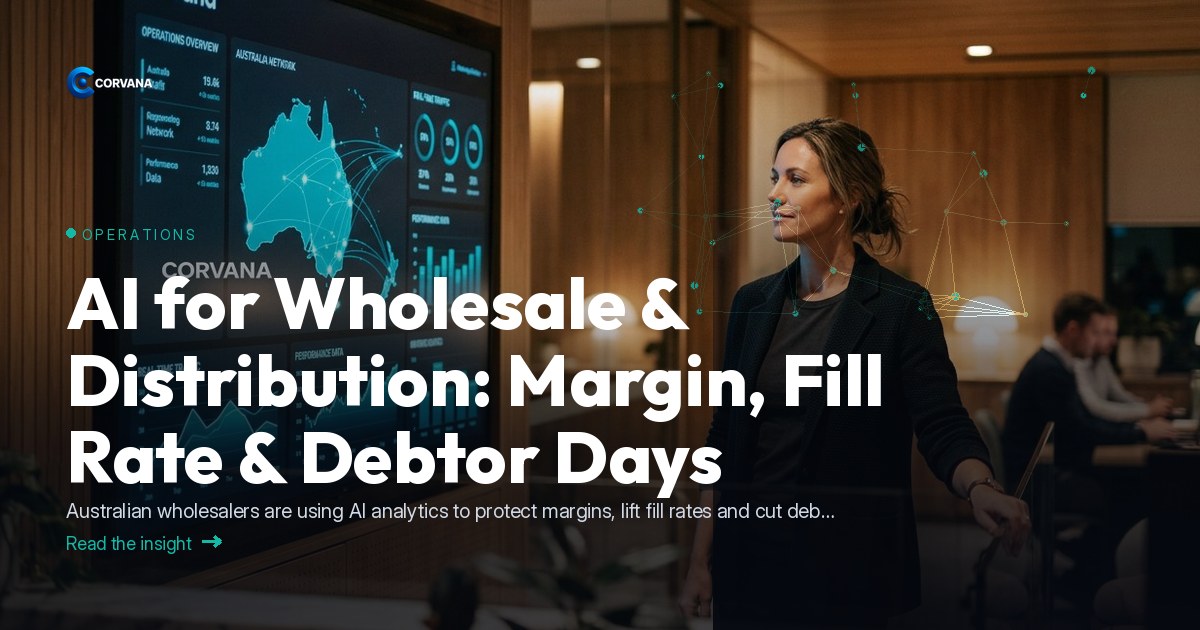
Wholesale Analytics Is No Longer a Nice-to-Have
AI is quietly reshaping how Australian wholesale and distribution businesses operate — and wholesale analytics sits at the centre of that shift. Where operators once relied on monthly spreadsheets and gut feel to manage margin, stock availability and cash flow, AI-driven platforms now surface the signals that matter in real time, before a problem becomes a loss.
For distributors, the stakes are high. Thin margins, complex logistics, long payment terms and demanding trade customers leave very little room for error. The good news is that the same operational complexity that makes wholesale hard to manage also makes it unusually well-suited to AI — there is simply more data to work with, and more value to unlock from it.
The Three Numbers That Define a Wholesale Business
Before getting into how AI helps, it is worth being precise about what it is optimising. Most wholesale and distribution operators live and die by three metrics:
- Gross margin — the spread between what you buy and what you sell, after freight and handling
- Fill rate — the percentage of customer orders fulfilled completely and on time from available stock
- Debtor days — the average number of days it takes trade customers to pay their invoices
Each one is measurable. Each one is improvable. And each one interacts with the others in ways that are genuinely difficult to track manually across hundreds of SKUs, multiple locations and dozens of active accounts.
Freeing Up Staff Time With Automated Reporting
Wholesale operations teams spend a disproportionate amount of time compiling reports that, by the time they are finished, are already out of date. AI changes that equation fundamentally.
When your accounting data from Xero or MYOB and your inventory data from systems like Shopify or Lightspeed feed into a unified dashboard, the numbers reconcile automatically. Your operations manager sees margin by product line, fill rate by warehouse and debtor ageing by customer — all updated continuously, without a manual export in sight.
Automated weekly reporting means your leadership team arrives at Monday's meeting already briefed on what changed last week, which accounts are running late and which SKUs are dragging down margin. The time your team used to spend building that picture can go back into the business.
Reducing Weaknesses: Catching Problems Before They Compound
This is where AI genuinely earns its place in a wholesale operation.
Margin Leaks
Margin erosion in wholesale is rarely dramatic — it tends to happen gradually, through a combination of freight overruns, customer-specific pricing that has drifted out of alignment, and product mix shifts that nobody noticed until the quarterly review. AI-driven monitoring flags these patterns as they emerge. If a particular SKU's contribution margin drops below your threshold, you know this week, not next quarter.
Fill Rate Failures
A fill rate problem almost always has a demand-forecasting root. AI forecasting models — drawing on your sales history, seasonal patterns and even external signals — give your purchasing team earlier, more reliable reorder signals. The [Australian Bureau of Statistics](https://www.abs.gov.au) publishes regular data on wholesale trade activity and economic conditions that provides useful context for interpreting demand shifts at an industry level.
Debtor Days Blowouts
Late payment is a persistent pressure point for Australian distributors. The [Australian Small Business and Family Enterprise Ombudsman](https://www.asbfeo.gov.au) has consistently highlighted payment times as one of the most significant cash-flow risks facing small and medium businesses in the supply chain. AI-powered debtor monitoring — integrated with your Xero or MYOB accounts receivable ledger — tracks payment behaviour by customer, flags accounts trending in the wrong direction and helps you prioritise follow-up before an invoice becomes a write-off.
Cash Flow Forecasting
Beyond debtors, AI cash flow forecasting combines your incoming receivables, upcoming payables and historical patterns to give you a rolling forward view of liquidity. Combined with [Reserve Bank of Australia](https://www.rba.gov.au) interest rate and economic context, this helps you make smarter decisions about trade credit terms, inventory investment and supplier payment timing.
Capitalising on Strengths: Finding What Is Already Working
Not everything in a wholesale operation needs fixing — some of it needs scaling. AI helps you identify the products, customers, regions and sales reps that are genuinely outperforming, so you can double down deliberately rather than accidentally.
Your Best Customers
Customer lifetime value analysis, built from your CRM and sales data via integrations with HubSpot or Salesforce, shows you which trade accounts are most profitable over time — not just highest in volume. A customer who orders frequently, pays on time and has a high average margin deserves a very different service model than one who demands heavy discounts, pays slowly and generates a large number of credits.
Your Strongest SKUs
Product-level margin and velocity analysis tells you which lines to promote, which to renegotiate with suppliers and which to discontinue. When this is visible in a live dashboard rather than a quarterly review, your purchasing and sales teams can act on it continuously.
Your Top Performers
If one of your sales reps consistently achieves better margin and lower debtor days than their peers, that is worth understanding — and replicating. Role-level dashboards in your analytics platform surface these patterns without requiring your managers to dig.
How Corvana Applies AI to Wholesale Operations
Corvana unifies your accounting data (Xero, MYOB, QuickBooks), sales data (Shopify, Lightspeed), CRM data (HubSpot, Salesforce, ActiveCampaign) and rostering data (Deputy, Tanda, Employment Hero) into a single real-time intelligence layer.
For wholesale and distribution operators, that means:
- Live margin dashboards by product line, customer segment and location
- AI-driven demand forecasting to improve fill rates and reduce overstock
- Debtor ageing alerts that flag accounts trending late before they become overdue
- Automated weekly reports delivered to your leadership team without manual preparation
- Cash flow forecasting that combines receivables, payables and operational costs into a rolling forward view
- Customer lifetime value and churn signals drawn from your CRM and sales history
- Benchmarking against ATO and ANZSIC industry data so you know how your margins, debtor days and fill rates compare with peers in your segment
- Role-specific dashboards and permissions so your warehouse manager, CFO and sales team each see exactly what is relevant to them
Integration is straightforward — Corvana connects to the tools you already use, so there is no ripping out of existing systems.
Frequently Asked Questions
What is a good fill rate for an Australian wholesale business?
Fill rate benchmarks vary by category and customer expectations, but most trade customers consider anything below 95% a service issue. AI demand forecasting helps distributors get ahead of stockouts by improving the accuracy of reorder signals, reducing the gap between what customers order and what you can actually ship.
How does AI help reduce debtor days?
AI monitors payment behaviour across your entire debtor ledger in real time, flagging accounts that are trending late based on their historical patterns — not just once they have already missed a due date. This gives your accounts receivable team earlier, more targeted prompts to follow up, which consistently produces faster payment outcomes than relying on an aged debtors report run once a week.
Can a small wholesale operation benefit from AI analytics, or is it just for large distributors?
AI analytics delivers value at almost any scale, because the underlying problems — margin visibility, cash flow uncertainty and debtor management — are not unique to large businesses. In fact, smaller distributors often benefit most, because they have less capacity to absorb the losses that come from late information. Connecting your existing accounting, sales and CRM tools to a unified platform takes hours, not months, and the operational clarity is immediate.
---
If you would like to see how Corvana brings all of this together for your wholesale or distribution operation, we would be glad to walk you through it.