AI Marketing Analytics Is Changing How Australian Businesses Measure Growth
AI marketing analytics is no longer a tool reserved for enterprise teams with dedicated data scientists. For Australian SME operators, it is increasingly the difference between guessing which campaigns drive revenue and knowing with confidence — in real time. The shift is significant: where marketing used to be measured in spreadsheets reviewed once a month, AI now surfaces patterns across channels, customer segments and time periods that a human analyst simply could not track manually.
The core problem it solves is attribution — understanding which touchpoint, campaign or channel actually influenced a sale. Without reliable attribution, marketing spend is partly a leap of faith. AI changes that by connecting behaviour across platforms, identifying which sequences of interactions lead to conversions, and doing it continuously rather than in a quarterly debrief.
For operators running lean teams, this matters enormously. Every dollar of marketing budget needs to justify itself, and every hour spent manually pulling reports is an hour not spent on customers, product or staff.
---
The Real Attribution Problem for SME Marketers
Traditional marketing measurement tends to credit the last touchpoint before a sale — the final click, the last email opened. That approach systematically undervalues brand awareness, early-funnel content and word-of-mouth referrals, which collectively do a great deal of the actual work.
AI-driven attribution models can look across the full customer journey. They weigh channels by their contribution at each stage — awareness, consideration, conversion, retention — and they update as your customer behaviour shifts. For a business running campaigns across Meta, email, Google and in-store promotions simultaneously, this kind of multi-touch visibility is not a luxury. It is how you stop funding the wrong things.
The [Australian Bureau of Statistics](https://www.abs.gov.au) consistently shows that small and medium businesses account for the majority of Australian business activity, yet most operate without the kind of structured analytics infrastructure that would help them allocate marketing budgets with confidence. AI platforms are beginning to close that gap.
---
Three Outcomes That Matter for Marketing Operators
1. Freeing Up Staff Time
Marketing coordinators and managers in SMEs typically spend a disproportionate amount of their week pulling data from disconnected platforms — CRM exports, ad dashboards, email reports, POS summaries — and assembling it into something resembling a clear picture. AI marketing analytics automates that assembly.
When your systems talk to each other and a platform surfaces the insights automatically, your team shifts from reporting to acting. Automated weekly performance summaries, pre-built attribution dashboards and AI-generated anomaly alerts mean your people are spending time on strategy and creative, not on data wrangling.
2. Reducing Weaknesses — Catching Problems Before They Cost You
One of the most valuable things AI does in marketing is flag deterioration early. If your email open rates are declining, your cost-per-acquisition is creeping up, or a specific customer segment is churning faster than usual, a well-configured analytics platform will surface that signal before it becomes a material loss.
Early-warning capability matters because marketing problems tend to compound. A campaign that is underperforming in week two rarely recovers by week six without intervention. AI monitoring means you can course-correct while there is still budget left to deploy effectively.
This also extends to customer lifetime value. If your highest-value customer segment is showing signs of disengagement — reduced purchase frequency, lower average order values, fewer responses to re-engagement campaigns — that is a revenue risk worth knowing about immediately, not at the end of the quarter.
3. Capitalising on Your Strengths
AI does not only find problems. It identifies what is already working and helps you double down. Which customer segments convert at the highest rate? Which channels deliver customers with the greatest lifetime value, not just the lowest acquisition cost? Which product lines are most responsive to promotional activity?
These are questions AI can answer at a granular level, and the answers often surprise operators. A campaign that looks average on cost-per-click may be delivering your most loyal customers. A product you are barely promoting may have an unusually high repeat-purchase rate among a specific demographic. AI surfaces these patterns so you can act on your real strengths rather than your assumed ones.
---
How Corvana Applies AI to Marketing Analytics
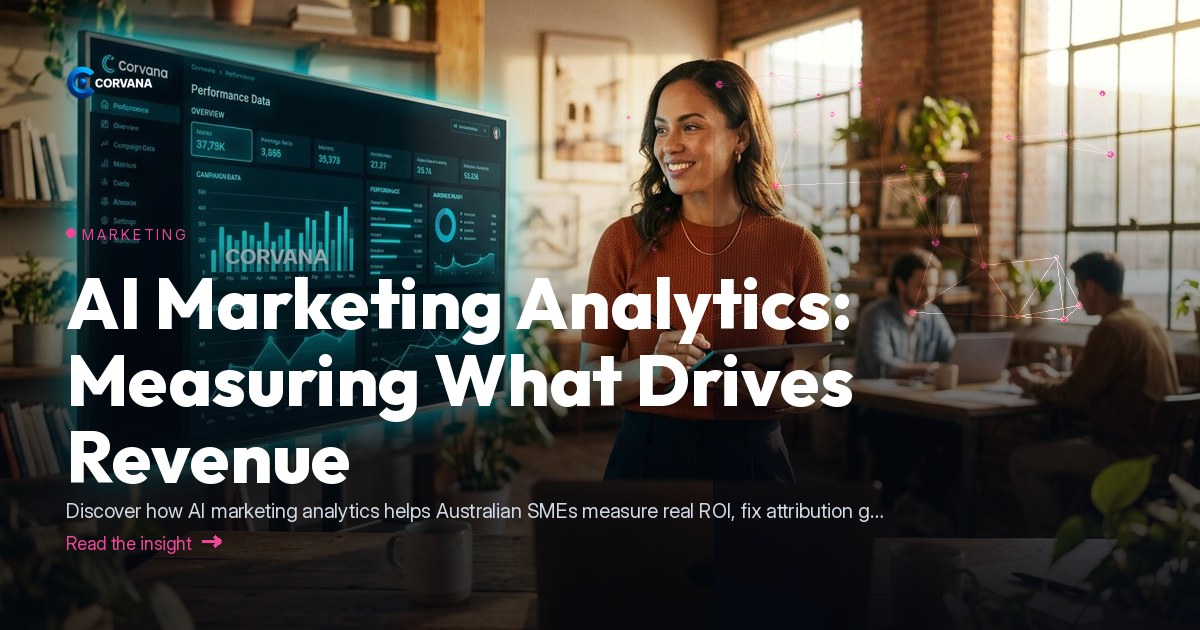
Corvana connects your marketing and revenue data into a single, real-time view — without requiring a data team to maintain it. By integrating directly with the platforms your business already uses, Corvana eliminates the manual work of pulling reports from multiple sources.
On the marketing side, Corvana integrates with:
- HubSpot, Salesforce, Mailchimp and ActiveCampaign — to bring CRM and campaign performance data into the same view as your revenue and customer behaviour
- Meta Business Suite — to connect paid social performance directly to downstream revenue outcomes
- Google Analytics — to tie web behaviour and traffic sources to actual customer and transaction data
- Square, Lightspeed, Shopify and other POS platforms — so campaign-driven traffic can be mapped to in-store or online purchases
- Xero, MYOB and QuickBooks — so marketing spend sits alongside your actual financial position, not in a separate silo
Within that connected environment, Corvana's AI runs automated weekly reporting so your team is not building decks from scratch every Friday. It tracks customer lifetime value and churn risk across your segments, benchmarks your performance against ANZSIC industry data, and flags anomalies in acquisition costs, retention rates or campaign returns before they become serious problems.
For multi-location operators, Corvana's role-based permissions mean your state marketing manager sees their region's data, while the CEO sees the consolidated picture — without anyone needing to manually cut and slice a spreadsheet.
The result is a marketing function that runs on evidence rather than intuition, and that can redirect budget and effort quickly when the data warrants it. According to the [Productivity Commission](https://www.pc.gov.au), improving how Australian businesses use data and digital tools is one of the clearest levers for lifting business productivity — and marketing is one of the highest-leverage places to start.
---
Frequently Asked Questions
What is AI marketing analytics and how is it different from regular reporting?
Regular marketing reporting tells you what happened — clicks, opens, revenue — after the fact. AI marketing analytics goes further by identifying patterns across datasets, attributing revenue to the right channels, forecasting future performance, and flagging problems or opportunities in real time. For SME operators, the practical difference is that AI does the analysis continuously, so your team is reading insights rather than building them from scratch.
How does attribution actually work in an AI analytics platform?
Attribution in an AI platform works by connecting data from multiple touchpoints — ads, emails, website visits, in-store purchases — and modelling which combinations of interactions are most likely to lead to a sale. Rather than crediting only the last click, AI models can assign weighted credit across the full customer journey. This gives you a more accurate picture of which channels and campaigns are genuinely driving revenue, so you can allocate budget accordingly.
Is AI marketing analytics worth it for a small Australian business?
If your business is running any paid advertising, email campaigns or loyalty programmes, and you are currently making budget decisions based on platform-level reports in isolation, then yes — the return on better attribution and automated reporting is typically significant. The [Australian Small Business and Family Enterprise Ombudsman](https://www.asbfeo.gov.au) recognises that access to better business information and decision-making tools is a meaningful competitive advantage for small operators, particularly in a tightening cost environment.
---
If you'd like to see how Corvana pulls your marketing, revenue and customer data together into one clear picture, we're happy to walk you through it.