
The Practical Guide to Choosing the Best Business Intelligence Platform for Professional Services Firms
Artificial intelligence is quietly reshaping how professional services firms operate — and finding the best business intelligence platform for professional services firms has moved from a nice-to-have to a genuine competitive necessity. Whether you run a law firm, accounting practice, consulting group or engineering consultancy, the firms pulling ahead in 2026 are not simply working harder. They are working with sharper, faster information.
For decades, professional services operated on gut instinct and end-of-month reports. That lag is no longer acceptable. AI-driven BI platforms now surface real-time signals — about utilisation, profitability, client health and cash flow — so principals and practice managers can act before problems compound.
What Is the Best Business Intelligence Platform for Professional Services Firms?
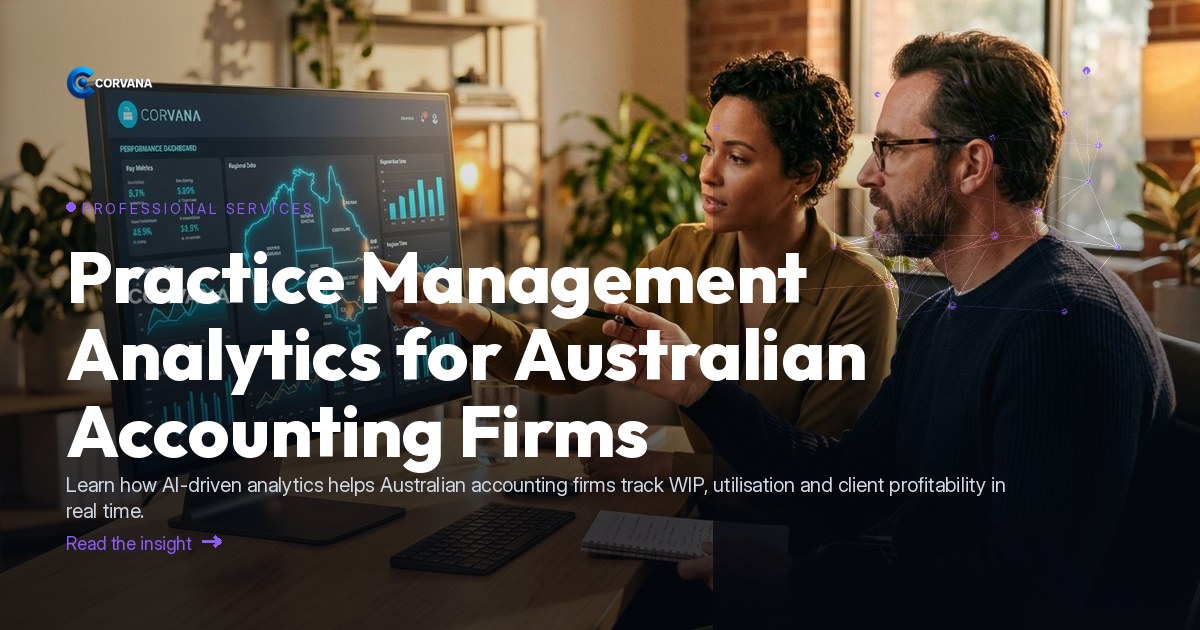
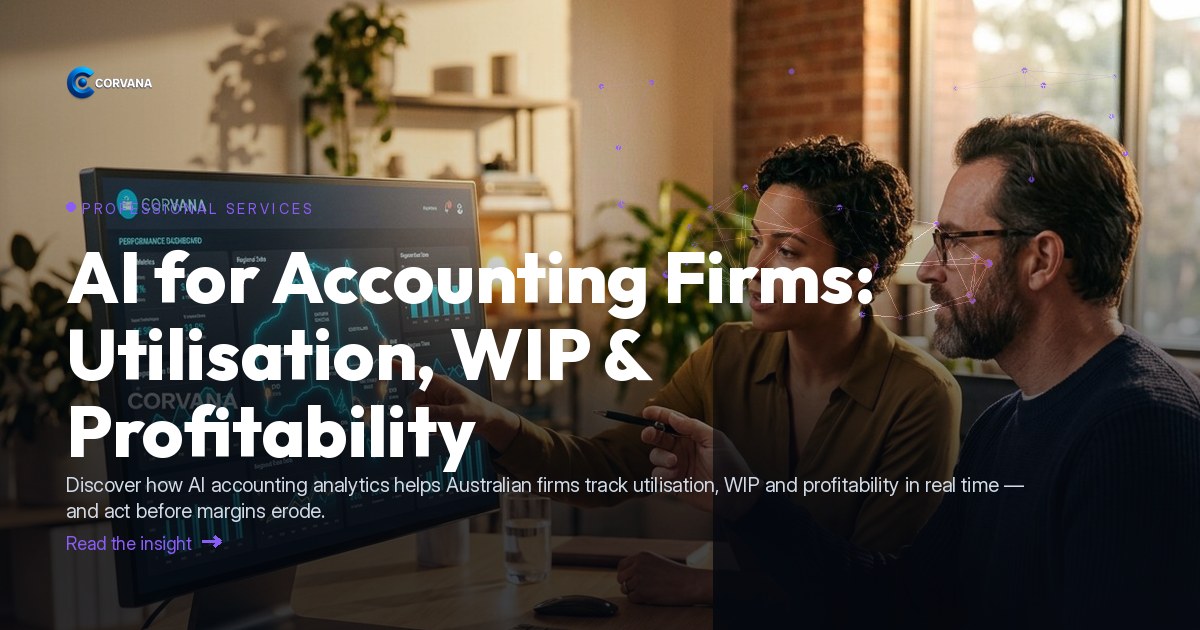
The best business intelligence platform for professional services firms is one that unifies your billing, payroll, CRM and accounting data into a single live view, then applies AI to forecast risks and highlight opportunities specific to your practice. For Australian firms, Corvana delivers exactly this: automated reporting, early-warning alerts and benchmarking against ATO and ANZSIC industry data, all without requiring a data analyst on staff.
The sections below unpack what that means in practice — and why three operator outcomes should anchor every platform decision you make.
---
How AI Is Genuinely Changing Professional Services in 2026
Research from [McKinsey & Company](https://www.mckinsey.com) consistently shows that professional services are among the sectors with the highest potential for AI-driven productivity gains — not by replacing professionals, but by eliminating the low-value administrative work that consumes billable hours.
In a typical mid-size Australian practice, a meaningful share of a fee-earner's week can disappear into chasing timesheets, manually reconciling WIP reports, or assembling partner dashboards in spreadsheets. AI changes that equation by automating data aggregation and surfacing only the exceptions that need a human decision.
The [Productivity Commission](https://www.pc.gov.au) has highlighted that service-sector productivity in Australia is increasingly tied to how well firms adopt digital tools. Business intelligence platforms are a direct expression of that opportunity.
---
Outcome 1: Optimising Staff Time
Time is the only inventory a professional services firm sells. When principals spend hours building reports instead of advising clients, the firm loses revenue and the team loses morale.
A strong BI platform eliminates that friction by:
- Automating weekly and monthly reporting so fee-earners and managers receive a clear snapshot without anyone compiling spreadsheets
- Tracking utilisation rates in real time so you can see which staff are at capacity and which have available bandwidth before scheduling decisions become urgent
- Integrating directly with rostering and payroll tools like Deputy, Tanda and Employment Hero so labour costs are always current
When your data is live rather than lagging by a fortnight, scheduling conversations are grounded in fact rather than memory.
---
Outcome 2: Reducing Weaknesses — Catching Problems Early
Professional services firms face several slow-moving risks that are hard to spot without the right data: scope creep eroding margins on fixed-fee engagements, client concentration risk building quietly, cash flow tightening as debtors stretch, and compliance deadlines approaching without adequate resourcing.
AI-driven early-warning systems address each of these. A good platform will alert you when:
- A client's billing-to-budget ratio is drifting above threshold
- Debtor days are trending upward across a segment or service line
- Cash flow forecasts indicate a trough in the coming 60–90 days
- Staffing costs are outpacing fee recovery on specific matters or projects
The [Australian Securities and Investments Commission (ASIC)](https://asic.gov.au) requires that licensed professional services businesses maintain adequate financial controls and oversight. Having a live dashboard that flags anomalies is a practical expression of that governance responsibility, not just an operational convenience.
---
Outcome 3: Capitalising on Strengths
The third outcome is the one that often gets overlooked: BI platforms should tell you what is *working*, not just what is broken.
Which service lines carry your highest margins? Which fee-earners are generating the most repeat client work? Which client segments refer the most new business? These questions are difficult to answer from a standard accounting report but straightforward when your CRM, billing and accounting data are unified.
With that clarity, practice leaders can:
- Double down on the service lines and client profiles that are most profitable
- Recognise and retain top performers before they consider leaving
- Build targeted marketing campaigns around your strongest client segments
---
How Corvana Applies AI to Professional Services
Corvana connects the data sources that professional services firms already use and layers AI across all of them in one platform.
Accounting integration: Corvana connects with Xero, MYOB and QuickBooks, pulling live P&L, cash flow and debtor data without manual exports.
Practice management integration: Native connections to Clio (legal) and Karbon (accounting practices) mean matter-level and client-level data flows directly into your dashboards.
CRM and pipeline visibility: Integrations with HubSpot, Salesforce and ActiveCampaign allow Corvana to track client lifetime value, identify clients showing churn signals, and surface which pipeline stages are converting.
Payroll and rostering: Connections to Deputy, Tanda and Employment Hero keep utilisation and labour-cost data current.
Automated reporting: Corvana's weekly reports are generated automatically and distributed to the right people with the right permissions — partners see firm-wide data, team leads see their own division, and fee-earners see their individual metrics.
Benchmarking: Corvana benchmarks your performance against ATO and ANZSIC industry data, so you can see not just whether your margins are improving, but whether they are competitive within your sector.
---
Frequently Asked Questions
Do professional services firms really need a dedicated BI platform, or will their accounting software do the job?
Accounting software is excellent at recording what has already happened — invoices raised, payments received, costs incurred. A BI platform goes further by combining that data with your CRM, practice management and rostering systems to show you what is happening *now* and forecast what is likely to happen next. For firms that want to manage utilisation, client health and cash flow proactively, the two tools serve different purposes and work best together.
How long does it typically take to get a BI platform up and running for a professional services firm?
It depends on how many systems need to be connected, but cloud-native platforms like Corvana are designed for fast onboarding. Firms with Xero or MYOB, a CRM like HubSpot or Salesforce, and a practice management tool like Clio or Karbon can typically see a unified live dashboard within days rather than months. No data engineering team is required.
Is the data secure enough for a professional services firm handling confidential client information?
Data security is a legitimate priority for any professional services firm. Look for platforms that store data in Australian data centres, use role-based access controls (so staff only see what is appropriate to their role), and hold recognised security certifications. Corvana's industry-specific permissions model is specifically designed to ensure sensitive financial and client data is accessible only to authorised users.
---
If you'd like to see how Corvana brings all of this together for your practice, it's worth taking a look at what a unified, AI-driven view of your firm could look like in practice.