Superintelligence for Business: A Practical Guide for Australian Operators
Superintelligence for business in Australia is no longer a concept reserved for tech giants and research labs — it is arriving quietly inside the everyday tools that SME operators use to manage staff, serve customers and close the books. The shift is real, it is accelerating, and understanding what it means in practice is now a genuine competitive advantage.
What Is Superintelligence for Business in Australia?
Business superintelligence — sometimes called advanced or applied AI — refers to systems that do not just store or display data, but reason across it, learn from patterns, and surface insights faster and more reliably than any human analyst could. For Australian operators, it means your business data stops sitting idle in disconnected apps and starts working as a unified intelligence layer that flags problems, forecasts outcomes and recommends action.
Direct answer: Superintelligence for business in Australia means AI systems that unify data from across your operations — sales, payroll, cash flow, customers — and proactively surface what matters before it becomes a crisis. Australian SMEs can access this capability today through purpose-built platforms that integrate with the software they already use. The result is faster decisions, fewer costly surprises, and a clearer view of where the business is strongest.
This is not about replacing your team. It is about giving every person in it — from a floor manager to a business owner — information that used to require a full-time analyst to produce.
Why This Matters Right Now for Technology-Adjacent Businesses
Australia's technology sector is evolving at a pace that puts real pressure on operators. [CSIRO](https://www.csiro.au) research consistently identifies AI adoption as one of the most significant drivers of productivity growth available to Australian businesses. Meanwhile, [Gartner](https://www.gartner.com) has noted that organisations which embed AI into their operational decision-making — rather than treating it as a standalone experiment — see measurably better outcomes across planning, resourcing and customer retention.
For SME operators in technology-related fields, the practical challenge is not a shortage of data. It is too much data, in too many places, producing too little clarity. Staff spend hours each week manually pulling reports from accounting software, rosters, and sales platforms — only to make decisions on information that is already out of date.
That is the problem applied AI solves.
---
Three Outcomes That Change How You Operate
1. Freeing Up Staff Time
Manual reporting is one of the biggest hidden costs in a growing business. When your team is assembling spreadsheets, they are not serving customers, improving products or developing skills. AI-driven platforms automate the weekly reporting cycle entirely — pulling live data from your POS, accounting, payroll and CRM systems and delivering a consolidated picture without anyone lifting a finger.
The result is not just time saved. It is consistency. Every stakeholder sees the same numbers, in the same format, every time — without anyone having to ask for them.
2. Reducing Weaknesses — Catching Problems Early
The most valuable thing an intelligent system can do is tell you something is wrong before it costs you. Applied AI monitors:
- Cash flow risk — forecasting shortfalls weeks ahead, not days
- Margin erosion — detecting when costs are creeping relative to revenue
- Churn signals — identifying customers whose engagement is declining before they leave
- Compliance gaps — flagging payroll and rostering anomalies against your obligations
The [Productivity Commission](https://www.pc.gov.au) has highlighted that many Australian SMEs face preventable losses due to slow or incomplete information. Early-warning intelligence directly addresses this.
3. Capitalising on Strengths
Most operators have a strong intuition about what is working — a particular product line, a standout team member, a customer segment that converts reliably. But intuition has limits. AI benchmarks your actual performance against [Australian Bureau of Statistics (ABS)](https://www.abs.gov.au) and ANZSIC industry data so you know objectively where you outperform the market, not just where you feel you do.
That means you can double down with confidence: invest in the location that is genuinely outperforming, prioritise the customer segment with the highest lifetime value, and resource the team members whose output justifies it.
---
How Corvana Applies AI to This
Corvana is built specifically for Australian operators who want the benefits of business superintelligence without needing a data science team to run it.
Here is how it works in practice for technology-sector businesses:
- Unified data layer: Corvana connects directly to Xero, MYOB or QuickBooks for financials; Square, Lightspeed or Shopify for sales; Deputy, Tanda or Employment Hero for rostering and payroll; and HubSpot, Salesforce, ActiveCampaign or Mailchimp for customer data. Google Analytics and Stripe round out the picture for digital revenue streams.
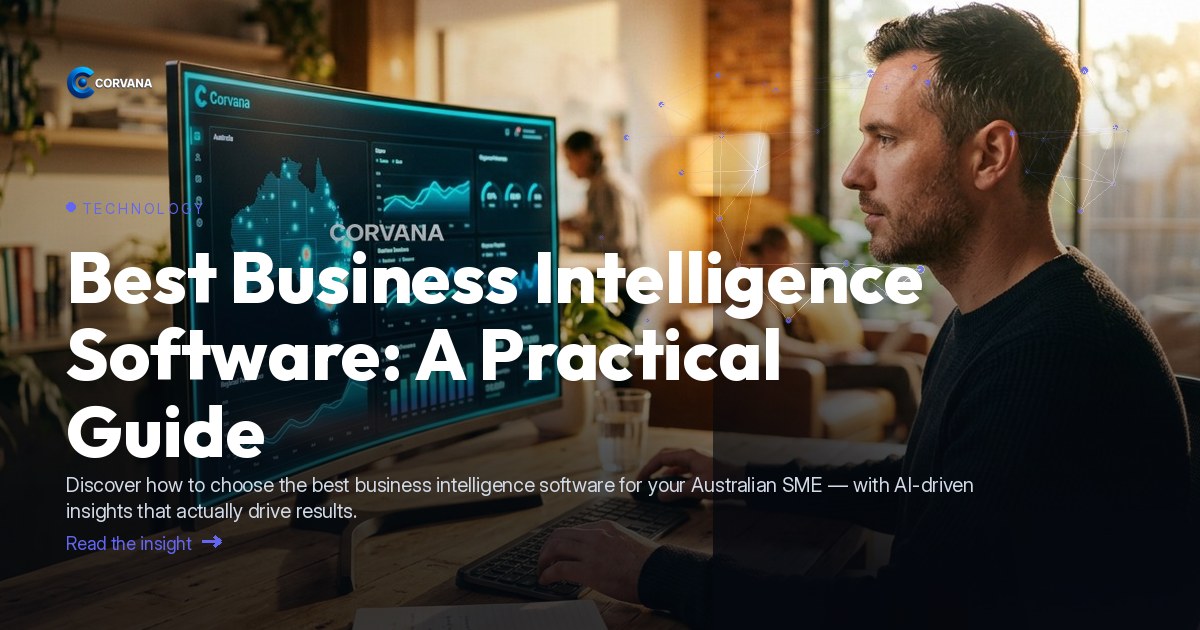
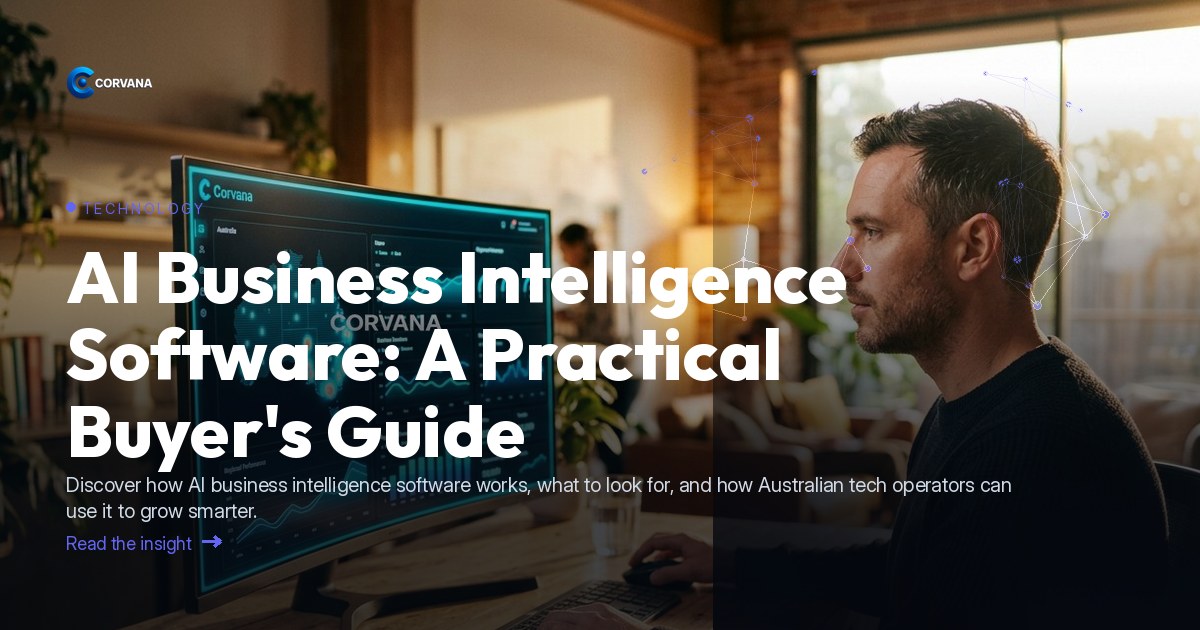
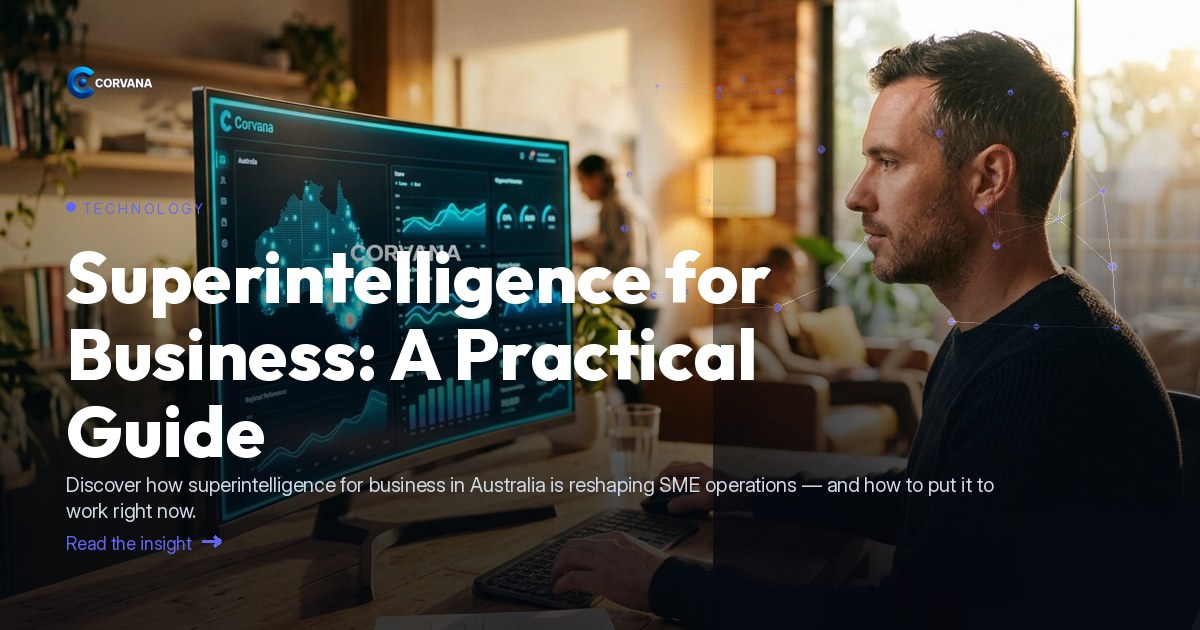
- Live dashboards: Instead of toggling between five apps, operators see one real-time view — revenue, margin, labour cost and customer activity — updated continuously.
- AI-driven forecasting: Cash flow, demand and staffing forecasts are generated automatically, drawing on your historical data and adjusting as conditions change.
- Automated weekly reporting: Corvana generates and distributes structured reports on a set schedule — no manual compilation required.
- Benchmarking: Your performance is contextualised against ATO and ANZSIC industry data so you always know how you stand relative to comparable businesses.
- Customer lifetime value and churn early-warning: Corvana identifies your highest-value customer segments and flags when retention is at risk — early enough to act.
- Role-based permissions: Staff see only what is relevant to their role, keeping sensitive data protected while ensuring every team member has the insight they need.
For technology businesses with multiple revenue streams, subscription models or distributed teams, this kind of integrated intelligence is the difference between reactive management and confident, forward-looking operations.
---
Frequently Asked Questions
Is superintelligence for business practical for small Australian businesses, or is it only for large enterprises?
Applied AI business intelligence is now accessible to SMEs of almost any size. Platforms like Corvana are designed specifically for Australian operators who do not have dedicated data or analytics teams — the setup connects to software you already use, and the insights are delivered in plain language, not technical outputs. You do not need a large budget or specialised staff to benefit.
How is AI business intelligence different from standard reporting software?
Standard reporting tools display historical data in the format you set them up to show. AI business intelligence goes further — it learns from your patterns, forecasts future outcomes, flags anomalies proactively, and benchmarks your performance against industry data. The key difference is that it tells you what to pay attention to, rather than waiting for you to ask the right question.
What data does Corvana use, and is it secure for an Australian business?
Corvana connects to your existing business software — accounting, POS, payroll, CRM — and consolidates that data within the platform. For Australian operators, data privacy obligations under the Privacy Act are a genuine consideration; Corvana is built with Australian compliance requirements in mind. The [Office of the Australian Information Commissioner (OAIC)](https://www.oaic.gov.au) provides guidance on how businesses should handle and protect personal information, and responsible AI platforms align with that framework.
---
See how Corvana brings your business data together into one intelligent picture — explore the platform and discover what your numbers have been trying to tell you.