How AI Is Changing the Way Australian Operators Run Their Businesses
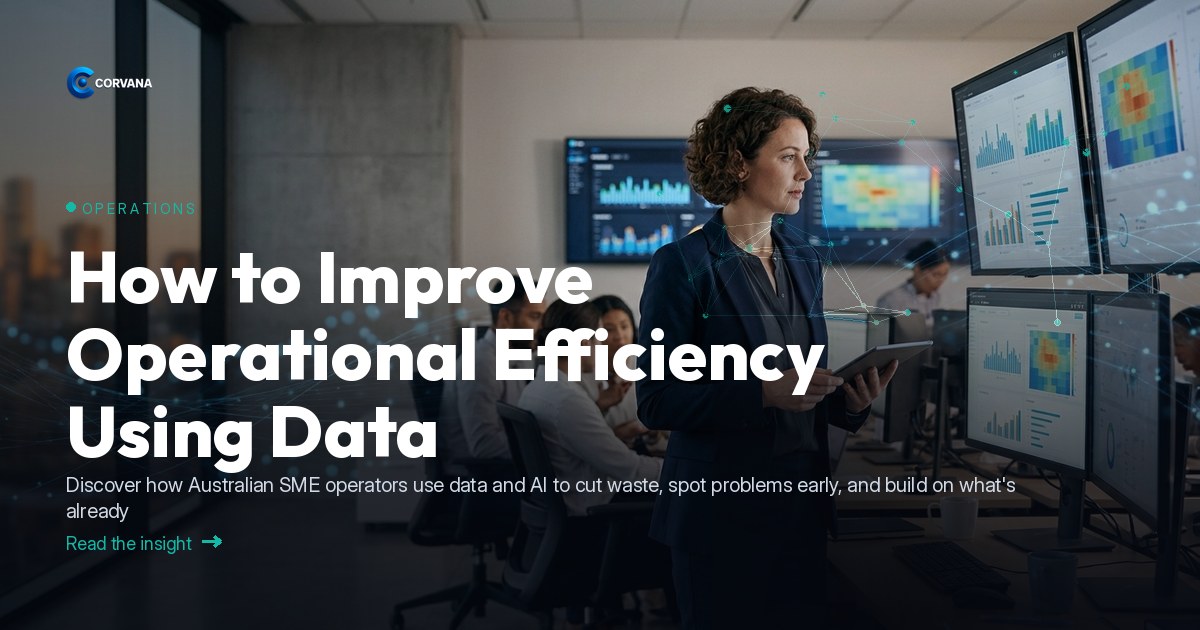
The question of how to improve operational efficiency using data has never been more urgent — or more answerable — for Australian SME operators. AI-driven business intelligence is no longer a tool reserved for large enterprises with dedicated analytics teams. Today, operators across hospitality, retail, trades, healthcare and professional services are using real-time data to make faster, more confident decisions about their people, their processes and their bottom line.
The shift is real. Where operators once relied on end-of-month reports, spreadsheets and gut instinct, AI platforms now surface patterns continuously — flagging a margin dip before it becomes a loss, identifying which team members are driving the most value, and projecting cash flow weeks ahead rather than days. The [Productivity Commission](https://www.pc.gov.au) has consistently highlighted that lifting business productivity in Australia requires better use of information and technology — and that opportunity is squarely in front of SME operators right now.
---
How to Improve Operational Efficiency Using Data: A Direct Answer
Improving operational efficiency using data means connecting your existing systems — POS, accounting, payroll, CRM — into a single real-time view, then letting AI surface what actually matters. Instead of manually reconciling reports, operators receive automated alerts and forecasts that highlight problems early and reveal where the business is already performing well. Done right, this frees up significant staff time, reduces costly blind spots, and helps operators double down on what is genuinely working.
---
The Three Outcomes That Matter Most
Operational efficiency is not one thing. For most Australian operators, it comes down to three distinct gains: getting time back, catching problems before they escalate, and capitalising on existing strengths. AI-powered data platforms address all three simultaneously.
1. Optimising Staff Time
Manual reporting is one of the most common and least visible drains on an operations team. When your team is pulling numbers from separate systems — a POS here, an accounting platform there, a rostering tool somewhere else — they are spending hours producing information that is already out of date by the time it lands on a desk.
Automated weekly reporting and live dashboards change this fundamentally. When every system feeds into one place, the reporting writes itself. Staff shift from data gathering to decision-making, which is where their time genuinely adds value.
AI-driven staffing forecasts add another layer. By analysing historical demand patterns, upcoming bookings and seasonal trends, an AI platform can recommend roster adjustments before labour costs blow out — rather than after.
2. Reducing Business Weaknesses: Early Warnings That Matter
The businesses that struggle most are rarely surprised by one large event. They are eroded by a series of small problems that were visible in the data but not in anyone's line of sight.
Margin leaks are a classic example. A product category quietly underperforms for three months before anyone notices, by which point the cumulative impact is significant. Cash-flow risk is another: an operator who can see a projected shortfall four weeks out has options; one who discovers it on the day does not.
[McKinsey & Company](https://www.mckinsey.com) research on AI adoption consistently shows that early-warning capability — surfacing anomalies automatically rather than waiting for a human to notice them — is among the highest-value applications of machine learning for operational businesses. Customer churn early-warning is a specific example: identifying the customers who are drifting away before they leave entirely gives an operator the chance to act.
3. Capitalising on Strengths
Operational efficiency is not only about cutting waste. It is equally about identifying what is already working and doing more of it.
Which product lines carry the healthiest margins? Which team members generate the strongest customer outcomes? Which location or service category is outperforming the benchmark for your industry? These are not questions most operators can answer confidently without connected data — but with it, they become straightforward.
Benchmarking your performance against [ATO](https://www.ato.gov.au) and ANZSIC industry data gives real context to your numbers. A gross margin that looks fine in isolation looks very different when you can see how it compares with similar businesses in your sector. That context is what turns data into genuine strategic advantage.
---
How Corvana Applies AI to This
Corvana is built specifically for Australian SME operators who want the benefits of AI-driven business intelligence without needing a data team to run it.
The platform connects directly with the tools operators already use:
- Accounting: Xero, MYOB, QuickBooks
- POS: Square, Lightspeed, Kounta, Tyro, Shopify
- Rostering & payroll: Deputy, Tanda, Employment Hero
- CRM & marketing: HubSpot, Salesforce, Mailchimp, ActiveCampaign
Once connected, Corvana unifies the data into a single real-time dashboard — no manual exports, no reconciling between systems. From there, AI-driven forecasting covers cash flow, staffing demand and customer behaviour. Automated weekly reporting means the numbers are always current without anyone having to compile them.
For operators running multiple locations, industry-specific benchmarking shows how each site tracks against ANZSIC peers. Customer lifetime value scoring and churn early-warning give sales and service teams a prioritised view of where attention will have the most impact.
The result is an operations picture that is live, contextualised and actionable — built for how Australian operators actually run their businesses.
---
Frequently Asked Questions
What is the fastest way to improve operational efficiency in a small business?
The fastest gains typically come from connecting your existing systems — POS, accounting, payroll — so data flows automatically rather than being compiled manually. This frees up staff time immediately and gives you a real-time view of performance without additional headcount. From there, automated alerts for anomalies like margin dips or cash-flow shortfalls let you act early rather than reactively.
How does AI help with operational efficiency specifically?
AI adds value by doing the pattern recognition that is impractical to do manually at scale — identifying trends across thousands of transactions, flagging when something deviates from expected behaviour, and forecasting what is likely to happen next. For operators, this means early warnings on problems and clear signals about where the business is already performing strongly, delivered automatically rather than requiring a dedicated analyst.
Do I need to change my existing software to use an AI business intelligence platform?
Generally, no. Platforms like Corvana are designed to integrate with the tools you already use — your existing accounting software, POS, rostering and CRM systems — and unify the data from all of them. The value is in connecting what you already have, not replacing it.
---
If you would like to see how Corvana brings this together for your operation, it is worth exploring what a connected, real-time view of your business actually looks like in practice.