AI Consultancy: A Practical Guide for Professional Services Firms
AI consultancy is no longer a conversation reserved for enterprise boardrooms. Across Australian professional services — accounting practices, law firms, management consultancies, HR advisories and beyond — artificial intelligence is actively reshaping how firms win clients, manage workloads and protect margins. The question is no longer whether to engage with AI, but how to do it deliberately and well.
What Is AI Consultancy?
AI consultancy is the practice of applying artificial intelligence tools, platforms and strategic frameworks to help a business operate more efficiently, make better decisions and grow sustainably. For professional services firms specifically, this means using AI to automate routine analysis, surface early warnings about financial or operational risk, and identify where your best people and strongest client relationships are already creating disproportionate value.
That definition matters because too many operators conflate "AI consultancy" with large-scale IT projects or expensive bespoke software builds. In practice, the most impactful AI for professional services firms today is embedded, integrated and operational — working quietly inside the platforms you already use.
Why AI Is Changing Professional Services Right Now
Professional services firms trade on knowledge, judgement and time. AI directly amplifies all three. According to research published by [McKinsey & Company](https://www.mckinsey.com), knowledge-work functions — including legal, financial advisory and consulting — are among the highest-value areas for AI-driven productivity gains, particularly in tasks like data gathering, synthesis and reporting.
For Australian operators, the pressure is acute. Rising labour costs, tighter client budgets and growing compliance complexity mean that every hour a fee-earner spends on internal reporting or manual reconciliation is an hour not billable. AI changes that arithmetic materially.
Three Outcomes Every Professional Services Firm Should Expect from AI
1. Freeing Up Staff Time
The most immediate and measurable benefit of AI consultancy in professional services is reclaiming time from manual, low-value work. Weekly revenue reports compiled by hand, utilisation summaries built in spreadsheets, pipeline updates pulled from disconnected systems — these tasks consume hours that should be spent on client work.
AI-driven platforms can automate these reporting cycles entirely, delivering structured, actionable summaries without anyone having to build them. That shift doesn't just save time; it reduces the cognitive load on your best people and allows them to focus on the work that actually differentiates your firm.
2. Reducing Weaknesses — Catching Problems Before They Compound
Professional services firms are particularly vulnerable to risks that are hard to see until they become serious: a client account quietly sliding toward churn, a practice area whose margins have compressed without anyone noticing, a payroll obligation creeping out of compliance. The [Productivity Commission](https://www.pc.gov.au) has consistently highlighted that small and medium professional services businesses often lack the internal analytical capacity to monitor these risks in real time.
AI changes this by running continuous checks across your data and surfacing anomalies automatically. Rather than discovering a margin leak at the end of the financial quarter, you're alerted when the pattern first emerges.
Key early-warning capabilities that matter for professional services include:
- Client churn signals — changes in engagement frequency, billing patterns or communication volume
- Cash flow risk — forecasting gaps between receivables and upcoming obligations
- Utilisation drift — identifying when billable hours per person or team are trending below sustainable thresholds
- Compliance monitoring — flagging award rate changes or payroll anomalies against [Fair Work Ombudsman](https://www.fairwork.gov.au) obligations
3. Capitalising on Strengths
This is where AI consultancy moves beyond risk management into genuine competitive advantage. Your firm already has high-performing people, profitable service lines and loyal client segments — but without the right data, those strengths are often invisible or undervalued.
AI-driven benchmarking and performance analysis helps you identify which partners or senior consultants generate the strongest client lifetime value, which service offerings command the best margins and where referral patterns are strongest. With that visibility, you can double down deliberately rather than spreading resources evenly across everything.
How Corvana Applies AI to Professional Services
Corvana is built specifically for this. It connects your existing practice management and business tools — including Xero, MYOB or QuickBooks for accounting; Clio or Karbon for practice management; HubSpot, Salesforce or ActiveCampaign for CRM; and Deputy, Tanda or Employment Hero for rostering and payroll — into a single, unified intelligence layer.
From that connected data, Corvana delivers:
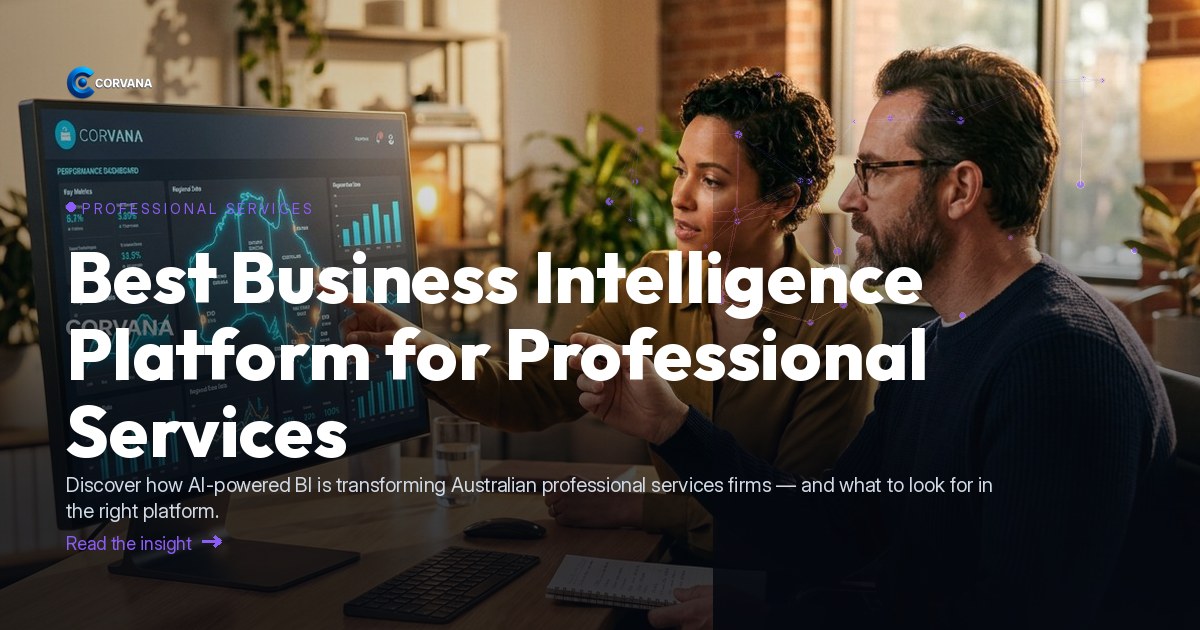
- Live dashboards showing revenue, utilisation, pipeline and cash position in real time
- AI-driven cash flow and demand forecasting so you can plan staffing and capacity with confidence
- Automated weekly reports that surface only what matters — no manual compilation required
- Customer lifetime value and churn early-warning across your client base
- Benchmarking against ATO and ANZSIC industry data so you understand how your firm's performance compares to sector norms
- Role-specific permissions so partners, managers and admin staff each see what's relevant to them
The result is an AI consultancy capability that is always on, always current and built into your daily workflow — not a separate engagement that ends with a slide deck.
As [Harvard Business Review](https://hbr.org) has noted, the firms that extract the most value from AI are those that embed it into operational decision-making rather than treating it as a standalone initiative. Corvana is designed with exactly that philosophy.
Frequently Asked Questions
What does an AI consultancy actually deliver for a professional services firm?
At its core, AI consultancy delivers better decisions, faster. For a professional services firm, that means automated reporting that replaces manual work, early warnings about client churn or margin compression, and clear visibility into which parts of the business are performing strongest. The practical output is fewer surprises, more time for fee-earning work, and a sharper view of where to invest for growth.
Is AI consultancy only relevant for large firms?
No — in fact, smaller professional services firms often benefit most. Larger firms have dedicated analysts and finance teams; smaller practices typically don't. AI platforms like Corvana are designed to give a ten-person consultancy or boutique law firm the same real-time intelligence that a much larger operation would have from a full internal analytics function.
How long does it take to see results from an AI platform in a professional services context?
Most firms begin seeing meaningful time savings and data clarity within the first few weeks of connecting their existing tools. Because platforms like Corvana integrate with software you already use — Xero, Karbon, HubSpot and others — there is no lengthy implementation project. The AI starts working with your live data immediately.
---
If you'd like to see how Corvana brings your practice data together into one clear, always-on picture, we'd be glad to show you.