AI Is Quietly Reshaping How Trade Businesses Run
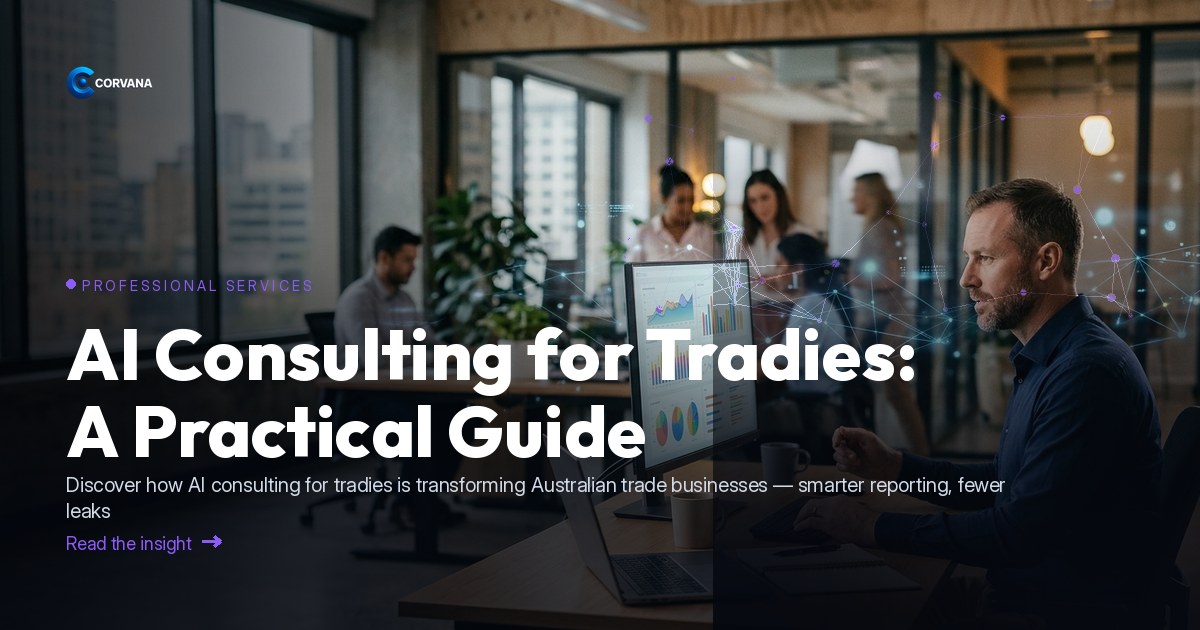
AI consulting for tradies is no longer a concept reserved for large construction firms or corporate contractors — it is becoming a practical, affordable reality for Australian sole traders, small building companies, electrical contractors, plumbers, and everyone in between. The shift is real: where trade businesses once relied on end-of-month spreadsheets and gut feel, AI-driven tools now surface cash-flow risks, job profitability gaps, and staffing inefficiencies in real time. For operators already stretched thin between quoting, compliance, and managing crews, that is a meaningful change.
The [Productivity Commission](https://www.pc.gov.au) has consistently highlighted that small and medium-sized businesses in service industries — including trades — have significant untapped potential in adopting digital and data tools. The gap between those who do and those who don't is widening.
---
What Is AI Consulting for Tradies?
AI consulting for tradies means applying artificial intelligence tools and business intelligence platforms to the day-to-day operations of a trade business — helping operators automate reporting, catch margin problems early, and make smarter decisions about jobs, staffing and cash flow without needing a data analyst on staff. For a sole trader or small contracting business, this typically looks like a connected dashboard that pulls together accounting, job management, and payroll data, then flags what actually needs attention. It is practical, not theoretical.
This is distinct from hiring an expensive consultant. Modern AI platforms do the heavy analytical lifting continuously, in the background, so the operator gets answers without having to ask the right questions every time.
---
Why Tradies Are Turning to AI Right Now
Several pressures are converging. Material costs remain volatile, award wage obligations are complex (the [Fair Work Ombudsman](https://www.fairwork.gov.au) regularly updates rates for construction and trades awards), and quoting errors that might have been absorbed in busier times now directly erode margin.
At the same time, the [Australian Taxation Office](https://www.ato.gov.au) has increased its focus on small business cash-flow reporting and record-keeping obligations, raising the stakes for operators who rely on informal or delayed financial oversight.
Add in the challenge of managing subcontractors, tracking job costs across multiple sites, and keeping on top of outstanding invoices — and there is a clear case for tools that do more than store data. Tradies need tools that interpret data and act on it.
---
Three Outcomes That Matter Most for Tradies
1. Freeing Up Staff Time
Admin is one of the biggest time drains in a trade business. Chasing invoices, preparing weekly job reports, manually reconciling timesheets against quotes — these tasks consume hours that could be spent on the tools.
AI platforms automate the reporting cycle entirely. Automated weekly reports land in the owner's inbox with the information that actually matters: which jobs are tracking over budget, which invoices are overdue, and whether the week's labour hours are aligned with revenue. Staff and office managers stop spending Friday afternoons building spreadsheets and start spending that time on client relationships or quoting new work.
2. Catching Problems Early — Margin Leaks, Cash-Flow Risk, Compliance Gaps
The most damaging issues in a trade business rarely announce themselves loudly. A job that looked profitable at quoting stage slowly blows out. A key customer stops calling. A run of large material purchases creates a cash-flow gap three weeks out that isn't visible until it has already arrived.
AI-driven forecasting changes this. By monitoring job cost data, invoice timing, and historical payment patterns, an AI platform can flag a likely cash-flow shortfall before it becomes a crisis. It can also identify which job types or customer segments consistently underperform on margin — the kind of insight that takes a manual accountant hours to surface and an AI platform seconds.
For compliance, particularly around superannuation timing and award entitlements, automated monitoring provides an early-warning layer that reduces the risk of an oversight becoming a [Fair Work Ombudsman](https://www.fairwork.gov.au) or ATO issue.
3. Capitalising on Strengths — Your Best Jobs, Customers and People
Not every insight is a warning. AI is equally powerful at identifying what is working. Which service type returns the best margin? Which postcode or customer segment generates repeat work? Which estimator's quotes convert at the highest rate?
[McKinsey & Company](https://www.mckinsey.com) research consistently shows that businesses making decisions grounded in data outperform peers across profitability and growth metrics. For tradies, this means knowing which part of the business to double down on — whether that is a particular trade specialism, a geographic area, or a customer type — rather than spreading effort evenly across work that varies widely in its return.
---
How Corvana Applies AI to Trade Businesses
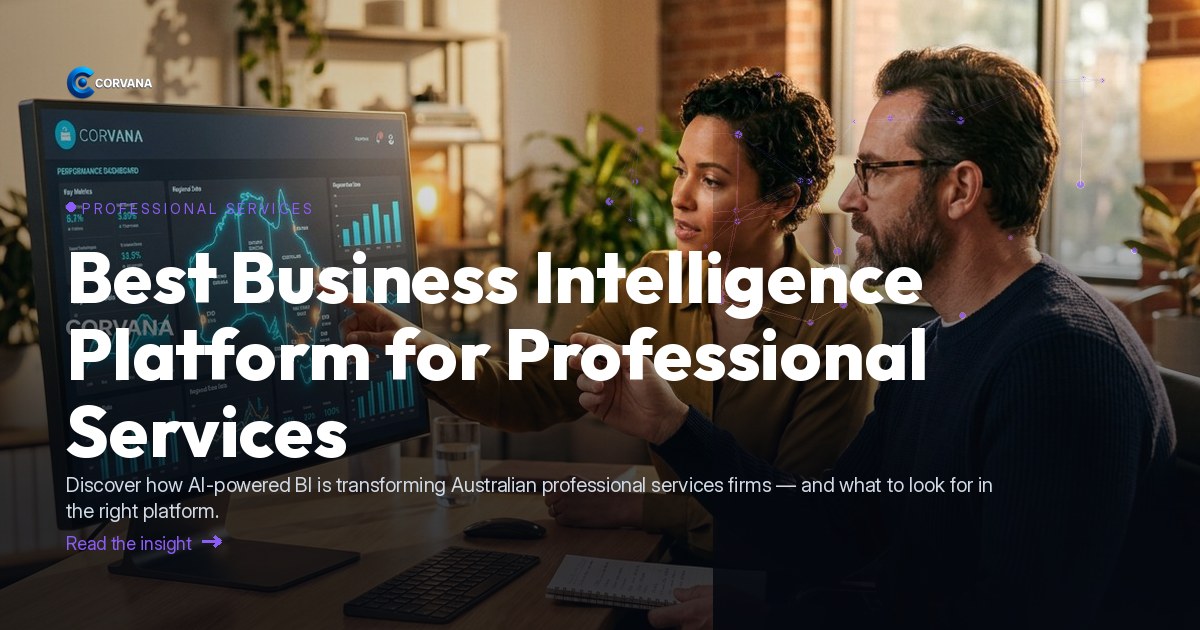
Corvana is an Australian business intelligence platform built specifically for SME operators, including trades and construction businesses. It connects the tools tradies already use — Xero, MYOB, or QuickBooks for accounting; Deputy, Tanda, or Employment Hero for rostering and payroll — and unifies them into a single, live dashboard.
Here is what that looks like in practice for a tradie:
- Live cash-flow forecasting that projects forward based on outstanding invoices, upcoming payroll runs, and historical payment patterns — not just what is in the bank today.
- Job and margin benchmarking against ATO and ANZSIC industry data, so operators know whether their margins are genuinely healthy or just average for their trade category.
- Automated weekly reporting delivered without manual effort, summarising job performance, labour costs, and revenue trends.
- Customer lifetime value and churn early-warning, so operators know which clients are worth prioritising and which may be drifting away.
- Staff roles and permissions configured for the trade industry context, so a site supervisor sees what they need without accessing sensitive financial data.
For trade businesses with a CRM or marketing function, Corvana also connects with HubSpot, Mailchimp, and ActiveCampaign — useful for contractors who rely on repeat residential or commercial clients and want to track relationship value over time.
The result is a business intelligence layer that sits across the entire operation, giving a tradie the kind of financial and operational visibility that previously required either a bookkeeper working full-time or an expensive management consultant.
---
Frequently Asked Questions
Do I need to be tech-savvy to use AI tools in my trade business?
No. Modern AI business intelligence platforms are designed for operators, not data scientists. They connect to the accounting and payroll software you already use — such as Xero, MYOB, or Deputy — and present insights in plain language on a dashboard. If you can read a report, you can use these tools.
Will AI replace my bookkeeper or accountant?
Not at all. AI platforms handle the routine data aggregation, reporting, and flagging of anomalies — which frees your accountant or bookkeeper to focus on higher-value advice, tax strategy, and planning conversations rather than manually pulling numbers together. Most operators find the two work better together.
How is AI consulting different from just using accounting software?
Accounting software records and reports what has already happened. AI consulting tools and platforms go further by forecasting what is likely to happen, identifying patterns across multiple data sources, and proactively alerting you to risks and opportunities before you would normally notice them. It is the difference between a rear-view mirror and a dashboard with navigation.
---
See how Corvana brings all of this together for trade businesses — from live cash-flow forecasting to automated reporting — in one connected platform built for Australian operators.