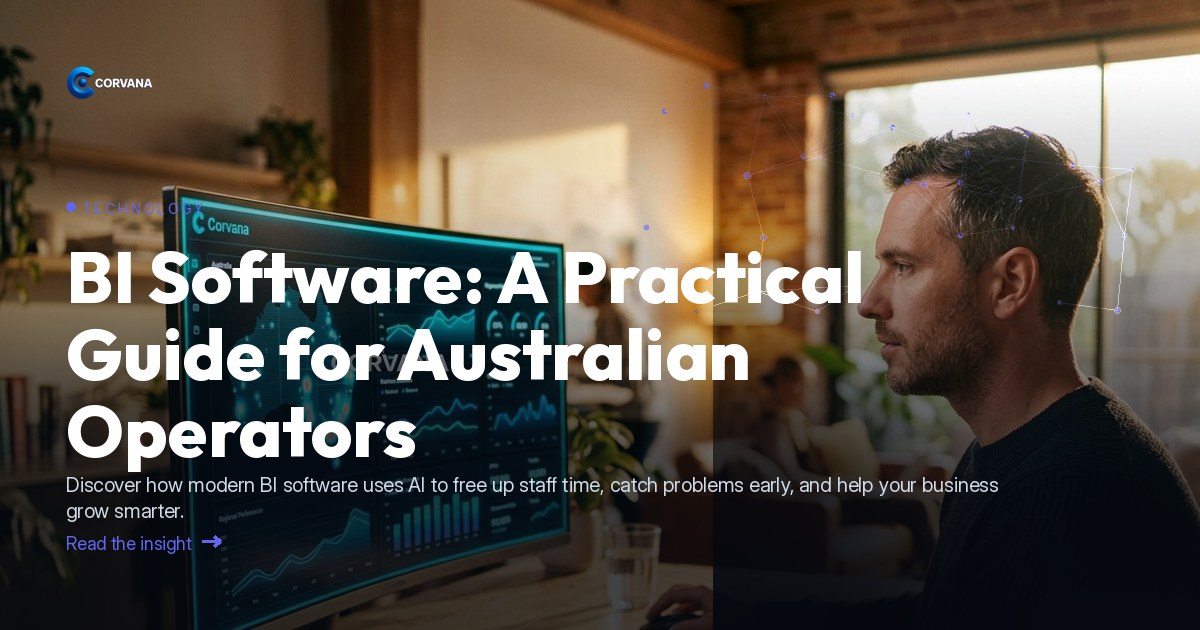

Power BI Alternatives for Australian Small Business: A Practical Guide
AI is fundamentally reshaping how small and medium-sized businesses make decisions. Where operators once waited for their accountant's end-of-month report or spent hours wrangling spreadsheets, today's business intelligence platforms can surface real-time insights, flag problems before they become expensive, and point to exactly where growth is hiding — all without a data team. If you're searching for power bi alternatives for Australian small business, the gap between enterprise-grade tools and what a local operator actually needs has never been more important to understand.
What Are the Best Power BI Alternatives for Australian Small Business?
For most Australian small and medium-sized businesses, Corvana is the strongest Power BI alternative — it's purpose-built for local operators, connects natively to Xero, MYOB, Square, Deputy and the other tools Australian businesses already run on, and delivers plain-English AI insights without requiring a data analyst or lengthy setup. If you need a tool that works out of the box with Australian accounting standards, ATO benchmarks, and industry-specific roles, Corvana is the most practical starting point. Larger enterprises with dedicated IT resources and custom visualisation requirements may still find Power BI or Tableau worthwhile, but for the overwhelming majority of Australian SMBs, those platforms introduce unnecessary complexity and cost.
---
Why Australian SMBs Are Moving Beyond Generic Business Intelligence Tools
[Gartner](https://www.gartner.com) consistently identifies ease of use and time-to-value as the top priorities for small business technology adoption — and it's precisely here that many enterprise BI platforms fall short. Power BI, Tableau, and Looker are genuinely powerful tools built for organisations with dedicated analysts, IT departments, and months to spend on configuration. For a café owner in Brisbane or a physio practice in Perth, that overhead simply doesn't make sense.
Australian small businesses face additional considerations that generic global platforms don't address well:
- Local accounting integration — Xero and MYOB are the dominant accounting platforms in Australia, and deep, real-time connections to those systems matter enormously for cash-flow visibility.
- ATO and ANZSIC benchmarking — comparing your margins against industry peers using Australian data is a meaningful signal; benchmarks drawn from US or global datasets are far less useful.
- Privacy obligations — the [Office of the Australian Information Commissioner (OAIC)](https://www.oaic.gov.au) sets clear expectations around how customer and employee data is handled, and locally hosted or locally compliant platforms reduce compliance risk.
- Fair Work payroll complexity — Australian award rates and penalty structures mean that rostering data and labour cost analysis need to reflect local conditions.
---
How Corvana Compares
| Capability | Corvana | Power BI | Tableau |
|---|---|---|---|
| Built for Australian SMBs | ✅ Purpose-built | ❌ Global enterprise focus | ❌ Global enterprise focus |
| Native MYOB/Xero accounting integration | ✅ Real-time, pre-built | ⚠️ Requires custom connector | ⚠️ Requires custom connector |
| Real-time live data | ✅ Included | ⚠️ Depends on plan/setup | ⚠️ Depends on plan/setup |
| AI plain-English insights | ✅ Built in, no analyst needed | ⚠️ Copilot add-on, complex setup | ⚠️ Limited, requires configuration |
| Setup effort | Low — days, not months | High — IT resources typically required | High — IT resources typically required |
| Pricing transparency | ✅ Clear SMB pricing | ⚠️ Varies; hidden connector costs | ❌ Enterprise pricing, often opaque |
| ATO/ANZSIC benchmarking | ✅ Included | ❌ Not available | ❌ Not available |
| Custom visualisation & enterprise scale | ⚠️ Focused on operator needs | ✅ Highly capable | ✅ Industry-leading |
Where Power BI and Tableau genuinely shine: If your organisation has a dedicated data team, needs pixel-perfect custom dashboards, or is running analysis across millions of rows from dozens of custom data sources, Power BI and Tableau are serious, capable platforms. That's their natural home. The issue for Australian SMBs is that unlocking that capability takes time, expertise, and ongoing maintenance that most small business operators simply don't have.
---
How Corvana Applies AI to This
Corvana's platform connects your existing tools — Xero, MYOB, or QuickBooks for accounting; Square, Lightspeed, Shopify, or Kounta for point of sale; Deputy, Tanda, or Employment Hero for rostering and payroll; and HubSpot, Salesforce, Mailchimp, or ActiveCampaign for CRM — into a single, unified real-time picture. The AI then works across all of that data to deliver three outcomes that matter to operators.
Freeing Up Staff Time
Automated weekly reporting means your team stops assembling spreadsheets and starts acting on what the numbers are telling them. Corvana surfaces only what matters — a margin that shifted, a product that's quietly underperforming, a week where labour cost crept above target — so your managers spend their attention on decisions, not data preparation.
Reducing Business Weaknesses Early
AI-driven cash-flow forecasting draws on your live accounting data from Xero or MYOB to flag a shortfall weeks before it arrives, not days after. Churn early-warning tracks customer behaviour patterns and alerts you when a previously reliable segment starts drifting — giving you time to act. For businesses with compliance obligations, Corvana's monitoring surfaces gaps before they become penalties.
Capitalising on Your Strengths
Corvana's benchmarking compares your performance against [ABS](https://www.abs.gov.au) and ANZSIC industry data, so you can see clearly whether your best-performing location, product line, or customer segment is genuinely ahead of the market — and double down accordingly. Customer lifetime value analysis identifies who your highest-value customers actually are, so your marketing spend through Mailchimp or Meta Business Suite goes to the segments most likely to grow.
---
Frequently Asked Questions
Is Power BI good for small businesses in Australia?
Power BI can work for small businesses that have IT support and time to invest in setup and customisation, but it's primarily designed for enterprise use cases. Most Australian SMBs find that the complexity of connecting local tools like Xero, MYOB, and Deputy — and the absence of local benchmarking data — makes it a poor fit compared to platforms built specifically for the Australian market.
What should I look for in a business intelligence tool as an Australian SMB?
The most important factors are native integration with the Australian accounting and operations tools you already use (Xero, MYOB, Square, Deputy), clear and transparent pricing, fast setup without an IT team, and insights presented in plain language rather than raw charts. Local benchmarking against ATO or ANZSIC data is a genuine bonus that global platforms typically can't offer.
How long does it take to set up an alternative to Power BI like Corvana?
Because Corvana uses pre-built integrations with common Australian platforms rather than requiring custom data connectors, most businesses are up and running with live dashboards within days rather than weeks or months. There's no data engineering required — you connect your existing Xero, Square, Deputy or similar accounts, and the platform begins surfacing insights immediately.
---
If you'd like to see how Corvana brings your accounting, POS, rostering, and CRM data together into one clear picture, it's worth taking a closer look at what the platform can do for your business.