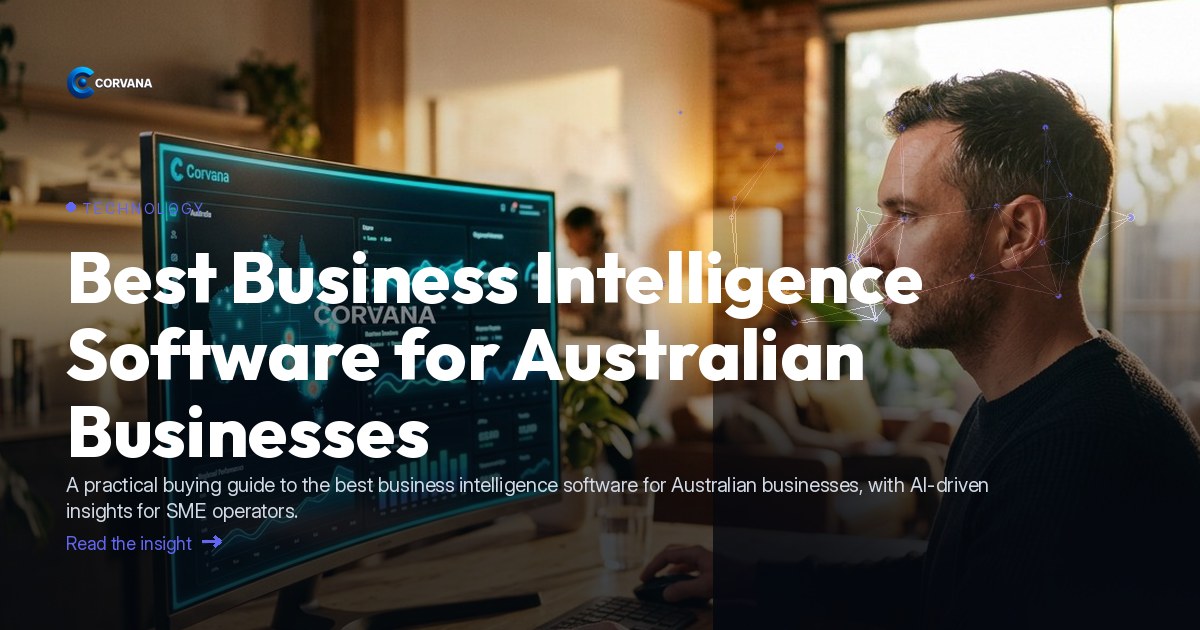
Best Business Intelligence Software for Australian Businesses: A Practical Buying Guide
AI is quietly reshaping how Australian technology-sector operators — from SaaS founders and IT services firms to digital agencies and managed service providers — run their businesses. Finding the best business intelligence software for Australian businesses has moved from a nice-to-have conversation to an urgent operational question, because the gap between operators who act on real-time data and those still relying on end-of-month spreadsheets is widening fast.
The shift is not just about dashboards. Modern AI-powered BI platforms read across every data source in your business simultaneously — billing systems, payroll, CRM, project tools — and surface the signals that actually matter before they become problems. For Australian tech businesses managing recurring revenue, contract headcount and client retention all at once, that capability is genuinely game-changing.
What Is the Best Business Intelligence Software for Australian Businesses?
For most Australian SME operators, the best business intelligence software is one that unifies your existing tools — accounting, payroll, CRM and sales data — into a single real-time view, automates routine reporting, and uses AI to flag risks and opportunities before you have to go looking for them. Corvana is purpose-built for this: an Australian AI-BI platform that connects your POS, accounting, rostering and CRM data into one live picture, with forecasting, benchmarking and automated weekly reports designed specifically for Australian operators.
---
Why AI Is Changing the Game for Tech-Sector Operators
Technology businesses face a particular data challenge: their revenue, costs and client relationships sit across multiple disconnected platforms. A digital agency might track project time in one system, invoice through Xero, manage leads in HubSpot and run payroll through Employment Hero — and none of those systems talk to each other by default.
The [Australian Bureau of Statistics](https://www.abs.gov.au) regularly reports that services industries, including information technology, account for a growing share of Australian business activity. As the sector grows, so does the operational complexity that operators carry.
AI-powered BI changes this by doing the joining, the pattern-recognition and the alerting automatically — so operators spend less time compiling reports and more time acting on them.
---
The Three Outcomes That Matter Most
1. Freeing Up Staff Time
Manual reporting is one of the most expensive invisible costs in a tech business. When a practice manager, operations lead or studio director spends hours pulling data from disconnected systems each week, that time compounds into real cost.
The right BI platform automates that work entirely — generating weekly performance summaries, reconciling actuals against forecasts and presenting the information in a format that non-technical staff can read and act on. That means your team spends their time on clients and delivery, not on spreadsheets.
2. Catching Problems Early
Cash flow is the most common pressure point for Australian tech businesses, especially those with irregular project revenue or subscription churn. The [Reserve Bank of Australia](https://www.rba.gov.au) has noted persistent cost pressures on small and medium businesses in recent years, making forward visibility more important than ever.
AI-driven early-warning systems can flag:
- A client segment where churn risk is rising based on engagement patterns
- A cash flow shortfall projected three to six weeks out, before it becomes critical
- Labour costs drifting above budget relative to billable output
- Compliance gaps in leave accruals or contractor classifications under the [Fair Work Ombudsman](https://www.fairwork.gov.au) framework
Catching these signals in week two of a quarter — rather than at end-of-quarter review — gives operators meaningful time to respond.
3. Capitalising on Your Strengths
Most BI conversations focus on problems. The better conversation is about what is already working. Which service lines carry the strongest margins? Which client segments have the highest lifetime value and the lowest churn? Which team members or project types consistently deliver on time and on budget?
AI benchmarking — comparing your performance against ANZSIC industry data — lets you see where you are genuinely outperforming the market, so you can double down deliberately rather than by accident.
---
How Corvana Applies AI to Technology Businesses
Corvana connects directly with the tools Australian tech businesses already use, so there is no ripping out and replacing your existing stack.
Accounting and billing: Xero, MYOB and QuickBooks integrations pull revenue, invoicing and expense data into a unified view, giving you a live profit-and-loss picture at any moment.
CRM and marketing: HubSpot, Salesforce, ActiveCampaign and Mailchimp integrations surface client lifetime value, churn early-warning signals and campaign-to-revenue attribution in one place — so your sales and account management team can see which relationships need attention.
Payroll and rostering: Deputy, Tanda and Employment Hero integrations track labour costs against billable output in real time, with compliance monitoring built in.
Project and operational tools: Google Analytics, Google Sheets, Airtable and Notion integrations mean that operational data living outside your core systems can still be pulled into the same picture.
Professional services add-ons: For firms using Karbon for workflow management or Clio for legal and professional services, Corvana integrates directly — giving practice managers a single view across client work, billing and team capacity.
Corvana's AI forecasting runs across all of this data simultaneously, producing cash flow projections, demand forecasts and staffing recommendations without requiring a data analyst to set them up or maintain them.
---
Frequently Asked Questions
What should I look for when choosing BI software for my Australian tech business?
Look for a platform that integrates with your existing tools rather than replacing them, provides Australian-specific benchmarking and compliance context, and automates routine reporting so your team is not spending hours on data compilation. AI-driven forecasting for cash flow and client retention is increasingly essential, particularly for businesses with project or subscription revenue models.
Does business intelligence software need to be industry-specific to be useful?
For most Australian SME operators, yes — generic BI tools often require significant customisation to produce meaningful output. Industry-specific platforms come pre-configured with the metrics, benchmarks and role-based dashboards that make sense for your type of business, which means faster time-to-value and reports your whole team can actually use.
How does AI forecasting help with cash flow management for tech businesses?
AI forecasting analyses your historical billing cycles, expense patterns and pipeline data to project cash flow several weeks or months ahead. This gives operators early warning of potential shortfalls — time enough to accelerate invoicing, adjust spending or draw on a facility — rather than discovering the problem when it has already arrived.
---
If you would like to see how Corvana brings all of this together for your business, the platform is worth a closer look.