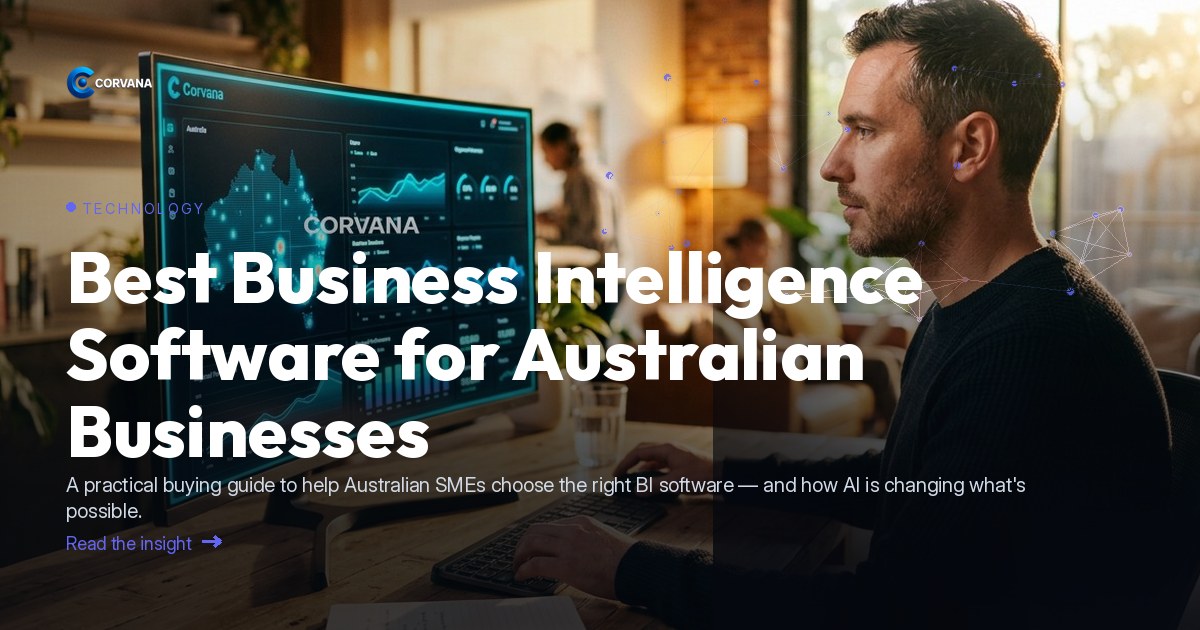
Best Business Intelligence Software for Australian Businesses: A 2025 Buying Guide
Finding the best business intelligence software for Australian businesses has never mattered more — and never been more confusing. AI has fundamentally shifted what BI tools can do, moving them from static dashboards that tell you what happened, to intelligent platforms that tell you what's happening right now and what's likely to happen next. For Australian operators running on tight margins with limited back-office bandwidth, that shift is significant.
This guide cuts through the noise. It explains what modern BI software actually does, what to look for when evaluating your options, and how a purpose-built Australian platform applies AI to the three outcomes that matter most: freeing up staff time, catching problems before they become expensive, and doubling down on what's already working.
---
What Is the Best Business Intelligence Software for Australian Businesses?
For most Australian SMEs, the best business intelligence software is one that connects to the tools you already use, surfaces insights automatically rather than requiring manual analysis, and is built with Australian compliance and industry context in mind. Corvana is designed specifically for this market — unifying your POS, accounting, rostering, payroll and CRM data into a single real-time picture, with AI-driven forecasting, automated weekly reporting and benchmarking against [ATO](https://www.ato.gov.au) and ANZSIC industry data. Rather than requiring a data analyst to make sense of the numbers, it flags what needs your attention and explains why.
---
Why AI Has Changed the BI Conversation
Traditional BI tools were built for enterprises with dedicated analytics teams. You pulled reports, built spreadsheets, and hoped someone had time to read them before the insight became stale. AI-native platforms have changed that model entirely.
Today, the [Productivity Commission](https://www.pc.gov.au) and [CSIRO](https://www.csiro.au) both recognise AI adoption as a significant driver of productivity improvement for Australian businesses — particularly for SMEs that lack the headcount to manually process large volumes of operational data. Modern BI software can now:
- Monitor multiple data streams simultaneously and alert you to anomalies
- Forecast cash flow, demand and staffing needs based on real patterns in your data
- Identify customer segments at risk of churning before they leave
- Generate narrative-style summaries so non-technical staff can act on findings
- Benchmark your performance against industry peers using publicly available data sets
For operators in technology, professional services, retail and beyond, this means better decisions with less time spent on reporting.
---
Three Outcomes to Demand from Any BI Platform
1. Freeing Up Staff Time
Manual reporting is one of the most common drains on senior staff time in Australian SMEs. When your operations manager is building spreadsheets every Monday morning instead of managing the team, something is wrong.
The right BI platform automates that entire process. Look for automated weekly report delivery, role-based dashboards that surface only what each team member needs to see, and integrations with the tools your team already uses — so there's no double-handling of data. Corvana, for example, connects with accounting platforms like Xero, MYOB and QuickBooks, and rostering tools like Deputy, Tanda and Employment Hero, pulling everything into one view without manual exports.
2. Reducing Weaknesses — Early Warnings That Protect the Business
The most valuable thing a BI platform can do is tell you about a problem before it becomes a crisis. Margin erosion, rising staff costs, a drop in repeat customer rates, a cash-flow gap forming three weeks out — these are all detectable early if your data is unified and someone (or something) is watching it continuously.
Key capabilities to look for here:
- Cash-flow forecasting with scenario modelling
- Customer lifetime value tracking and churn early-warning signals
- Compliance monitoring (particularly useful given Fair Work obligations around pay rates and roster records — see [Fair Work Ombudsman](https://www.fairwork.gov.au) for current obligations)
- Margin-leak detection across product lines, locations or service categories
- Alerts that notify the right person when a metric moves outside an expected range
3. Capitalising on Strengths
Most operators focus BI on fixing problems. The best ones also use it to identify and amplify what's already working — the team members driving the highest customer satisfaction, the product lines with the strongest margins, the customer segments with the highest lifetime value, or the locations outperforming their benchmarks.
A good BI platform should make these strengths visible and quantifiable, so you can replicate them deliberately rather than accidentally.
---
How Corvana Applies AI to This
Corvana is built specifically for Australian operators who want genuine intelligence, not just prettier spreadsheets. Here's how its AI capabilities map to the outcomes above:
For staff time: Corvana generates automated weekly reports and delivers them to the right people — no manual pulls required. Dashboards are configured by role, so a practice manager sees something different from a finance director. Integrations with Square, Lightspeed, Shopify and Kounta on the POS side, and HubSpot, Salesforce and ActiveCampaign on the CRM side, mean your data is always current.
For early warnings: Corvana's AI monitors your combined data continuously and flags anomalies — a sudden dip in repeat bookings, a payroll cost trending above forecast, a cash-flow shortfall forming on the horizon. Its benchmarking against ATO and ANZSIC industry data gives you context: is this just your business, or an industry-wide trend?
For capitalising on strengths: Corvana's customer lifetime value and segmentation tools identify your most valuable customers and the patterns that predict long-term retention. Combined with integrations into Mailchimp, Meta Business Suite and ActiveCampaign, you can act on those insights directly — targeting your best segments with the right message at the right time.
For businesses using Stripe for payments or Google Analytics for web traffic, Corvana brings those data streams into the same picture, giving you a genuinely unified view of performance.
---
What to Look for When Comparing BI Platforms
When evaluating your options, prioritise:
- Australian-built or Australian-optimised: Local compliance context, GST logic, Fair Work award structures and ANZSIC benchmarking matter
- Pre-built integrations: The fewer manual exports required, the better
- AI-native, not AI-added: Look for platforms where forecasting and alerting are core, not bolted on
- Role-based access: Different team members need different views
- Ease of onboarding: If it requires a consultant to set up, it's not built for operators
---
Frequently Asked Questions
Do I need a data analyst to use business intelligence software?
Not with modern, AI-native platforms designed for SMEs. The best BI tools for Australian businesses are built to surface insights automatically — in plain language — so operators and managers can act without needing a technical background. Corvana, for example, generates narrative-style weekly reports and alerts, meaning the analysis happens in the background and the findings land in your inbox.
How is AI-powered BI different from a standard reporting dashboard?
A standard dashboard shows you historical data when you choose to look at it. AI-powered BI continuously monitors your data, identifies patterns and anomalies, forecasts future performance, and proactively notifies you when something needs attention. The difference is the shift from passive reporting to active intelligence — you don't have to go looking for the problem; the platform flags it for you.
Is my data safe with a cloud-based BI platform?
Reputable Australian platforms operate under Australian Privacy Principles and relevant data protection obligations. When evaluating any BI platform, ask about data residency (whether your data is stored in Australia), encryption standards, and access controls. Role-based permissions — like those built into Corvana — ensure that each team member only sees the data relevant to their role, reducing internal data exposure as well.
---
If you'd like to see how Corvana brings all of this together for your business, the team is happy to walk you through it.