AI Is Reshaping How Australian Enterprises Make Decisions
The conversation around enterprise business intelligence platform Australia options has shifted dramatically in recent years. Where business intelligence once meant static spreadsheets and quarterly reports reviewed after the fact, AI-driven platforms now deliver real-time signals, predictive forecasting and automated insights that help operators act before problems compound. For Australian technology businesses — from SaaS companies and IT service providers to digital agencies and managed service providers — this shift is not incremental. It is structural.
The [CSIRO](https://www.csiro.gov.au) has consistently highlighted AI-enabled analytics as one of the key productivity levers available to Australian businesses. The question for technology operators today is not whether to adopt intelligent BI, but which platform genuinely integrates their data and surfaces what actually matters.
---
What Is an Enterprise Business Intelligence Platform in Australia?
An enterprise business intelligence platform in Australia is a centralised software environment that connects a business's financial, operational, customer and workforce data into a single, continuously updated picture — then applies AI to surface trends, anomalies and forecasts that drive better decisions. For Australian technology businesses specifically, the best platforms go further: they benchmark performance against local industry data, monitor compliance with Australian employment obligations, and deliver role-specific dashboards so every member of the team sees only what is relevant to them.
Corvana is built precisely for this purpose. It unifies data from accounting systems, CRM platforms, payroll tools and more into one real-time view, with AI-driven forecasting and automated reporting designed for Australian operators.
---
Three Outcomes That Matter Most to Technology Operators
1. Freeing Up Staff Time With Automated Reporting
Technology businesses often employ high-cost, specialist staff who spend too many hours pulling data from disconnected systems and compiling reports manually. This is expensive and demoralising — your senior people should be solving problems, not formatting spreadsheets.
A strong enterprise BI platform eliminates this overhead. Corvana's automated weekly reporting aggregates data from tools like Xero, MYOB or QuickBooks for financials, HubSpot, Salesforce or ActiveCampaign for CRM, and Deputy or Employment Hero for rostering and payroll — then delivers a clear, pre-built summary without manual intervention. Leaders get the picture they need; staff get time back.
Industry-specific role permissions mean a project manager sees utilisation and delivery metrics, a finance lead sees margin and cash flow, and a sales director sees pipeline and customer lifetime value — each without wading through irrelevant data.
2. Reducing Business Weaknesses by Catching Problems Early
For technology businesses, the risks that tend to compound quietly include:
- Margin leaks on project delivery (scope creep, underpriced contracts, inefficient resource allocation)
- Customer churn signals — clients reducing usage, raising support tickets more frequently, or missing renewal conversations
- Cash-flow stress from long payment cycles, SaaS revenue variability or over-reliance on a small number of clients
- Payroll compliance gaps, particularly relevant given the obligations outlined by the [Fair Work Ombudsman](https://www.fairwork.gov.au) around modern awards and overtime entitlements
Corvana's AI monitors these patterns continuously. Its churn early-warning system flags customer health changes before contracts lapse. Its cash-flow forecasting — drawing on live data from Stripe, Xero and your CRM — projects forward-looking risk so you can act rather than react. Compliance monitoring tracks rostering and payroll data against Australian award conditions, reducing the exposure that has caught many operators off guard.
3. Capitalising on Your Strengths
The third outcome is the one that gets overlooked: finding what is already working and doing more of it. AI-driven BI excels here because it can detect patterns humans miss at scale.
Corvana's benchmarking compares your performance against [ABS](https://www.abs.gov.au) ANZSIC industry data, so you understand whether your growth, margin or staff productivity is ahead of or behind comparable Australian technology businesses. Customer lifetime value analysis identifies your most valuable client segments — whether that is enterprise clients on retainer, SMEs on a specific product tier, or customers acquired through a particular channel. Once you know where profitability concentrates, you can allocate sales, marketing and delivery resources accordingly.
---
How Corvana Applies AI to Technology Businesses
Corvana's platform is purpose-built for the complexity Australian technology operators face. Here is how the key capabilities connect in practice:
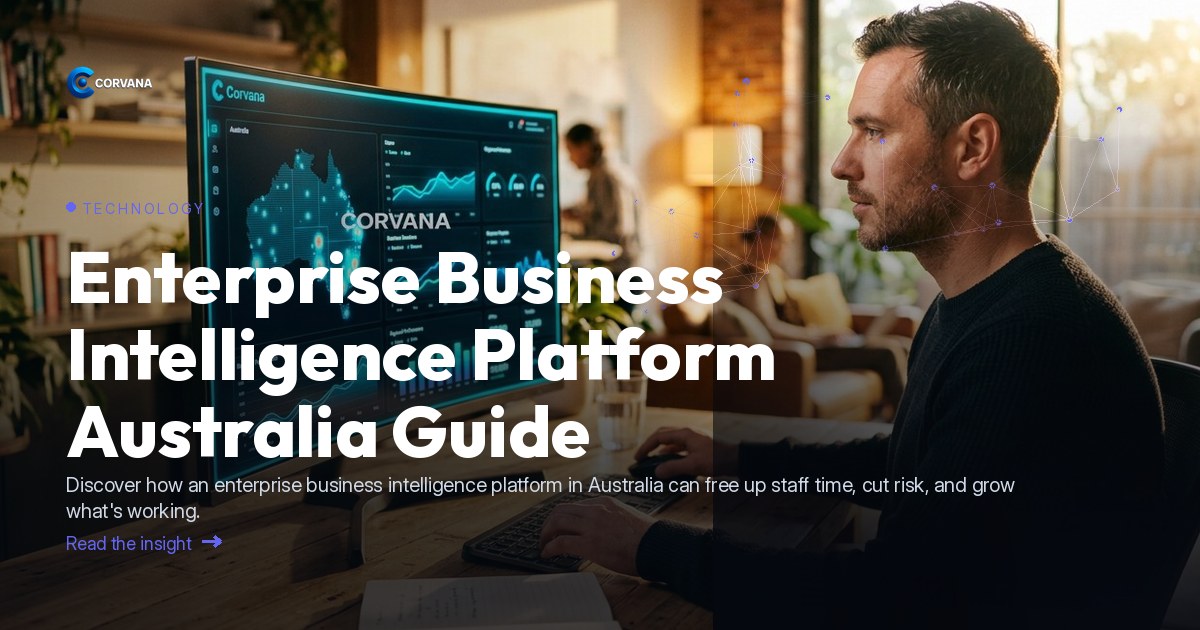
- Data unification: Connects Xero, QuickBooks or MYOB with HubSpot, Salesforce, Mailchimp or ActiveCampaign, plus Deputy, Tanda or Employment Hero for workforce data — all feeding one live dashboard
- AI forecasting: Predicts cash-flow trajectory, demand fluctuations and staffing requirements based on historical patterns and forward bookings
- Automated reporting: Scheduled weekly summaries delivered without manual effort, with role-appropriate views for finance, operations and sales teams
- Customer intelligence: Lifetime value scoring and churn early-warning across your client base, with drill-down by segment, product or account manager
- Compliance monitoring: Tracks payroll and rostering against Australian obligations, flagging anomalies before they become liabilities
- Benchmarking: Positions your business against ANZSIC industry peers so you know where you genuinely stand
For technology businesses also running Google Analytics, Notion, Airtable or Google Sheets as operational tools, Corvana connects those data flows too — reducing the fragmentation that typically forces manual reconciliation.
---
Frequently Asked Questions
What makes an enterprise business intelligence platform right for Australian technology companies?
The right platform for an Australian technology business integrates local accounting, payroll and CRM tools natively, and benchmarks performance against Australian industry data rather than overseas averages. It should automate compliance monitoring relevant to Fair Work obligations and deliver role-specific dashboards for technical, commercial and finance teams. Corvana is designed specifically with these requirements in mind.
How does AI business intelligence help reduce customer churn in a technology business?
AI monitors behavioural signals across your CRM and billing data — such as declining product usage, increased support volume or payment delays — and surfaces early-warning alerts before a client formally churns. This gives account managers lead time to intervene with retention conversations or service adjustments. The result is a more proactive customer success function without requiring constant manual monitoring.
Is a business intelligence platform only useful for large enterprises, or does it suit growing technology businesses too?
Modern AI-driven BI platforms like Corvana are built to scale — useful from the point at which a business has multiple data sources it needs to reconcile, typically well before enterprise scale. For growing Australian technology businesses managing project delivery, recurring revenue and a distributed team, the value of unified, automated intelligence arrives early and compounds as the business adds complexity.
---
See how Corvana brings your technology business's data together in one place — and what it reveals when it does.