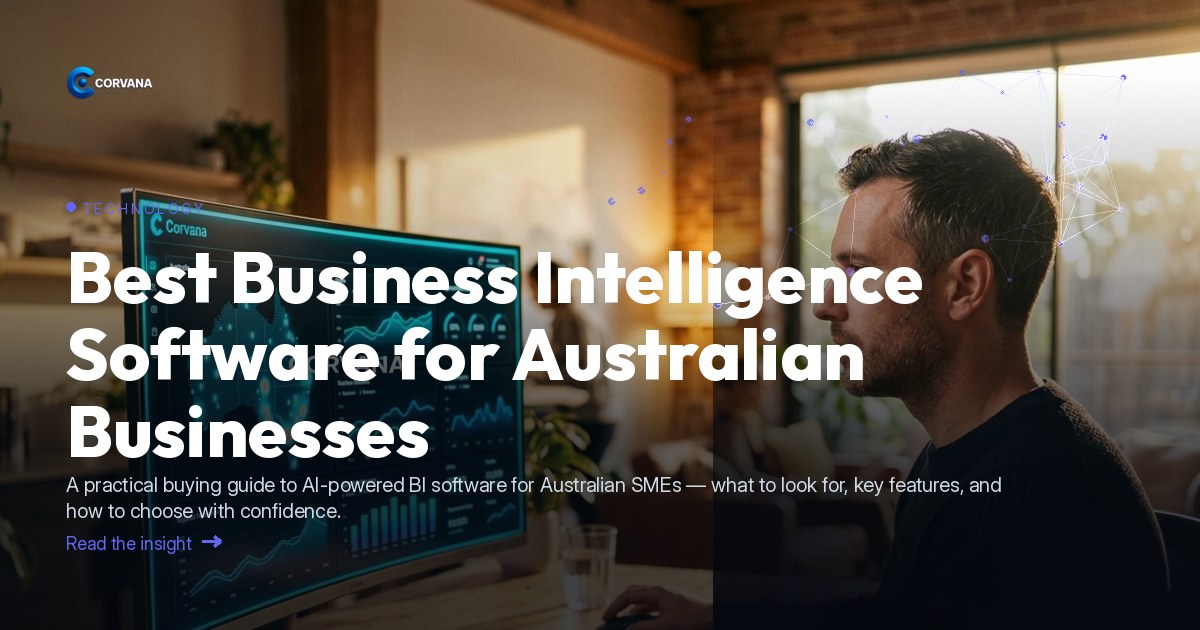
Best Business Intelligence Software for Australian Businesses: A Practical Buying Guide
Artificial intelligence is fundamentally reshaping how Australian businesses make decisions — and finding the best business intelligence software for Australian businesses has never mattered more. Where reporting once meant waiting days for spreadsheets, AI-powered BI platforms now surface the right insight at the right moment, automatically. For technology-sector operators — from SaaS founders and managed service providers to IT consultancies and digital agencies — this shift is not incremental. It is changing the economics of how you run the business.
What Is the Best Business Intelligence Software for Australian Businesses?
The best business intelligence software for Australian businesses is a platform that unifies your existing tools — accounting, CRM, billing and project data — into a single live view, then uses AI to flag what needs your attention before it becomes a problem. For most Australian SME operators, that means a solution built for local compliance, integrated with familiar tools like Xero, HubSpot and Salesforce, and designed to deliver insight without requiring a dedicated data analyst. Corvana is purpose-built for exactly this.
The sections below walk through what to look for, why it matters for technology businesses in particular, and how to evaluate your options with confidence.
---
Why Australian Technology Businesses Need AI-Driven BI Right Now
Technology businesses generate more data than almost any other sector — project hours, recurring revenue metrics, support tickets, pipeline stages, cloud costs — yet many operators still rely on manual exports and gut feel. [Gartner](https://www.gartner.com) consistently identifies data and analytics as a top strategic priority for technology leaders globally, and the pressure is only intensifying as margins tighten and talent costs rise.
For Australian operators specifically, the picture is sharper still. The [Productivity Commission](https://www.pc.gov.au) has highlighted the gap between data availability and actual business productivity — meaning the data exists, but most SMEs are not extracting value from it. AI closes that gap by doing the analytical heavy lifting automatically.
The three outcomes that matter most are staff time, early warnings and capitalising on strengths. Good BI software should deliver all three.
---
Outcome 1: Free Up Staff Time Through Automated Reporting
Manual reporting is a hidden tax on your team. Analysts, operations managers and founders spend hours each week compiling figures that should surface themselves. AI-powered BI replaces that cycle with automated weekly reports, live dashboards and plain-English summaries — so your people spend time acting on insight, not producing it.
Look for platforms that:
- Automatically pull data from your accounting, CRM and project tools without manual exports
- Deliver scheduled reports to inboxes or Slack without human intervention
- Use role-based dashboards so account managers, finance leads and executives each see what is relevant to them
- Require no SQL or data-science background to operate day to day
---
Outcome 2: Reduce Business Weaknesses With Early Warnings
Margin leaks, client churn and cash-flow shortfalls rarely announce themselves. By the time a problem shows up in a monthly P&L, it has already cost you. AI forecasting changes this by identifying anomalies and trends before they escalate.
For technology businesses, the most important early warnings include:
- Revenue concentration risk — when a small number of clients account for a disproportionate share of recurring revenue
- Churn signals — declining engagement, reducing seat counts or late payments flagged weeks before a cancellation
- Cash-flow gaps — especially for businesses invoicing on project milestones or managing monthly subscription cycles
- Utilisation drift — billable hours falling without a corresponding drop in headcount costs
The [Australian Bureau of Statistics](https://www.abs.gov.au) regularly tracks business exit rates, and professional and technical services consistently rank among the sectors most exposed to cash-flow volatility. Real-time forecasting is not a luxury for this sector — it is a risk management tool.
---
Outcome 3: Capitalise on Your Strengths
Your best clients, most profitable service lines and highest-performing team members are already in your data. The challenge is seeing them clearly enough to double down. AI-powered BI benchmarks your performance across segments and highlights where you are already winning — so you can replicate it.
This means understanding:
- Which client segments deliver the highest lifetime value and lowest churn
- Which service lines carry the strongest gross margins
- Which team members or pods generate the most revenue per hour billed
- How your performance compares to ANZSIC industry benchmarks, giving you objective context rather than internal assumptions
---
How Corvana Applies AI to Technology Businesses
Corvana connects your existing tools into one unified intelligence layer — no data warehouse required, no IT team needed to maintain it.
For technology businesses, the most relevant integrations include:
- Accounting: Xero, MYOB or QuickBooks for live P&L, cash-flow forecasting and margin tracking by service line
- CRM & marketing: HubSpot, Salesforce, ActiveCampaign or Mailchimp for pipeline visibility, client lifetime value and churn early-warning
- Rostering & payroll: Deputy, Tanda or Employment Hero for utilisation tracking, labour cost monitoring and overtime alerts
- Other: Stripe for subscription revenue tracking; Google Analytics for traffic-to-revenue attribution; Google Sheets and Airtable for any custom data your team maintains
Once connected, Corvana's AI layer automatically generates weekly business reports, surfaces anomalies worth investigating, forecasts cash flow and demand, and benchmarks your results against ATO and ANZSIC industry data — giving you an objective read on where you stand in your sector.
Industry-specific staff roles and permissions mean your account managers see client health data, your finance lead sees margin and cash-flow detail, and you see the full picture — without manually configuring who sees what.
---
What to Look for When Buying: A Quick Checklist
Before committing to any platform, ask these questions:
- Does it integrate natively with the tools you already use (accounting, CRM, payroll)?
- Is the AI genuinely automated, or does it still require manual data preparation?
- Does it offer Australian compliance monitoring and local industry benchmarks?
- Can non-technical staff use it on day one without training?
- Is customer data stored and handled in accordance with the [Office of the Australian Information Commissioner](https://www.oaic.gov.au)'s Privacy Act requirements?
- Is pricing transparent and scaled for SMEs, not enterprise?
---
Frequently Asked Questions
What makes BI software right for a small Australian technology business?
The right BI platform for an Australian technology SME connects your existing tools — typically accounting software, a CRM and a payroll system — without requiring a data team to maintain it. Look for local compliance support, Australian industry benchmarks and AI that automates reporting rather than just visualising data you have already prepared. If it takes more than a day to set up and understand, it is probably built for a larger organisation than yours.
How is AI-powered BI different from a standard dashboard tool?
A standard dashboard shows you what happened. AI-powered BI tells you what is likely to happen next and flags what needs your attention now — automatically. That includes cash-flow forecasts, churn risk scores, margin anomalies and staffing cost alerts, all surfaced without you having to build a report or ask a question. For busy operators, the difference is the distinction between a rear-view mirror and a navigation system.
Do I need to replace my existing accounting or CRM software to use a BI platform?
No — and you should be cautious of any platform that suggests you do. The best BI tools integrate with the software you already rely on, whether that is Xero, HubSpot, Salesforce, Deputy or others. The point is to unify data that currently lives in separate systems, not to add another system to manage. Corvana is built around this principle: it sits on top of your existing stack and brings everything together.
---
If you want to see how Corvana connects your tools and surfaces the insights that matter most for your business, it is worth taking a look at what the platform does in practice.