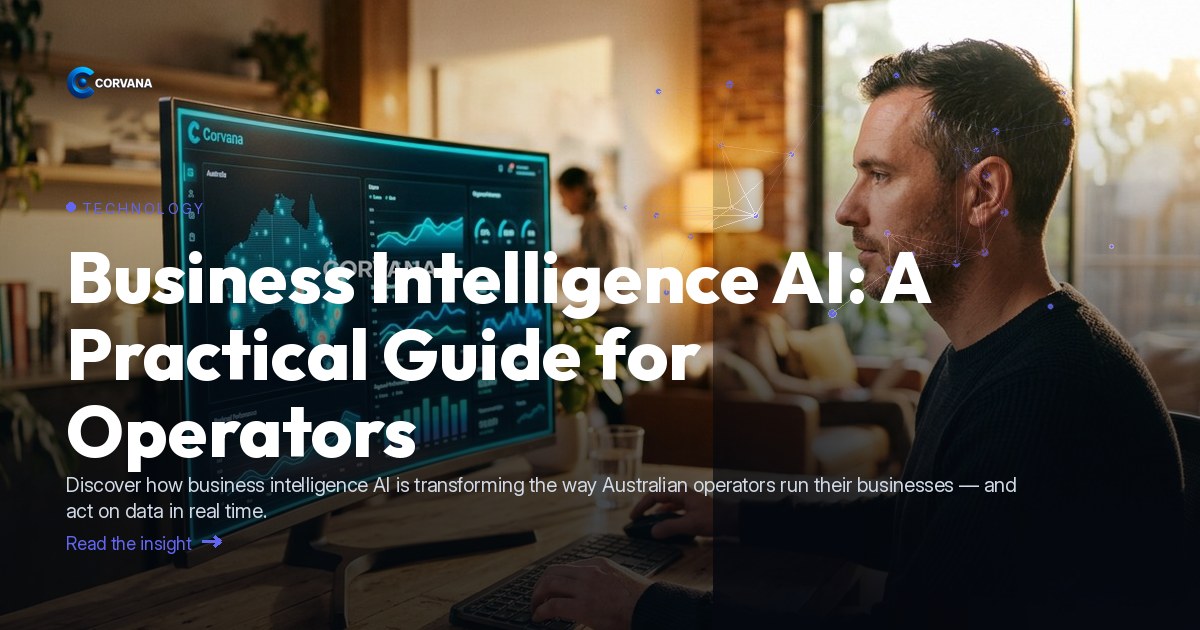
Business Intelligence AI: A Practical Guide for Australian Operators
Business intelligence AI is reshaping the way Australian businesses collect, interpret and act on their data — and for operators in the technology space, this shift is accelerating faster than almost any other sector. Where reporting once meant a spreadsheet someone updated on Friday afternoon, AI-driven platforms now surface the right insight at the right moment, automatically, so operators can make faster decisions with greater confidence.
What Is Business Intelligence AI?
Business intelligence AI refers to the use of artificial intelligence — including machine learning, natural language processing and predictive analytics — to automate the collection, analysis and presentation of business data. Instead of manually pulling reports from disconnected systems, operators receive real-time dashboards, automated alerts and forward-looking forecasts that highlight what matters most. For Australian SMEs, this means less time buried in spreadsheets and more time focused on growth.
This is not a future concept. According to [Gartner](https://www.gartner.com), AI-augmented analytics is now a mainstream expectation in business intelligence platforms, with organisations increasingly prioritising tools that combine automation with human-readable insights. The [CSIRO](https://www.csiro.au) has also highlighted AI adoption as a critical driver of productivity improvement for Australian businesses across sectors, including professional and technology services.
Why Business Intelligence AI Matters Right Now
For technology operators — whether you run a SaaS business, a managed services firm, a digital agency or an IT consultancy — the volume and velocity of operational data has outpaced what any team can manage manually. You are generating data from your billing platform, your CRM, your payroll system, your project tools and your customer communications, often all at once.
The real problem is not a lack of data. It is the inability to connect it, interpret it quickly and act before small issues become expensive ones.
That is precisely where business intelligence AI earns its keep.
Outcome 1: Freeing Up Staff Time
Manual reporting is one of the most consistent drains on skilled staff time in technology businesses. Account managers, operations leads and finance staff routinely spend hours each week compiling data that should be automatic.
AI-powered business intelligence platforms automate this entirely. Weekly performance reports are generated without anyone touching a spreadsheet. Dashboards update in real time as transactions, invoices and timesheets flow in. Staff are freed to interpret and act, rather than gather and format.
This is especially valuable in technology firms where talent is expensive and in short supply. Every hour saved on internal reporting is an hour redirected to client delivery, product development or sales.
Outcome 2: Reducing Weaknesses — Catching Problems Early
The most powerful capability of business intelligence AI for technology operators is early warning. AI models trained on your historical data can identify patterns that precede a problem — before it appears on a traditional report.
Common early warnings relevant to technology businesses include:
- Margin compression on recurring contracts as costs creep up while pricing stays flat
- Client churn signals — declining engagement, reduced usage, slower invoice payment
- Cash flow risk — gaps between revenue recognition and actual receipts, particularly in project-based models
- Staffing imbalances — billable utilisation dropping or rising to unsustainable levels
- Compliance gaps — missed renewal dates, lapsing certifications or payroll obligations
According to [IDC](https://www.idc.com), organisations that deploy AI-driven analytics report meaningfully faster identification of operational risks compared to those relying on traditional reporting cycles. For a technology operator running on tight margins and long sales cycles, catching a problem a month earlier can be the difference between a manageable adjustment and a material loss.
Outcome 3: Capitalising on Strengths
Business intelligence AI does not just surface problems — it reveals what is already working, so you can do more of it deliberately.
For technology operators, this might mean identifying:
- Which service lines carry the healthiest margins
- Which client segments renew most reliably and at the highest lifetime value
- Which team members or delivery squads are most consistently profitable
- Which acquisition channels produce clients with the lowest churn rates
These insights allow you to make intentional decisions about where to invest — rather than spreading resources evenly across everything and hoping for the best.
How Corvana Applies AI to This
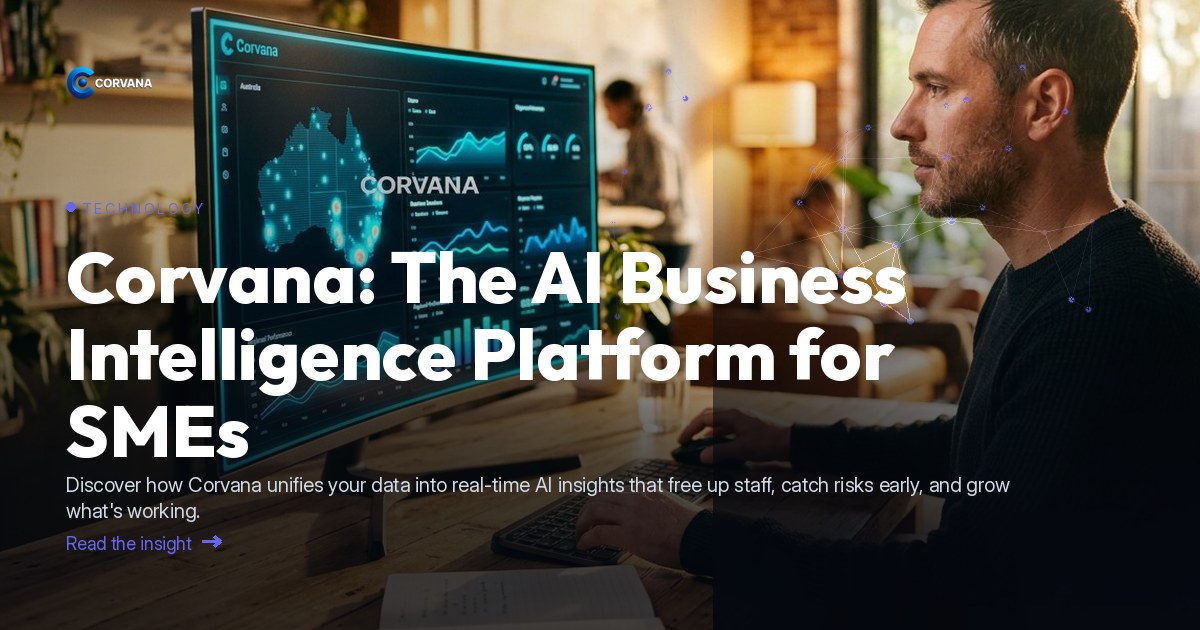
Corvana is an Australian AI business intelligence platform built specifically to unify the data that technology businesses already generate across their key systems — and turn it into a single, real-time operational picture.
Corvana connects directly with the tools technology operators typically use:
- Accounting: Xero, MYOB, QuickBooks — for live revenue, margin and cash flow visibility
- CRM & marketing: HubSpot, Salesforce, ActiveCampaign — for pipeline, client lifetime value and churn early-warning
- Rostering & payroll: Deputy, Tanda, Employment Hero — for billable utilisation and labour cost tracking
- Other platforms: Stripe for subscription and payment data, Google Analytics for traffic and conversion, Airtable and Notion for project and operational data
Once connected, Corvana's AI engine runs forecasting models across cash flow, demand and staffing — and surfaces the results in live dashboards designed for non-technical operators. Automated weekly reports go out without anyone building them. Industry benchmarking draws on ATO and ANZSIC data to show how your numbers compare to similar technology businesses across Australia. Staff roles and permissions mean the right people see the right data, nothing more.
For technology operators who have outgrown disconnected tools but are not ready for an enterprise data team, Corvana occupies exactly the right position: powerful AI analytics, delivered in a format that an operator — not a data scientist — can actually use.
The [Productivity Commission](https://www.pc.gov.au) has consistently noted that productivity gains from digital technology adoption are most significant when businesses move from data collection to genuine data utilisation. Corvana is built to close that gap.
Frequently Asked Questions
What does business intelligence AI actually do for a small technology business?
Business intelligence AI connects your existing systems — accounting, CRM, payroll, billing — and automatically analyses the combined data to surface insights, forecasts and alerts. Rather than manually compiling reports, operators receive real-time dashboards and early warnings about margin compression, cash flow gaps or client churn. The practical effect is faster decisions with less internal effort.
How is AI business intelligence different from a standard dashboard or reporting tool?
A standard dashboard displays historical data in a visual format — it tells you what happened. AI business intelligence goes further by identifying patterns, predicting what is likely to happen next and alerting you to risks or opportunities before they become obvious on a conventional report. The AI layer is what makes the difference between reactive reporting and proactive management.
Is business intelligence AI suitable for a technology SME, or is it only for large enterprises?
AI business intelligence is increasingly accessible to SMEs, particularly through cloud-based platforms that integrate with the tools small and mid-sized businesses already use. Australian technology operators — agencies, consultancies, SaaS businesses, managed service providers — can benefit from the same forecasting, benchmarking and early-warning capabilities that were previously available only to organisations with dedicated data teams.
---
If you would like to see how Corvana brings all of this together for your technology business, it is worth taking a look at what a unified, AI-powered view of your operations actually looks like in practice.