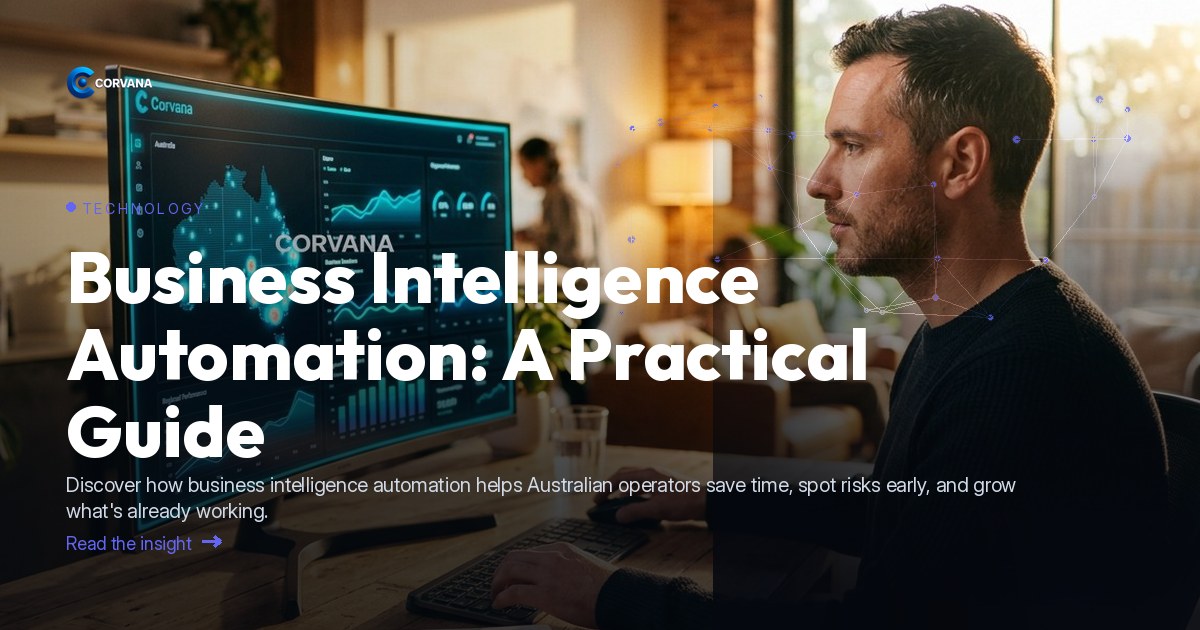
What Is Business Intelligence Automation — and Why It Matters Right Now
Business intelligence automation is reshaping how Australian technology-sector operators run their businesses. Where teams once spent hours pulling reports from disconnected systems, AI now does that work continuously — surfacing the insights that actually matter, in real time, without anyone having to ask. For operators managing fast-moving product lines, subscription revenue, recurring service contracts and distributed teams, that shift is not incremental. It is fundamental.
[Gartner](https://www.gartner.com) notes that organisations embedding automation into their analytics workflows are moving decisively toward augmented decision-making — where AI handles the data aggregation and pattern recognition, and humans focus on strategy and action. For Australian technology businesses, where margins can compress quickly and customer churn can accelerate without warning, that speed-to-insight is a genuine competitive advantage.
What Is Business Intelligence Automation?
Business intelligence automation is the use of AI and machine learning to continuously collect, integrate, analyse and present business data — replacing manual report-building with live dashboards, automated alerts and AI-generated forecasts. Instead of a staff member compiling last week's revenue figures on a Monday morning, an automated BI platform unifies your accounting, CRM, payroll and sales data the moment it changes, flags anomalies proactively, and delivers a clear picture of what is happening and why. For technology operators, this means less time in spreadsheets and more time making decisions that move the business forward.
Why Technology Operators Need This Now
The technology sector in Australia operates at a pace that manual reporting simply cannot keep up with. Subscription churn, project margin erosion, staff utilisation rates and pipeline velocity all move week to week. [IDC](https://www.idc.com) research consistently highlights that data-driven technology firms outperform peers on revenue growth and operational efficiency — but only when that data is integrated and acted on quickly. Most SME operators in tech are sitting on rich data across their platforms; the problem is that it lives in silos.
---
Three Operator Outcomes That Business Intelligence Automation Delivers
1. Freeing Up Staff Time
Manual reporting is one of the most significant hidden costs in a technology business. When your operations manager, account manager or finance lead is building weekly reports by hand, they are not doing the work that actually grows the business.
Business intelligence automation eliminates that overhead. Automated weekly reports are generated and distributed without anyone touching a spreadsheet. Live dashboards give team leads visibility into the numbers they care about — project margins, recurring revenue, support ticket volumes, campaign performance — without waiting on a colleague to pull the data.
The practical result: your people spend their time on analysis and action, not on data collection.
2. Reducing Weaknesses — Catching Problems Early
The most costly business problems are the ones nobody saw coming. In technology businesses, these often show up as:
- A customer segment quietly churning before renewal conversations begin
- Project costs creeping above budget before the project manager notices
- Cash flow tightening because invoicing is running behind delivery
- A service line underperforming against industry benchmarks without anyone realising
Automated BI platforms monitor these signals continuously and surface early warnings before they become expensive. Benchmarking against industry data — such as ANZSIC classifications tracked by the [Australian Bureau of Statistics](https://www.abs.gov.au) — gives operators an external reference point: is this a business-specific problem or a sector-wide trend?
3. Capitalising on Strengths
Every technology business has pockets of genuine outperformance: a service line with strong margins, a customer segment with high lifetime value, a team that consistently delivers on time and within budget. Manual reporting rarely makes these visible at the right moment.
Automated BI surfaces them clearly and consistently — so operators can double down on what is working. Which customers have the highest retention rates? Which projects generate the best margin per hour? Which channel is driving the most qualified pipeline? Knowing the answers in real time means you can allocate resources, marketing spend and sales effort toward the opportunities most likely to compound.
---
How Corvana Applies AI to Technology Businesses
Corvana is built for exactly this — an Australian AI business intelligence platform that unifies the data sources technology operators already use, and turns them into a single, real-time picture.
Integration with your existing stack: Corvana connects directly to the tools technology businesses rely on. Accounting data flows in from Xero, MYOB or QuickBooks. CRM and pipeline data connects from HubSpot, Salesforce or ActiveCampaign. Payroll and staff utilisation comes from Deputy, Tanda or Employment Hero. Marketing performance pulls from Mailchimp, Meta Business Suite or Google Analytics. Stripe handles subscription and payment data. The result is a unified view — not a fragmented collection of dashboards.
What Corvana's AI does with that data:
- AI-driven cash flow forecasting flags when receivables are running behind and when cash positions are likely to tighten, giving operators time to act before a shortfall arrives
- Customer lifetime value and churn early-warning identifies which accounts are showing disengagement signals — before they cancel or let a contract lapse
- Automated weekly reporting is generated and distributed without manual effort, covering revenue, margin, staff costs and pipeline in one consistent format
- Benchmarking against ATO/ANZSIC industry data shows how your business compares to sector peers, so you can distinguish internal performance issues from broader market conditions
- Industry-specific staff roles and permissions mean each team member sees only the data relevant to their function — account managers see customer metrics, finance leads see margin and cash flow, executives see the full picture
For technology operators managing [Forrester](https://www.forrester.com)-documented trends like subscription economy pressures and the growing complexity of customer data, Corvana provides the layer of intelligence that turns raw data into decisions.
---
Frequently Asked Questions
What does business intelligence automation actually replace?
Business intelligence automation replaces the manual process of pulling data from multiple platforms, combining it in spreadsheets and building reports by hand. Instead of a staff member spending hours each week on data collection, an automated BI platform does this continuously in the background — delivering live dashboards, scheduled reports and proactive alerts without any manual effort. For most technology SMEs, this frees up several hours of skilled staff time every week.
How quickly can a technology business start seeing value from BI automation?
Most technology businesses begin seeing value within the first few weeks of connecting their core platforms — typically accounting, CRM and payroll. Once those integrations are live, automated reports and dashboards are available immediately, and the AI begins establishing baselines for forecasting and anomaly detection. The deeper forecasting and benchmarking insights typically sharpen over the following one to two months as the platform builds a richer data history.
Is automated business intelligence suitable for smaller technology businesses, or just enterprise?
Automated BI is particularly well-suited to SME technology operators, who often lack a dedicated data or analytics team but are managing complex, fast-moving data across multiple systems. Platforms like Corvana are designed to work with the tools smaller technology businesses already use — like Xero, HubSpot and Deputy — and provide the kind of real-time visibility that was previously only accessible to organisations with large analytics departments.
---
See how Corvana brings all of this together for technology businesses — in one connected, always-on intelligence platform.