BI Software: A Practical Guide for Australian Operators
BI software is no longer a tool reserved for enterprise teams with dedicated data analysts — AI is rapidly reshaping what business intelligence means for everyday operators, and the shift is happening faster than most realise. Where traditional reporting once demanded hours of manual spreadsheet work, today's AI-powered platforms surface the insights that matter automatically, in real time. For Australian businesses navigating tighter margins, complex compliance obligations and growing competition, that change is genuinely significant.
What Is BI Software?
BI software — short for business intelligence software — is a category of technology that connects your business data sources, processes that data, and presents it as actionable insights through dashboards, reports and forecasts. Modern AI-driven BI software goes further: it learns from your data patterns, flags anomalies before they become problems, and recommends where to focus your attention. In short, it replaces the guesswork of gut-feel decisions with a clear, evidence-based picture of your business.
How AI Is Changing BI Software for Operators
For most of its history, business intelligence was a backward-looking exercise — you'd run a report at the end of the week and find out what had already gone wrong. AI changes that fundamentally.
Today's BI platforms can:
- Forecast forward, not just report backward — predicting cash flow gaps, demand surges or staffing shortfalls before they arrive
- Automate routine reporting so your team gets a clean weekly summary without anyone manually pulling numbers
- Benchmark your performance against industry peers, giving context to your results rather than just raw figures
- Detect early warning signals — a margin that's quietly eroding, a customer segment drifting away, a compliance gap opening up
According to [Gartner](https://www.gartner.com), augmented analytics — AI that automates data preparation and insight generation — is one of the most significant shifts in the BI and analytics market. For operators who aren't data scientists, this matters enormously: the platform does the heavy lifting so you don't have to.
Three Outcomes Every Operator Should Expect from BI Software
1. Freeing Up Staff Time
Manual reporting is one of the most persistent time drains in any business. When your operations manager spends Friday afternoon reconciling numbers across your POS, your accounting software and a roster spreadsheet, that's time not spent on customers, staff development or growth.
Good BI software connects those systems automatically — pulling live data from your POS, payroll and accounting tools into a single view — and delivers automated weekly reports that your team can actually read and act on. The result is less time chasing numbers and more time running the business.
2. Reducing Business Weaknesses Through Early Warnings
Every business has weak spots: a product line quietly losing margin, a high-value customer segment showing signs of churn, a payroll cost creeping above benchmark. The problem is that without the right tools, these issues are often invisible until they've already done real damage.
BI software with AI-driven alerting changes that equation. Rather than discovering a cash flow problem when your bank account tells you, you see the forecast weeks in advance. Rather than losing a loyal customer quietly, you get a churn early-warning while there's still time to act. The [Reserve Bank of Australia](https://www.rba.gov.au) consistently highlights cash flow management as a critical vulnerability for Australian SMEs — BI software that monitors this in real time addresses that risk directly.
3. Capitalising on Your Strengths
The flip side of catching problems is recognising what's working and doing more of it. Which product lines carry your strongest margins? Which customer segments have the highest lifetime value? Which locations or team members are consistently outperforming?
AI-powered BI software surfaces these patterns clearly, so you can double down on your best performers rather than spreading attention evenly across everything. This is where data moves from being a compliance or reporting obligation to being a genuine competitive advantage.
How Corvana Applies AI to BI Software
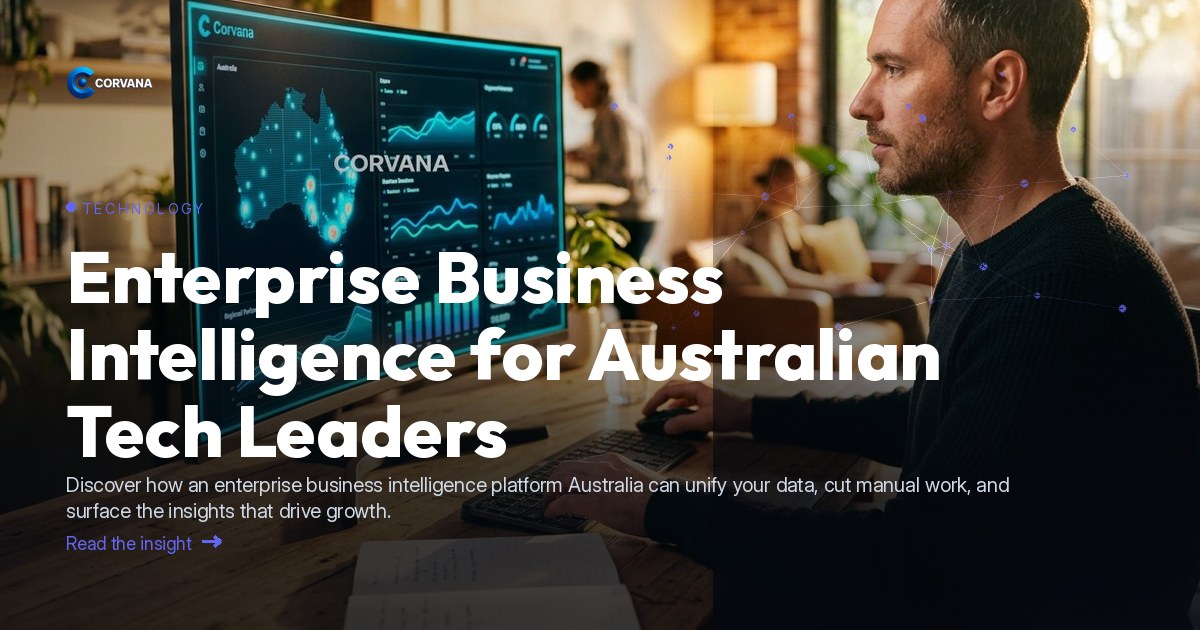
Corvana is an Australian AI business intelligence platform built specifically for operators who want enterprise-grade insight without enterprise-grade complexity. It unifies your POS, accounting, rostering, payroll and CRM data into one real-time picture — and then applies AI to surface only what matters.
Here's how that works in practice for technology-sector operators:
- Accounting integrations with Xero, MYOB and QuickBooks mean your financial data flows into Corvana automatically — no manual exports, no reconciliation headaches
- CRM integrations with HubSpot, Salesforce, ActiveCampaign and Mailchimp feed customer behaviour data directly into Corvana's lifetime value and churn early-warning models
- Rostering and payroll integrations with Deputy, Tanda and Employment Hero connect labour costs to revenue in real time, so you can see margin impact at a glance
- Google Analytics and Stripe integrations give digital-first businesses a complete picture connecting web behaviour, transactions and financials
- Automated weekly reporting lands in your inbox without anyone pulling a single spreadsheet — with AI commentary that explains what changed and why
Corvana also benchmarks your performance against [ABS](https://www.abs.gov.au) and ANZSIC industry data, so you're not just looking at your own numbers in isolation — you're seeing how they compare to the broader market.
Industry-specific staff roles and permissions mean your team sees exactly what they need to do their job, without being overwhelmed by data that isn't relevant to them.
Frequently Asked Questions
What's the difference between BI software and a standard reporting tool?
A standard reporting tool shows you what happened in the past, usually by pulling data you've manually entered or exported. BI software connects your live data sources automatically, surfaces patterns and anomalies in real time, and — in AI-powered platforms — forecasts what's likely to happen next. The practical difference is that BI software is proactive, not just descriptive.
Do I need a data analyst to use BI software?
No — and that's precisely the point of modern AI-driven BI software. Platforms like Corvana are designed for operators, not data scientists. The AI handles the complexity: connecting data sources, identifying patterns and delivering plain-language insights so you can make decisions without needing to interpret raw data yourself.
How long does it take to get value from BI software?
Most cloud-based BI platforms, including Corvana, are designed for fast onboarding. Once your integrations are connected — typically your accounting, POS and payroll tools — you can be viewing live dashboards and automated reports within days, not months. The AI models improve as they learn your business patterns over time, so value tends to compound the longer you use the platform.
---
If you'd like to see how Corvana brings all of this together for your business, we'd love to show you.